

Tax fraud allegations can expose individuals, businesses, directors, and professionals to serious financial and criminal consequences. Therefore, early legal advice becomes important when tax authorities begin enforcement proceedings. Tax disputes may involve income concealment, false invoices, bogus expenses, undisclosed assets, fraudulent refunds, or incorrect declarations. Furthermore, tax investigations can involve multiple authorities and overlapping proceedings. The Income-tax Act, 2025 now governs tax years beginning from April 2026. However, earlier tax years continue under the Income-tax Act, 1961. GST allegations may proceed separately under the CGST Act and corresponding State laws. Meanwhile, BNS, BNSS, and BSA provisions can become relevant where general criminal offences arise. A focused tax fraud defense strategy should therefore address evidence, procedure, liability, jurisdiction, and available remedies. Rajendra CriminalLaw Firm provides criminal-law advocacy for tax fraud investigations, prosecution, bail, trial, and related proceedings.
Understanding Tax Fraud Allegations
What Constitutes Tax Fraud
Wilful Tax Evasion and Under-Reporting
Intent Matters in Tax Fraud Prosecution
Tax fraud generally involves deliberate conduct intended to defeat a lawful tax obligation. However, every tax discrepancy does not automatically establish criminal fraud. Authorities may examine whether the taxpayer knowingly concealed income, falsified records, or supplied misleading information. Under the Income-tax Act, 2025, Section 478 addresses wilful attempts to evade tax, penalty, or interest. It also addresses under-reporting of income within specified circumstances. Earlier tax years may attract corresponding provisions under the Income-tax Act, 1961. Therefore, lawyers first identify the relevant tax year before assessing criminal exposure. The defense may examine accounting records, correspondence, returns, audit reports, bank statements, and explanations. Furthermore, professional advice can help distinguish an accounting error from intentional conduct. Relevant issues may include omitted income, inflated deductions, unexplained credits, false entries, or manipulated books. Consequently, tax fraud advocacy requires both tax-law analysis and criminal-law scrutiny before responding to allegations.
False Returns, Statements, and Verification
False statements can create separate prosecution risks under applicable income-tax provisions. Section 482 of the Income-tax Act, 2025 addresses false statements and false accounts in specified circumstances. Earlier proceedings may involve Section 277 of the Income-tax Act, 1961. Therefore, the defense must examine exactly what statement allegedly became false. A material distinction exists between deliberate falsification and an inadvertent reporting mistake. Additionally, the surrounding documents can clarify whether the taxpayer relied upon professional or third-party information. Lawyers may compare the disputed statement against books, invoices, bank records, contracts, and supporting correspondence. They may also examine whether the authority correctly understood the transaction. Importantly, a tax prosecution requires proof under the applicable statutory framework. Thus, defense preparation should not depend solely upon the disputed tax demand. Instead, counsel should develop a complete evidentiary narrative addressing knowledge, intention, documentation, causation, and statutory requirements. This approach can support appropriate responses during investigation, prosecution, appeal, or trial.
Falsification of Books and Documents
Falsified accounts can significantly increase criminal exposure when authorities allege intentional tax evasion. Such allegations may involve fabricated invoices, altered ledgers, duplicate entries, concealed transactions, or manipulated financial statements. Furthermore, several people may become implicated in a disputed accounting arrangement. Directors, employees, accountants, consultants, and business associates may therefore require separate legal analysis. The defense should identify who created each document and who possessed decision-making authority. It should also establish whether disputed records originated from genuine commercial transactions. Digital accounting systems create additional evidence trails through audit logs, emails, cloud records, and access histories. Consequently, electronic evidence preservation becomes increasingly important. Under the Bharatiya Sakshya Adhiniyam, electronic records receive statutory recognition subject to applicable admissibility requirements. Lawyers should therefore preserve original data and relevant metadata wherever possible. A structured forensic review can help distinguish genuine business records from allegations of intentional falsification.
Tax Fraud and Professional Intermediaries
Tax fraud investigations can extend beyond the taxpayer when professionals allegedly facilitate improper transactions. Accountants, tax consultants, company officers, brokers, and authorised representatives may become relevant witnesses or accused persons. However, professional association alone does not establish criminal liability. Investigators generally need evidence connecting an individual with the alleged unlawful conduct. Therefore, defense counsel should examine engagement letters, instructions, emails, working papers, approvals, and payment records. A professional may have prepared a return using information supplied by a client. Conversely, evidence may show deliberate participation in false reporting. Each situation requires separate factual analysis. Furthermore, corporate cases require examination of statutory responsibility and actual involvement. Lawyers should avoid assuming that every director carries identical criminal exposure. Instead, counsel should identify specific acts, knowledge, authority, and documentary connections. This evidence-led method can prevent broad allegations from obscuring individual legal positions during tax fraud investigations and prosecution.
GST Tax Fraud and Related Offences
Fake Invoices and Wrongful Input Tax Credit
GST fraud allegations frequently involve invoices that allegedly lack genuine underlying supplies. Section 132 of the CGST Act addresses several serious offences involving invoices, input tax credit, refunds, records, and tax evasion. Therefore, investigators may examine purchase orders, e-way bills, delivery records, payment trails, stock registers, and supplier relationships. A defense should reconstruct the complete commercial transaction rather than relying upon invoices alone. Bank payments may support genuine supply, while logistics records can establish movement of goods. However, missing transport evidence may create additional questions during investigation. Lawyers should also examine whether the alleged recipient actually knew about irregular conduct by another party. Furthermore, electronic GST records can provide important chronological evidence. A careful reconciliation between GST returns, accounting ledgers, invoices, and bank transactions can identify inconsistencies. Consequently, GST criminal defense requires coordinated tax, accounting, documentary, and criminal-law analysis from the beginning.
Fraudulent Refunds and Suppressed Turnover
Fraudulent refund allegations can arise when authorities identify allegedly incorrect claims, manipulated exports, false transactions, or unsupported documentation. Suppressed turnover allegations may similarly involve differences between books, GST returns, banking records, and third-party information. Therefore, defense lawyers should obtain the underlying data supporting the department’s allegation. A taxpayer should also identify legitimate explanations for apparent mismatches. For example, timing differences can arise between invoicing, accounting, payment, and tax reporting. Similarly, credit notes and amendments can change reported figures across different periods. The defense should document such explanations before the matter reaches prosecution. Section 132 of the CGST Act provides criminal consequences for specified serious GST offences. Meanwhile, adjudication and penalty proceedings may proceed separately. Therefore, a tax fraud defense should coordinate responses across administrative and criminal proceedings. This strategy reduces the risk of contradictory statements and preserves consistent factual positions.
Tax Investigation and Enforcement
Search, Seizure, Summons, and Statements
Responding to Departmental Summons
A tax summons can require production of documents or attendance for examination. Consequently, ignoring a lawful summons may create additional procedural complications. The recipient should first identify the issuing authority, statutory provision, subject matter, date, and requested documents. Lawyers can then assess whether the request falls within lawful investigative powers. A representative may also assist where the governing procedure permits representation. However, witnesses should answer truthfully and avoid speculative explanations. They should also avoid destroying, altering, concealing, or transferring relevant records. Such conduct can create additional allegations and evidence concerns. Digital documents require particular care because deletion may leave recoverable traces. Therefore, counsel should establish a document-preservation protocol immediately. The defense should maintain copies of all communications, submissions, acknowledgements, and produced records. Furthermore, counsel should prepare a factual chronology before significant questioning. This approach can reduce inconsistent answers and improve coordination between tax specialists and criminal defense lawyers.
Search and Seizure Defense
Search and seizure proceedings require careful attention because investigators may obtain extensive financial and digital material. The defense should document the date, authority, premises, persons present, materials taken, and procedural events. Lawyers should review the applicable statutory provisions governing the search. They should also verify whether seized materials correspond with the authority’s stated reasons and investigation scope. However, resistance to lawful search procedures can create unnecessary complications. Therefore, legal objections should ordinarily proceed through appropriate statutory or judicial channels. Digital devices require additional safeguards because business and personal information may coexist on the same equipment. Counsel should preserve seizure inventories, panchnamas, acknowledgements, and copies of available documents. Furthermore, the defense can evaluate whether procedural irregularities affect admissibility or evidentiary weight. The Bharatiya Sakshya Adhiniyam provides specific treatment for electronic records. Consequently, digital evidence should receive forensic attention rather than casual review. A timely response can protect important evidentiary and procedural rights.
Protecting Electronic and Financial Evidence
Modern tax investigations often depend upon electronic accounting and financial information. Emails, spreadsheets, enterprise software, GST records, banking data, mobile communications, and cloud documents may all become relevant. Under the Bharatiya Sakshya Adhiniyam, electronic or digital records can carry evidentiary value when statutory requirements are satisfied. Therefore, businesses should preserve original records rather than relying solely upon screenshots or printed summaries. Lawyers may coordinate with forensic professionals when authenticity, metadata, or access history becomes disputed. A proper evidence map should connect each transaction with its source documents. It should also identify who created, approved, modified, or transmitted each record. Furthermore, financial evidence should be reconciled across independent sources. Bank statements can be compared with invoices, ledger entries, GST returns, and income-tax filings. Such reconciliation may reveal either supporting evidence or material inconsistencies. Consequently, early evidence management can substantially improve defense preparation. It also helps counsel respond accurately to investigative questions and challenge unsupported conclusions.
Criminal Law Overlay
BNS, BNSS, and BSA Considerations
BNS Offences Connected With Tax Allegations
Tax investigations can sometimes reveal conduct falling beyond tax statutes. Allegations may involve cheating, forgery, criminal conspiracy, falsification, or use of allegedly forged documents. The Bharatiya Nyaya Sanhita, 2023 contains general criminal provisions that may become relevant depending upon the facts. For example, Section 61 addresses criminal conspiracy. However, the applicability of any BNS provision depends upon the specific conduct and statutory ingredients. Therefore, defense lawyers should identify each alleged offence separately. They should avoid treating a tax dispute as automatically establishing a general criminal offence. Evidence must connect the accused with the required elements of the alleged offence. Consequently, documentary evidence becomes central to the defense. Contracts, invoices, communications, accounting records, and approvals may establish legitimate commercial purposes. Alternatively, investigators may rely upon the same documents to support criminal allegations. A careful legal analysis should therefore examine both interpretations. This process allows counsel to address tax offences and general criminal allegations within a unified defense strategy.
BNSS Bail and Arrest Protection
Criminal tax allegations can create concerns about arrest, custody, interrogation, and bail. The Bharatiya Nagarik Suraksha Sanhita, 2023 provides the current procedural framework for criminal investigations and bail. Therefore, counsel should examine the classification and statutory punishment of every alleged offence. The defense may consider appropriate bail remedies based upon the facts and applicable provisions. Where arrest is apprehended, lawyers should assess available anticipatory bail mechanisms. Where arrest has occurred, regular bail strategy may become necessary. Additionally, the court may consider factors such as cooperation, evidence status, custodial necessity, and flight concerns. Each application requires fact-specific drafting rather than generic allegations. Counsel should also preserve relevant documents supporting stable residence, business operations, and cooperation. Furthermore, simultaneous tax proceedings should remain consistent with criminal pleadings. A coordinated strategy can prevent accidental admissions or contradictory explanations. Consequently, prompt criminal-law advice becomes particularly important when tax authorities indicate possible prosecution or investigative escalation.
BSA and Electronic Evidence
Electronic evidence now plays a major role in complex financial investigations. The Bharatiya Sakshya Adhiniyam recognises electronic or digital records, subject to statutory conditions governing admissibility. Therefore, tax fraud defense may require detailed analysis of data sources and collection methods. Relevant materials can include emails, accounting software logs, payment records, mobile messages, cloud files, and electronic invoices. Lawyers should determine whether records remain complete and reliable. They should also examine whether metadata supports or contradicts the prosecution narrative. Furthermore, multiple copies should not automatically be treated as independent evidence. Their source, integrity, and chain of custody may require scrutiny. Digital forensic specialists can assist when allegations involve deletion, alteration, or unauthorized access. Consequently, BSA-based evidence analysis should begin before trial rather than during final arguments. Proper preservation can also help demonstrate that a disputed document arose from routine business activity. This evidence-focused approach strengthens both tax proceedings and connected criminal defense litigation.
Forums, Remedies, and Defense Strategy
Tax Authorities and Appellate Forums
Income-Tax Proceedings and Appeals
Assessing Officer and First Appeal
Income-tax disputes commonly begin before the Assessing Officer or another competent tax authority. A taxpayer may receive notices, assessment orders, penalty proceedings, or prosecution-related communications. The defense should first determine the nature and statutory stage of the proceeding. The Income Tax Department provides electronic mechanisms for responding to many notices and proceedings. Appeals against specified assessment and penalty orders can proceed before the appropriate appellate authority. Current online procedures require careful preparation of grounds, facts, supporting documents, and prescribed forms. The department’s Form 35 guidance states that specified appeals generally carry a thirty-day filing period. Delay may sometimes be condoned when statutory conditions support such relief. Therefore, limitation should receive immediate attention after receiving an adverse order. Counsel should also consider whether parallel prosecution creates additional risks. Administrative appeal strategy and criminal defense strategy should remain coordinated. Consequently, early review of the assessment record can identify both tax-law and criminal-law defenses.
Income Tax Appellate Tribunal and High Court
The Income Tax Appellate Tribunal handles appeals under direct-tax legislation. The ITAT Chennai Benches exercise jurisdiction over Chennai and numerous Tamil Nadu districts. Therefore, eligible taxpayers may pursue appellate remedies before the competent Chennai Bench. ITAT proceedings commonly require detailed examination of facts, accounting evidence, statutory interpretation, and departmental findings. Counsel should identify which findings concern facts and which raise legal questions. Further appellate proceedings before the High Court depend upon statutory requirements. The ITAT states that an appeal to the High Court lies where a substantial question of law arises. Consequently, dissatisfaction with factual findings alone may not satisfy that requirement. A tax lawyer and criminal advocate should coordinate when prosecution remains pending. Moreover, appellate findings may affect the factual background of connected proceedings. However, each proceeding retains its own statutory framework and evidentiary requirements. Therefore, lawyers should avoid assuming that success in one forum automatically determines another proceeding.
GST Authorities and Appellate Remedies
GST disputes can involve adjudication, penalties, recovery, appeals, and prosecution. The appropriate remedy depends upon the notice, order, alleged offence, tax period, and procedural stage. Section 132 of the CGST Act separately addresses specified criminal offences. Therefore, payment or settlement of a tax demand does not automatically answer every criminal issue. Counsel should assess whether adjudication remains pending and whether statutory appeal rights exist. They should also examine limitation, jurisdiction, natural justice, evidence, and procedural compliance. Furthermore, records should remain consistent across GST and income-tax proceedings. A business may face related allegations under both systems when transactions overlap. Consequently, counsel should prepare a unified transaction chronology. This chronology can identify duplicated allegations and distinguish independent legal issues. Proper coordination may also reduce contradictory factual positions. Where prosecution is initiated, criminal defense counsel should separately analyze ingredients, sanction requirements, evidence, and available bail remedies. Thus, GST defense requires both tax litigation knowledge and criminal procedure experience.
Civil and Criminal Court Jurisdiction
Role of CPC in Tax-Related Disputes
The Code of Civil Procedure, 1908 does not ordinarily govern criminal prosecution under tax statutes. However, CPC concepts can arise in connected civil proceedings involving contracts, accounts, recovery, property, or commercial disputes. Therefore, lawyers should identify the exact nature of the proceeding before selecting a procedural remedy. Tax authorities generally exercise powers under special fiscal legislation rather than ordinary civil procedure. Consequently, a taxpayer cannot assume that every tax dispute belongs before a civil court. Specialized appellate mechanisms often govern assessment and penalty challenges. Meanwhile, criminal prosecution proceeds before competent criminal courts under the applicable statutory framework. The CPC may become relevant when a separate civil dispute arises from the same commercial transaction. For example, a contractual dispute may concern invoices later examined during tax proceedings. Counsel should therefore maintain separate procedural tracks while coordinating factual evidence. This distinction helps prevent forum mistakes and unnecessary litigation. Ultimately, the correct forum depends upon the legal source of the disputed right.
High Court Writ and Supervisory Remedies
High Courts may exercise constitutional jurisdiction in appropriate tax and criminal matters. However, writ jurisdiction does not replace every statutory appeal or ordinary criminal remedy. Therefore, counsel should first identify whether an effective alternative remedy exists. Exceptional circumstances may justify constitutional intervention despite an available statutory mechanism. Such circumstances depend upon the facts and legal grounds presented. Possible issues can include jurisdictional error, procedural illegality, breach of natural justice, or fundamental legal defects. Furthermore, criminal investigations may raise separate questions requiring careful judicial review. Lawyers should therefore formulate precise grounds rather than seeking broad interference with statutory processes. Documentary evidence remains essential because courts assess the record and legal basis of challenged action. A writ petition should also identify the correct authority and challenged decision. Consequently, premature constitutional litigation can create procedural complications. A measured strategy should compare appeal, revision, bail, quashing, and writ remedies before filing. This approach helps ensure that the chosen forum addresses the actual legal problem.
Defense Strategy and Legal Remedies
Investigation and Prosecution Defense
Building a Transaction-Based Defense
A transaction-based defense reconstructs disputed events from beginning to end. It identifies the contract, invoice, payment, delivery, accounting entry, tax return, and subsequent communication. Therefore, the defense can test whether the alleged tax irregularity reflects genuine commercial activity. Lawyers may create a chronological evidence matrix for every disputed transaction. The matrix can connect each document with its source, date, author, and financial effect. Furthermore, independent evidence can strengthen the explanation of disputed entries. Bank statements, logistics documents, GST data, purchase orders, and correspondence may provide corroboration. If an accounting mistake occurred, counsel can distinguish correction from deliberate concealment. Similarly, third-party misconduct should be separated from the taxpayer’s own knowledge and actions. Consequently, transaction mapping can expose assumptions within an investigation narrative. It can also identify missing evidence that the prosecution would need to establish criminal liability. A disciplined transaction-based approach therefore supports investigation responses, bail applications, trial preparation, and appellate arguments.
Key Defense Documents
A strong tax fraud defense usually depends upon organized documentary preparation. Lawyers should request and preserve records before memories fade or systems overwrite data. Important evidence can include:
- Income-tax returns, notices, orders, and acknowledgements.
- GST returns, invoices, e-way bills, and reconciliation statements.
- Bank statements, contracts, purchase orders, and payment confirmations.
- Ledgers, audit reports, accounting backups, and correspondence.
- Search inventories, summons, statements, and departmental communications.
The defense should also maintain a document index with unique identifiers. Furthermore, original electronic records should remain preserved whenever authenticity may become disputed. Counsel should compare departmental allegations with primary source records. Any mismatch should receive a written factual explanation. Therefore, documentary organization can become as important as legal argument. It allows counsel to identify contradictions before authorities or courts rely upon them. The same evidence may support tax appeals and criminal defense, although legal standards differ. Consequently, a unified evidence repository can improve consistency across multiple proceedings. Rajendra CriminalLaw Firm can coordinate criminal defense strategy with tax counsel when proceedings overlap.
Bail, Quashing, and Trial Remedies
Tax-related criminal proceedings can require several forms of judicial intervention. Depending upon the offence and procedural stage, possible remedies may include anticipatory bail, regular bail, discharge, quashing, revision, or appeal. The appropriate remedy depends upon the statutory ingredients and evidence. Therefore, lawyers should avoid selecting remedies merely because another taxpayer obtained relief elsewhere. Each case requires examination of allegations, documents, procedural history, and jurisdiction. Bail applications should address custodial necessity and the applicant’s cooperation with investigation. Quashing petitions may focus on legal defects or allegations that fail to disclose the required offence. Discharge applications may address insufficient material at the relevant procedural stage. Trial defense then requires systematic testing of prosecution evidence and witness testimony. Furthermore, appellate remedies may become available after adverse orders. Consequently, the defense should maintain a procedural calendar throughout the case. Missing a limitation period can restrict otherwise available remedies. Early legal review therefore remains essential.
Chennai Courts, Forums, and Authorities
Chennai tax fraud matters can involve several forums depending upon the allegations. Income-tax disputes may progress through departmental authorities, appellate authorities, ITAT, and the Madras High Court. GST matters may involve jurisdictional tax officers and statutory appellate forums. Criminal allegations may proceed before competent Magistrate or Sessions Courts. Meanwhile, investigation may involve tax authorities or police agencies where independent criminal offences are alleged. Therefore, forum identification should occur at the beginning of representation. The ITAT Chennai Benches provide an important direct-tax appellate forum for Chennai and Tamil Nadu jurisdictions. Furthermore, electronic filing allows many tax responses and appeals to proceed through departmental portals. Counsel should maintain separate case files for each forum while preserving one master chronology. This prevents conflicting factual positions. It also allows criminal counsel to identify developments in tax litigation that may affect prosecution strategy. Consequently, Chennai tax fraud defense requires coordinated handling of fiscal and criminal proceedings.
Police Stations and Investigation Contacts
Police involvement depends upon the allegations and the authority legally competent to investigate them. A pure tax assessment does not automatically become a police criminal case. However, separate allegations involving cheating, forgery, conspiracy, cybercrime, or other offences may generate police proceedings. Chennai has jurisdictional police stations across different zones and specialized investigative units. For example, relevant facilities can include local stations such as Egmore Police Station or specialized units such as the Central Crime Branch Cyber Crime Police Station. The correct station depends upon territorial and subject-matter jurisdiction. Therefore, taxpayers should not assume that the nearest police station automatically controls every complaint. Lawyers can identify the competent investigating authority from the complaint, FIR, notice, or referral documents. They can then advise on appearance, statement recording, arrest risk, and bail strategy. Furthermore, electronic financial evidence may require specialized handling. Consequently, early criminal-law representation can help prevent avoidable procedural mistakes during police investigation.
Remedies Against Coercive Action
Tax fraud allegations may produce concerns about arrest, attachment, seizure, prosecution, or recovery. Each form of coercive action requires a separate legal analysis. Therefore, lawyers should identify the statutory authority behind the action before selecting a remedy. Bail may address personal liberty concerns when criminal proceedings exist. Statutory appeals may address assessment, penalty, or tax demands. Writ proceedings may address exceptional jurisdictional or procedural defects. Quashing may be considered where applicable criminal allegations fail to disclose statutory ingredients. Revision or appellate remedies may become available after particular judicial orders. Furthermore, appropriate representations can sometimes clarify factual misunderstandings before escalation. Counsel should avoid making unsupported promises about outcomes. Instead, the defense should identify realistic legal options from the available record. A documented response can preserve evidence and demonstrate procedural cooperation. Consequently, early intervention can reduce avoidable escalation and improve strategic decision-making. Every remedy should match the specific statutory stage and factual circumstances.
Corporate Directors and Key Officers
Corporate tax investigations can involve companies alongside directors, managers, accountants, and other officers. However, corporate position alone should not substitute for analysis of individual involvement. Lawyers should identify the person’s role, authority, knowledge, conduct, and documentary connection. Board minutes, delegation records, emails, accounting approvals, and internal policies can become relevant. Furthermore, different officers may have performed different functions within the disputed transaction. A defense should therefore avoid collective assumptions about responsibility. Company records can also clarify whether an employee acted independently or under instructions. Where prosecution provisions create statutory liability for responsible persons, counsel should examine their specific requirements. Additionally, professional advisors may need separate representation where their interests diverge from the company. Consequently, joint defense arrangements should consider possible conflicts of interest. Early legal advice can help preserve independent positions for each accused person. This approach is particularly important when investigators examine alleged false invoices, concealed income, or manipulated accounting records.
Tax Fraud Defense for Individuals
Individuals can face allegations involving undisclosed income, false deductions, unexplained assets, or incorrect declarations. Such cases require careful separation between genuine financial mistakes and alleged intentional evasion. Lawyers should examine employment income, investments, property transactions, loans, gifts, business receipts, and banking activity. Furthermore, information received from third parties may not always reflect the complete transaction. The defense should therefore compare departmental data with primary financial records. If another person controlled the relevant account, that fact may become significant. Similarly, inherited assets or legitimate loans require documentary proof. Counsel should prepare explanations supported by contemporaneous evidence. However, explanations should remain consistent with prior tax filings and communications. Contradictions can create additional evidentiary problems. Consequently, individuals should obtain legal advice before making detailed statements in serious investigations. A criminal defense lawyer can coordinate responses with tax professionals. This combined approach helps protect both tax rights and criminal procedural interests.
Remedies for Businesses and Taxpayers
Tax fraud defense can involve multiple remedies depending upon the case stage. A practical remedy checklist may include:
- Responding to departmental notices with documented evidence.
- Seeking statutory rectification where legally available.
- Filing timely tax appeals against appealable orders.
- Pursuing ITAT remedies in eligible direct-tax disputes.
- Seeking appropriate bail protection in criminal proceedings.
- Challenging legally defective criminal proceedings where applicable.
- Using constitutional remedies in exceptional circumstances.
Each remedy has its own limitation, jurisdiction, and evidentiary requirements. Therefore, taxpayers should not combine remedies without examining procedural consequences. A pending appeal may affect strategy but does not necessarily suspend criminal proceedings automatically. Likewise, payment of disputed tax does not always determine criminal liability. Counsel should therefore prepare a remedy matrix showing every proceeding and deadline. Furthermore, legal submissions should remain consistent across forums. This coordination can prevent accidental admissions and duplicated arguments. Consequently, a structured litigation plan can improve control over complex tax fraud cases. Rajendra CriminalLaw Firm can assist with criminal defense strategy while coordinating with specialist tax counsel where necessary.
Why Early Tax Fraud Counsel Matters
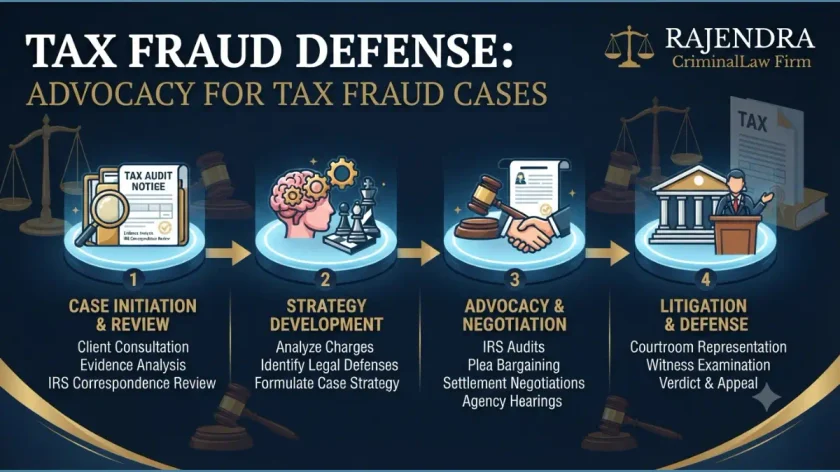
Early representation can materially change how a tax fraud case develops. Counsel can identify the relevant statute, tax period, investigating authority, and procedural stage before substantive responses begin. Therefore, legal advice should ideally start when a serious notice or investigation signal appears. Lawyers can preserve evidence and prevent accidental destruction of records. They can also advise clients about lawful cooperation with investigators. Furthermore, counsel can coordinate tax specialists, forensic accountants, and criminal advocates. This multidisciplinary approach becomes valuable when allegations involve complex transactions. A strong defense should identify weaknesses without creating unnecessary confrontation. It should also distinguish factual mistakes from allegations requiring proof of criminal intent. Consequently, preparation should begin before prosecution reaches the courtroom. The defense can then develop bail applications, statutory appeals, evidence challenges, and trial strategies together. Early action also helps protect limitation periods and procedural rights. Tax fraud defense therefore requires timely, evidence-based, and forum-specific advocacy.
Legal Support Through Rajendra CriminalLaw Firm
Rajendra CriminalLaw Firm can assist clients facing tax fraud allegations requiring criminal-law intervention. The legal support may include investigation advice, summons assistance, search-related guidance, arrest preparation, bail strategy, prosecution defense, trial representation, and appellate coordination. Tax disputes may also require specialist income-tax or GST professionals. Therefore, criminal counsel should coordinate with tax specialists whenever proceedings overlap. The first consultation should identify the tax period, notice, allegation, authority, documents, and procedural stage. Clients should bring copies of returns, assessments, notices, statements, bank records, invoices, and relevant communications. Furthermore, businesses should preserve accounting backups and electronic correspondence. Lawyers can then prepare a factual chronology and identify immediate legal risks. The defense strategy should remain evidence-based and consistent across authorities and courts. Consequently, prompt consultation can help protect procedural rights and prevent avoidable mistakes. Every tax fraud case remains fact-specific, so the appropriate remedy depends upon the governing law and available evidence.
Frequently Asked Questions
Can tax fraud lead to criminal prosecution in India?
Yes. Specified tax offences can attract prosecution and imprisonment. The applicable provisions depend on the tax period, statute, conduct, amount involved, and evidence. Legal advice should follow promptly.
Does every tax mistake amount to tax fraud?
No. A tax error does not automatically establish criminal fraud. Authorities must apply the relevant statutory ingredients. Evidence concerning knowledge, intention, records, and conduct remains important.
Can I get bail in a tax fraud case?
Bail depends upon the alleged offence, statutory classification, evidence, investigation stage, and individual circumstances. BNSS remedies may apply where criminal prosecution exists.
Can GST fake invoice allegations result in imprisonment?
Yes. Section 132 of the CGST Act covers specified serious offences involving invoices, input tax credit, refunds, and tax evasion. Punishment depends upon the applicable statutory category.
Which court handles tax fraud prosecution?
The forum depends upon the statute and alleged offence. Tax appeals may proceed before appellate authorities and ITAT, while criminal prosecution proceeds before competent criminal courts.
When should I contact a tax fraud defense lawyer?
Contact counsel as soon as you receive a serious notice, summons, search communication, prosecution notice, or arrest concern. Early advice helps preserve evidence and identify available remedies.