

Introduction: Strategic Securities Fraud Defense
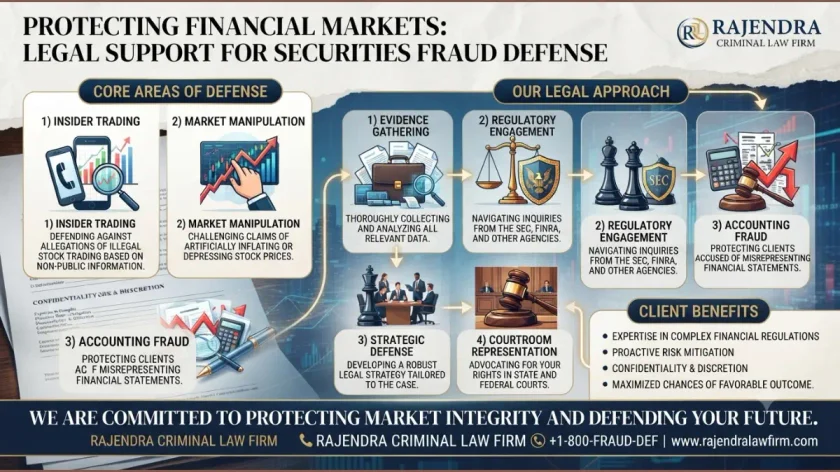
Securities fraud allegations can create simultaneous regulatory, criminal, civil, and commercial consequences. Therefore, early legal assessment becomes essential when trading activity attracts official scrutiny. Securities fraud may involve market manipulation, deceptive transactions, insider trading, false disclosures, or fraudulent investment schemes. In India, SEBI regulates securities markets and investigates suspected violations under securities laws.
Criminal allegations may also trigger police investigation under the Bharatiya Nyaya Sanhita, 2023. Procedural issues can involve the Bharatiya Nagarik Suraksha Sanhita, 2023 and established criminal courts. Electronic records require careful treatment under the Bharatiya Sakshya Adhiniyam, 2023. Meanwhile, civil disputes may involve the Code of Civil Procedure, 1908. A coordinated defense should therefore examine transactions, communications, financial records, intent, authority, and regulatory duties. Rajendra CriminalLaw Firm can assist clients with evidence review, investigation response, bail strategy, court representation, and regulatory coordination. Moreover, a defense strategy should distinguish genuine misconduct from accounting errors, business disputes, unauthorized acts, or misunderstood transactions.
Understanding Securities Fraud and Market Abuse Allegations
Legal Nature of Securities Fraud Allegations
Market Manipulation and Fraudulent Trading Conduct
Market manipulation allegations usually concern conduct that creates misleading market activity or artificial price movements. SEBI’s PFUTP Regulations prohibit fraudulent dealings and manipulative devices involving securities. :contentReference[oaicite:0]{index=0} However, unusual trading alone does not automatically establish fraudulent intent. Investigators may examine order patterns, trading accounts, counterparties, timing, communications, and beneficial ownership. A defense lawyer should therefore reconstruct the transaction sequence before responding to allegations. The review should identify whether trades had genuine commercial purposes and independent economic rationale. Additionally, the defense should examine whether the accused actually controlled every account mentioned. Sometimes brokers, employees, relatives, associates, or third parties may operate relevant accounts. Consequently, attribution becomes a central issue in securities fraud defense. Lawyers may also challenge assumptions based solely upon statistical trading patterns. Market volatility can produce unusual prices without deliberate manipulation. Therefore, expert financial analysis can help explain legitimate trading behavior and separate coincidence from coordinated conduct.
Insider Information and Unlawful Trading Allegations
Insider trading allegations generally require careful examination of information access, confidentiality, trading conduct, and applicable regulatory obligations. SEBI maintains the Prohibition of Insider Trading Regulations, 2015, alongside other securities regulations. :contentReference[oaicite:1]{index=1} A defense should determine whether the information actually qualified as unpublished price sensitive information. The timing of disclosure also requires detailed reconstruction using reliable records. Furthermore, lawyers should examine how the accused received the information and whether the person possessed legitimate reasons for accessing it.
Trading decisions may arise from pre-existing plans, portfolio strategies, liquidity needs, or independent research. Therefore, the existence of information alone does not answer every legal question. Communications should also be examined carefully because context can change their apparent meaning. Email chains, messaging applications, meeting records, and compliance approvals may establish legitimate decision-making. A securities fraud lawyer should preserve those records before deletion or alteration becomes possible. Moreover, internal compliance policies may help explain approval procedures and trading restrictions applicable during the relevant period.
Misrepresentation, Disclosure, and Accounting Issues
False Corporate Disclosures and Investor Communications
False disclosure allegations can arise from financial statements, exchange filings, offer documents, investor presentations, or public announcements. However, every inaccurate statement does not necessarily constitute securities fraud. Lawyers should examine materiality, knowledge, responsibility, timing, and the statement’s commercial context. A disclosure may contain an accounting estimate that later changes because circumstances developed unexpectedly. Similarly, management may rely on information supplied by professional advisers or internal departments.
Therefore, the defense should identify the decision-making chain behind each disputed statement. Documents can show who prepared, reviewed, approved, and released the communication. Additionally, board minutes may establish that directors considered available information before approving disclosures. Expert accountants can help distinguish deliberate falsification from technical accounting disagreements. Meanwhile, securities counsel can assess obligations under listing regulations and company law. A strong defense should address each allegation separately instead of treating every disputed disclosure as one event. That approach can clarify individual responsibilities and reduce unsupported assumptions about collective corporate intent.
Accounting Records, Books, and Financial Documentation
Financial records often become central evidence in securities fraud investigations and criminal proceedings. Investigators may examine ledgers, bank statements, demat records, invoices, contracts, valuation papers, and audit communications. Therefore, clients should preserve original records and avoid retrospective alterations. Digital accounting systems can also contain metadata showing creation dates, revisions, approvals, and user activity. The Bharatiya Sakshya Adhiniyam, 2023 recognizes electronic or digital records subject to statutory admissibility requirements. :contentReference[oaicite:2]{index=2} A defense team should therefore maintain reliable copies and document the source of electronic material.
Additionally, forensic accountants can reconcile disputed entries with underlying bank and securities transactions. Such reconciliation may expose duplicate entries, clerical errors, timing differences, or unauthorized transactions. Consequently, accurate documentation can materially affect the interpretation of financial conduct. Lawyers should also identify records held by brokers, exchanges, banks, custodians, auditors, and technology providers. The defense can then seek appropriate records through lawful procedures and challenge incomplete investigative assumptions. Proper evidence management also supports consistent submissions across regulatory and criminal forums.
Regulatory and Criminal Exposure
SEBI Investigation and Enforcement Framework
PFUTP Proceedings and Securities Market Fraud
The SEBI PFUTP framework addresses fraudulent and unfair practices involving securities markets. Current SEBI listings identify the PFUTP Regulations as amended through December 5, 2025. :contentReference[oaicite:3]{index=3} SEBI can investigate suspected violations and examine relevant trading and financial information. Its investigative framework includes powers concerning records, information, and certain search or seizure processes. :contentReference[oaicite:4]{index=4} Consequently, recipients of notices should treat requests seriously and coordinate responses with counsel. A legal team can assess the precise allegation, evidence relied upon, and statutory provisions invoked.
Moreover, responses should avoid unnecessary admissions and unsupported explanations. Each factual statement should match contemporaneous records wherever possible. The defense may also challenge jurisdiction, attribution, evidence quality, procedural defects, or incorrect legal characterization. Depending upon the proceeding, counsel may prepare written submissions, hearing arguments, settlement considerations, or appellate strategies. Therefore, regulatory defense requires both securities-law knowledge and careful evidence management. Early involvement can also reduce inconsistent statements between regulatory, civil, and criminal proceedings.
Insider Trading and Market Conduct Investigations
Insider trading investigations can involve employees, directors, promoters, advisers, relatives, intermediaries, and connected persons. SEBI’s current regulatory framework includes the Prohibition of Insider Trading Regulations, 2015. :contentReference[oaicite:5]{index=5} Investigators may examine trading records alongside communication and corporate information flows. Therefore, the defense should map information access before analysing trading activity. A timeline can establish when information arose, who received it, when it became public, and when trades occurred.
Furthermore, compliance records may show trading-window controls, pre-clearance procedures, and internal approvals. An employee may also have traded under a pre-existing arrangement or for reasons unrelated to confidential information. Consequently, motive assumptions should not replace evidence-based analysis. Counsel can prepare a structured chronology supported by documentary records and witness explanations. The defense should also identify inconsistencies between different versions of events. Where technical market data matters, independent experts can assist with transaction reconstruction. Ultimately, a precise factual record gives the client a stronger basis for responding to regulatory allegations and related criminal inquiries.
Criminal Allegations Under the Bharatiya Nyaya Sanhita
Cheating, Dishonest Inducement, and Fraudulent Conduct
The Bharatiya Nyaya Sanhita, 2023 replaced the Indian Penal Code framework from July 1, 2024. :contentReference[oaicite:6]{index=6} Securities disputes may generate criminal allegations involving cheating, dishonest inducement, forgery, falsification, or related conduct. BNS section 318 addresses cheating and provides different consequences depending upon the circumstances. :contentReference[oaicite:7]{index=7} However, a contractual failure does not automatically become cheating. The statutory illustrations distinguish dishonest intention at inception from a later failure to perform. :contentReference[oaicite:8]{index=8}
Therefore, defense counsel should examine the accused person’s intention when the transaction began. Bank records, contracts, emails, board materials, and payment histories may establish the original commercial purpose. Additionally, counsel should identify whether the accused personally made the alleged representation. A company employee’s unauthorized conduct may raise separate attribution questions. The defense should also examine whether the complainant suffered the legally relevant loss claimed. Consequently, BNS analysis should remain fact-specific and evidence-driven. Early representation can help protect the accused during police questioning, document collection, arrest-related proceedings, and subsequent court processes.
Forgery, False Records, and Documentary Allegations
Forgery allegations can become serious when investigators question transaction documents, corporate records, electronic communications, or financial instruments. The defense should first identify the exact document allegedly fabricated or altered. Next, counsel should determine its author, custodian, creation date, and business purpose. Digital evidence requires particular attention because files may contain metadata and multiple versions. The Bharatiya Sakshya Adhiniyam provides statutory rules governing electronic records and their admissibility. :contentReference[oaicite:9]{index=9} Therefore, evidence collection should preserve authenticity and chain-of-custody information.
Expert examination may determine whether signatures, documents, timestamps, or digital artifacts support the allegation. However, technical irregularity does not automatically prove fraudulent authorship. Documents may pass through several employees before final approval or filing. Consequently, responsibility should be traced through access rights, workflow records, and approval logs. Lawyers can also challenge unreliable copies, unexplained alterations, incomplete extracts, or unsupported forensic conclusions. A disciplined documentary defense can separate genuine evidence from assumptions based upon file appearance alone. This approach remains important when regulatory allegations later become criminal proceedings.
Investigation, Evidence, Jurisdiction, and Legal Forums
Managing Investigations and Evidence Preservation
BNSS Procedures and Police Investigation Strategy
Police Notices, Statements, Search, and Arrest Concerns
The Bharatiya Nagarik Suraksha Sanhita, 2023 governs criminal procedure from July 1, 2024. :contentReference[oaicite:10]{index=10} Securities fraud complaints may reach the jurisdictional police station or specialist economic-offence authorities. Therefore, an accused should obtain legal advice before making substantive statements. Counsel can review the complaint, applicable BNS provisions, documents, and alleged transaction history. The defense should also assess whether police action overlaps with an ongoing SEBI investigation.
Different proceedings may involve overlapping facts but separate statutory purposes. Consequently, consistent evidence strategy becomes particularly important. Where arrest concerns arise, lawyers can evaluate applicable bail or pre-arrest remedies under the BNSS. Investigators may seek documents, electronic devices, bank information, and transaction records. Clients should preserve relevant evidence and avoid deleting messages or modifying files. Additionally, counsel can coordinate lawful production of records while protecting privileged legal communications. In Chennai, the appropriate police or specialist economic-offence unit depends upon the alleged offence and territorial jurisdiction. Therefore, legal representation should begin before procedural decisions create avoidable complications.
Electronic Evidence and Forensic Financial Analysis
BSA Compliance for Digital Securities Evidence
Securities investigations increasingly depend upon emails, trading logs, chat messages, server records, spreadsheets, and mobile-device data. The Bharatiya Sakshya Adhiniyam, 2023 expressly addresses electronic and digital records. Section 61 recognizes electronic records subject to section 63 requirements. Therefore, lawyers should examine how digital evidence was generated, stored, extracted, and presented. Hash values, device information, system records, and certification requirements may become important. The defense should also distinguish complete conversations from selective screenshots. Context can materially change the apparent meaning of a message.
Furthermore, forensic specialists can compare timestamps across trading platforms, communication systems, and bank records. This process may expose gaps in investigative timelines. Counsel should preserve original devices when legally appropriate and document every transfer of electronic material. Investigators must also establish reliable links between a person and the alleged digital activity. Consequently, attribution remains as important as content. A strong digital evidence strategy can challenge manipulated extracts, incomplete records, unsupported assumptions, and uncertain authorship.
Jurisdiction, Courts, Tribunals, and Regulatory Forums
SEBI, Securities Appellate Tribunal, and High Court Remedies
Regulatory Appeals and Judicial Review
Securities disputes can involve SEBI proceedings, adjudication, appeals, and constitutional or judicial review. The Securities Appellate Tribunal provides an appellate forum for specified SEBI orders. SEBI’s published materials identify appeals before SAT under section 15I of the SEBI Act. :contentReference[oaicite:12]{index=12} Therefore, lawyers must identify the impugned order and applicable appeal route. Limitation periods also require immediate attention after receiving an adverse order. A regulatory appeal may challenge factual findings, statutory interpretation, evidence assessment, penalty reasoning, or procedural fairness.
Meanwhile, appropriate High Court proceedings may arise under its constitutional jurisdiction in suitable circumstances. However, forum selection depends upon the statutory scheme and facts. Counsel should therefore avoid treating every regulatory dispute as a conventional civil suit. The defense strategy should identify the legally available remedy before filing proceedings. Additionally, parallel criminal proceedings require separate analysis under criminal procedure. Coordinated representation can prevent inconsistent factual positions across SEBI, SAT, High Court, and criminal forums. Early jurisdictional analysis can therefore protect substantive and procedural rights.
Civil Litigation, CPC Remedies, and Commercial Claims
Injunctions, Declarations, Damages, and Recovery Proceedings
Some securities disputes also generate civil claims involving contracts, payments, shareholder rights, brokerage arrangements, or commercial losses. The Code of Civil Procedure, 1908 remains the principal procedural framework for civil courts. :contentReference[oaicite:13]{index=13} Depending upon the facts, parties may seek declarations, injunctions, recovery, damages, or other lawful relief. Courts apply procedural requirements governing pleadings, evidence, interim relief, and trial. Therefore, securities fraud defense should consider whether civil proceedings create admissions affecting criminal or regulatory matters. A temporary injunction may protect documents, assets, contractual rights, or other interests when legal requirements are satisfied.
The CPC also contains procedures concerning interim injunctions and related applications. :contentReference[oaicite:14]{index=14} However, civil remedies cannot automatically prevent statutory regulators from exercising lawful powers. Counsel should therefore coordinate civil strategy with SEBI and criminal proceedings. Commercial Court jurisdiction may also become relevant when statutory requirements are satisfied. Consequently, forum selection should follow the nature of the dispute rather than convenience alone. Proper pleadings can then separate commercial disagreements from allegations requiring criminal proof.
Chennai Legal Support and Regulatory Coordination
Lawyers can instead prepare a forum-specific factual chronology and supporting document set. This approach reduces contradictions and improves clarity during regulatory communication. Rajendra CriminalLaw Firm can coordinate criminal defense, securities-law analysis, evidence preparation, and court representation according to the applicable forum.
- Secure notices, complaints, orders, summons, emails, and transaction statements.
- Preserve computers, phones, trading records, accounting databases, and relevant communications.
- Identify every account, intermediary, company, employee, director, and adviser involved.
- Prepare a chronological transaction map with dates, amounts, approvals, and counterparties.
- Separate personal actions from company decisions and unauthorized third-party conduct.
- Assess SEBI, police, civil, criminal, and appellate forums before responding.
- Obtain specialist financial and forensic evidence where technical issues require clarification.
The appropriate remedy depends upon the allegations, evidence, procedural stage, and forum involved. Securities fraud defense may require several legal measures operating simultaneously. Potential remedies and support measures include the following:
| Legal Situation | Potential Legal Response | Relevant Forum |
|---|---|---|
| Police complaint | Representation, investigation response, bail strategy | Police and Criminal Court |
| Arrest concern | Applicable bail or pre-arrest relief | Competent Criminal Court |
| SEBI notice | Written response and hearing representation | SEBI |
| Adverse SEBI order | Statutory appeal | Securities Appellate Tribunal |
| Digital evidence dispute | Forensic examination and admissibility challenge | Relevant Court or Tribunal |
| Commercial dispute | Declaration, injunction, recovery, or damages | Civil or Commercial Court |
| Constitutional issue | Appropriate judicial review | High Court or Supreme Court |
However, no single remedy applies to every securities fraud allegation. Legal counsel should first identify the procedural stage and statutory source of authority. Additionally, limitation periods can affect appellate and civil remedies. Therefore, delayed legal advice can reduce available options. A coordinated defense should also consider reputational, regulatory, financial, and operational consequences. Where settlement or regulatory resolution mechanisms are legally available, counsel can evaluate their implications without assuming suitability. Criminal proceedings require a separate assessment of evidence and statutory ingredients. Consequently, each remedy should support the overall defense strategy rather than operate independently.
Frequently Asked Questions
1. What is securities fraud in India?
Securities fraud may involve deceptive trading, market manipulation, insider trading, false disclosures, or fraudulent conduct connected with securities.
2. Can securities fraud lead to criminal prosecution?
Yes. Conduct may trigger criminal allegations under the BNS alongside regulatory action under securities laws.
3. What evidence matters in securities fraud defense?
Trading records, communications, bank statements, accounting documents, approvals, digital evidence, and transaction timelines can become important.
4. Which authorities can investigate securities fraud?
SEBI, police agencies, specialist economic-offence units, exchanges, and other authorities may become involved depending upon the allegations.
5. Can electronic evidence be challenged?
Yes. Counsel can examine authenticity, completeness, attribution, extraction methods, certification, and statutory admissibility requirements.
6. Where can an adverse SEBI order be challenged?
Eligible SEBI orders may be appealed before the Securities Appellate Tribunal, subject to the applicable statutory requirements and limitation.
Important Legal Note: Securities fraud cases require fact-specific legal analysis. Regulatory obligations, criminal provisions, procedural remedies, limitation periods, and forum jurisdiction may change with amendments or judicial decisions. The current SEBI framework includes PFUTP and Insider Trading Regulations, while the BNS, BNSS, and BSA operate within India’s post-July 2024 criminal-law framework. :contentReference[oaicite:18]{index=18} The CPC continues to govern civil court procedure where applicable. :contentReference[oaicite:19]{index=19} Investors may use the current SCORES platform for eligible securities-market grievances. :contentReference[oaicite:20]{index=20} Clients should obtain professional advice before responding to notices, police inquiries, regulatory proceedings, or court processes. A defense strategy should always consider the specific facts, evidence, jurisdiction, applicable legislation, and procedural stage.