Medical Fraud Defense: Dedicated Legal Support: Medical fraud allegations can place doctors, hospitals, clinics, administrators, billing companies, and other professionals at significant legal risk. Investigations may concern billing, coding, referrals, documentation, medical necessity, or relationships with vendors. Healthcare systems are complex, and a billing error is not automatically proof of intentional fraud. A careful defense examines the clinical facts, coding rules, contracts, billing processes, training, and individual responsibility.
Jurisdiction note: Legal practitioners commonly associate the terms in this article with U.S. financial, healthcare, insolvency, or benefits law. Consequently, local governing statutes, procedure rules, evidentiary standards, and penalties determine the specific outcome of each case. For this reason, legal teams must evaluate the relevant jurisdiction carefully before applying any concepts. If a dispute arises within India, advocates must analyze the matter strictly under applicable Indian legislation. Therefore, practitioners should avoid importing foreign legal frameworks into domestic proceedings. Ultimately, applying the correct statutory framework ensures accurate legal analysis and effective defense strategies.
How a Defense Lawyer Approaches medical fraud defense
What Medical Fraud Allegations Can Involve
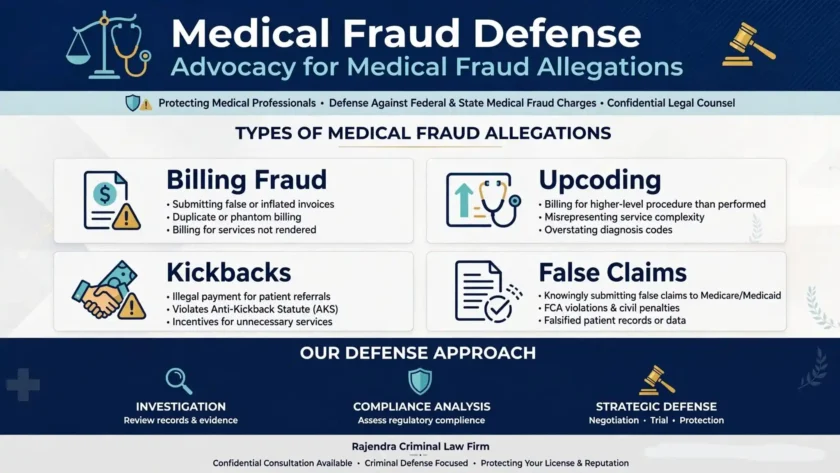
Healthcare fraud investigations often target claims submitted for services not rendered, incorrect coding, unneeded procedures, falsified records, or illegal referral arrangements. Additionally, public healthcare programs frequently enforce strict regulatory standards beyond baseline legal requirements. To build an effective response, defense counsel must immediately pinpoint the specific legal provision and factual charge at issue. After all, a broad accusation of medical fraud fails to provide adequate notice for trial preparation. Instead, the defense team requires precise details regarding which exact claim, service, record, or financial agreement the government challenges. Ultimately, identifying these core specifics allows counsel to mount a focused and persuasive legal strategy.
Clinical Judgment and Billing Rules
Medicine involves professional judgment. Coding and billing also involve detailed rules. The two can intersect in difficult ways. A treatment decision may be clinically reasonable even if an insurer later disputes reimbursement. A coding error may result from staff training rather than deliberate deception. The defense should reconstruct how the service was ordered, provided, documented, coded, reviewed, and submitted. Policies and training materials can show how the system was designed to operate.
Individual Responsibility in Large Organisations
Hospitals and medical groups may have many layers of administration. The person named in an investigation may not have controlled billing or compliance. Counsel should identify actual job duties, approval authority, access to systems, supervision, and communications. Corporate responsibility and individual criminal responsibility are related but distinct questions. The prosecution should connect the accused person to the alleged conduct and required mental state.
Patient Records and Digital Evidence
Healthcare investigations frequently analyze sensitive electronic records to evaluate potential billing compliance issues. Consequently, investigators routinely scrutinize electronic health records, billing software, audit trails, internal emails, and claim submissions for potential evidence. To maintain fairness, defense teams must emphasize data integrity throughout the entire process. Furthermore, investigators should not automatically interpret a subsequent record correction as evidence of an intentionally fraudulent entry. Counsel must therefore master system timestamps and audit functions to explain system workflows accurately. Ultimately, attorneys must safeguard patient privacy during disclosure, as improper data sharing creates severe separate legal and professional liabilities.
Audits, Exclusions, and Government Investigations
An audit or repayment demand can precede a criminal case. These processes should not be treated casually. A response that admits intentional wrongdoing may have consequences beyond the immediate billing dispute. Counsel should determine the authority of the investigating body, scope of the request, privilege, and preservation duties. Where multiple agencies are involved, communications should be coordinated carefully.
Experts and Compliance Evidence
Healthcare fraud defense often benefits from subject-matter experts. Coding specialists can explain billing rules. Physicians can address medical necessity. Compliance professionals can explain policies and training. Accountants can trace financial flows. Experts should clarify disputed facts, not manufacture a defense. Evidence of compliance programs, internal audits, training, corrective action, and reporting can also be relevant to knowledge and intent.
Why Early Defense Is Critical
Healthcare allegations can affect a professional’s licence, employment, reputation, contracts, and ability to practise. Early counsel can preserve evidence, protect confidential records, respond to investigators, and coordinate regulatory and criminal strategy. If charges follow, the defense should be built around the actual claim history and accused person’s role. In cross-border matters, local counsel in the relevant jurisdiction may be necessary.
Practical Steps After an Allegation
- Do not delete, alter, or conceal records.
- Preserve emails, messages, financial documents, contracts, and electronic records.
- Obtain the complaint, notice, subpoena, or charge and identify the exact allegation.
- Prepare a dated factual timeline before giving detailed explanations.
- Separate criminal exposure from civil, regulatory, employment, licensing, or administrative disputes.
- Use qualified experts where financial, technical, medical, or digital evidence requires specialist analysis.
Early legal intervention is especially important where an investigation can expand across multiple people, entities, accounts, or jurisdictions. The defense should be evidence-led, not emotion-led. It should test the prosecution theory, identify what the accused actually knew and did, and challenge assumptions that are not supported by reliable evidence. Where the matter is cross-border, the legal team should identify the controlling jurisdiction before giving advice on substantive liability.
Conclusion
An allegation can be serious, but an allegation is not the same as proof. Effective defense begins with the exact legal elements, a reliable factual timeline, preservation of evidence, and careful analysis of the accused person’s individual conduct and state of mind. Early representation can protect procedural rights and prevent avoidable mistakes. Rajendra Criminal Law Firm in Chennai handles complex criminal and white-collar matters and can assess Indian or cross-border aspects of a case. Foreign proceedings should also involve counsel qualified in the relevant jurisdiction.
Read More
Frequently Asked Questions About medical fraud defense
What is medical fraud?
It generally refers to intentional deception connected with healthcare services, billing, records, referrals, or payments, as defined by applicable law.
Is a billing error automatically fraud?
No. Errors can arise from coding mistakes, training problems, system failures, or misunderstandings. Criminal liability usually requires the mental state specified by law.
Can doctors be personally charged for staff mistakes?
Potentially, but individual liability depends on conduct, knowledge, authority, and applicable legal requirements.
Why are electronic health records important?
They can show when information was entered or changed, who accessed it, and how a claim or clinical record developed.
Can compliance programs help the defense?
They may provide evidence about training, internal controls, corrective action, and the accused person’s knowledge or intent.
What should a healthcare professional do after an investigation notice?
Preserve records, avoid altering files, protect patient confidentiality, and obtain legal advice before substantive responses.