

Introduction: Protecting Victims Through Effective Legal Intervention
Human trafficking and human smuggling can create serious criminal, immigration, labour, financial, and human-rights issues. However, trafficking and smuggling remain legally distinct concepts under Indian law. Trafficking generally involves exploitation through recruitment, transportation, harbouring, transfer, or receipt. Smuggling commonly involves facilitating unlawful movement across borders, often for payment. A smuggling arrangement can also develop into trafficking when exploitation begins. Therefore, victims require careful legal assessment before authorities classify the offence. Under the Bharatiya Nyaya Sanhita, 2023, Section 143 addresses trafficking of persons. Section 144 addresses exploitation of trafficked persons. The Bharatiya Nagarik Suraksha Sanhita, 2023, provides procedures for reporting cognizable offences and obtaining victim compensation. The Bharatiya Sakshya Adhiniyam, 2023, also recognises electronic and digital records subject to statutory requirements. (IndiaCode by eCourtsIndia)
Understanding Trafficking, Smuggling and Exploitation
Distinguishing Human Trafficking From Human Smuggling
Human smuggling generally concerns unlawful movement across borders with the person’s involvement in the arrangement. Human trafficking focuses on exploitation and coercive conduct. Therefore, a person may initially believe they accepted a migration arrangement voluntarily. Later, traffickers may impose debt, confinement, threats, violence, sexual exploitation, or forced labour. The legal classification then depends upon the actual conduct and available evidence. Under BNS Section 143, trafficking includes recruiting, transporting, harbouring, transferring, or receiving persons for exploitation. The provision identifies threats, force, coercion, abduction, fraud, deception, abuse of power, and certain inducements. (IndiaCode by eCourtsIndia)
| Issue | Human Smuggling | Human Trafficking |
|---|---|---|
| Primary concern | Unlawful migration | Exploitation |
| Border crossing | Usually involved | Not essential |
| Consent | Often initially present | Legally limited by coercive circumstances |
| Exploitation | May develop later | Central element |
| Main legal focus | Immigration and organised crime | Trafficking and exploitation |
Legal counsel should therefore examine the entire journey rather than relying upon labels used during initial reporting.
Identifying Common Trafficking Victim Situations
Victims can encounter trafficking through employment offers, domestic work arrangements, marriage promises, education opportunities, entertainment contracts, or migration services. Recruiters may use social media accounts, messaging applications, informal agents, travel intermediaries, or fraudulent documents. Consequently, victims may not recognise exploitation immediately. Some victims may also fear arrest because authorities discover immigration violations or forged documents. Legal support should address that fear without encouraging concealment of relevant facts. A lawyer can help present the circumstances chronologically and identify coercion, deception, exploitation, confinement, or financial control. Common warning indicators include:
- Passport or identity-document confiscation.
- Unpaid or forcibly deducted wages.
- Threats against victims or relatives.
- Restricted movement or communication.
- Debt-based coercion.
- Forced sexual or labour exploitation.
- Recruitment through deceptive promises.
These circumstances can materially affect criminal investigation and victim-protection measures.
Legal Issues Affecting Smuggling and Trafficking Victims
A victim’s case may involve several overlapping legal issues. These issues can include unlawful confinement, assault, sexual offences, forced labour, child exploitation, document fraud, cybercrime, immigration violations, financial exploitation, and organised criminal activity. Moreover, victims may require immediate protection before investigators complete the full offence analysis. Legal counsel can coordinate representations before police authorities, Magistrates, Sessions Courts, Child Welfare Committees, District Legal Services Authorities, and other appropriate forums. The exact forum depends upon the victim’s age, nationality, offence category, location, and procedural stage. Lawyers should also examine whether foreign nationals require consular assistance or immigration-related representation. Therefore, legal strategy should combine criminal-law protection with rehabilitation and documentation support. This approach can prevent a narrow immigration dispute from obscuring evidence of trafficking or exploitation.
Current Indian Legal Framework for Victims
BNS Section 143 and Trafficking Offences
BNS Section 143 provides the principal current offence provision for trafficking of persons. The section applies where specified acts occur for exploitation through listed coercive or deceptive methods. Its explanation includes physical exploitation, sexual exploitation, slavery, practices similar to slavery, servitude, beggary, and forced removal of organs. The provision also states that victim consent does not determine whether trafficking occurred. (IndiaCode by eCourtsIndia)
The provision is particularly important because trafficking cases can arise without international border crossing. Accordingly, domestic recruitment and transportation can fall within the offence. Lawyers should examine:
- Recruitment communications.
- Transportation arrangements.
- Accommodation records.
- Payment transactions.
- Threat messages.
- Employment promises.
- Identity-document control.
- Medical or injury records.
- Witness statements.
Proper evidence mapping can help investigators understand the complete exploitation chain.
BNS Section 144 and Exploitation of Trafficked Persons
BNS Section 144 separately addresses exploitation involving trafficked persons. This distinction matters because the person arranging trafficking and the person later exploiting the victim may not always be identical. Investigators should therefore identify recruiters, transporters, harbourers, intermediaries, employers, financiers, and direct exploiters. The offence structure can require separate consideration of each participant’s conduct. Furthermore, evidence should establish the relationship between recruitment and subsequent exploitation. A lawyer can assist victims by documenting each stage without forcing the victim to repeatedly narrate traumatic events unnecessarily. Where several jurisdictions become involved, counsel can coordinate representations and ensure relevant records reach investigating authorities. Courts may also need clear evidence regarding age, movement, communications, financial transactions, employment conditions, and coercive conduct. The legal strategy should therefore focus on individual acts and available evidence rather than assumptions about the entire group.
BNSS Section 173 and Filing a Police Complaint
BNSS Section 173 governs information concerning cognizable offences. It permits information to reach a police station irrespective of where the offence occurred. The provision also permits electronic communication, subject to statutory requirements. (IndiaCode by eCourtsIndia)
For a trafficking victim, this mechanism can reduce delays caused by territorial arguments. A lawyer can assist with preparing a detailed complaint containing:
- Recruiter’s identity and contact information.
- Dates and locations of recruitment.
- Travel and transportation details.
- Promises made before departure.
- Acts of coercion or deception.
- Locations where exploitation occurred.
- Names of witnesses and intermediaries.
- Available documents and electronic evidence.
If immediate danger exists, emergency assistance should take priority over lengthy documentation.
BNSS Procedures, Magistrates and Criminal Courts
Trafficking investigations can involve police stations, Anti Human Trafficking Units, Magistrates, Sessions Courts, High Courts, and other competent authorities. The appropriate forum depends upon the offence, procedural stage, and statutory jurisdiction. The BNSS provides the procedural framework for investigation, remand, statements, searches, seizure, prosecution, and trial. Lawyers can monitor procedural compliance while protecting the victim’s interests. They can also challenge unlawful detention, improper investigation, or procedural irregularities through appropriate remedies. In serious trafficking prosecutions, the Sessions Court may become the trial forum because the applicable offence can carry substantial punishment. The High Court can exercise its statutory and constitutional jurisdiction where appropriate. The Supreme Court may hear matters within its jurisdiction. No single forum automatically handles every trafficking-related issue, so early jurisdictional analysis remains important.
BSA Rules for Documentary and Digital Evidence
The Bharatiya Sakshya Adhiniyam, 2023, contains provisions concerning documentary, electronic, and digital evidence. Sections 61 to 63 specifically address electronic or digital records and their admissibility requirements. (India Code)
Modern trafficking networks often communicate through digital platforms. Therefore, victims should preserve relevant material whenever safely possible. Useful evidence may include:
- WhatsApp or messaging conversations.
- Emails and recruitment advertisements.
- Social-media profiles.
- Digital payment records.
- Travel tickets and booking records.
- Location information.
- Photographs and videos.
- Voice recordings.
- Employment documents.
- Passport or visa records.
Victims should avoid altering, deleting, or selectively editing original evidence. Lawyers can advise on lawful preservation, certification, seizure requests, and presentation before investigators or courts.
CPC and Civil Remedies Connected With Trafficking
The Code of Civil Procedure remains relevant to appropriate civil proceedings, although criminal prosecution now primarily follows the new criminal-law framework. A trafficking victim may have civil issues involving unpaid wages, contractual disputes, recovery of property, damages, or related financial claims. However, criminal proceedings and civil proceedings serve different purposes. Lawyers should identify the correct statutory remedy instead of treating every trafficking dispute as a civil case. Depending upon the facts, claims may involve employment authorities, civil courts, statutory compensation schemes, or other competent forums. Courts may also consider compensation within criminal proceedings under the BNSS framework. Section 396 establishes a victim compensation scheme involving State and Central Government coordination. (BPRD)
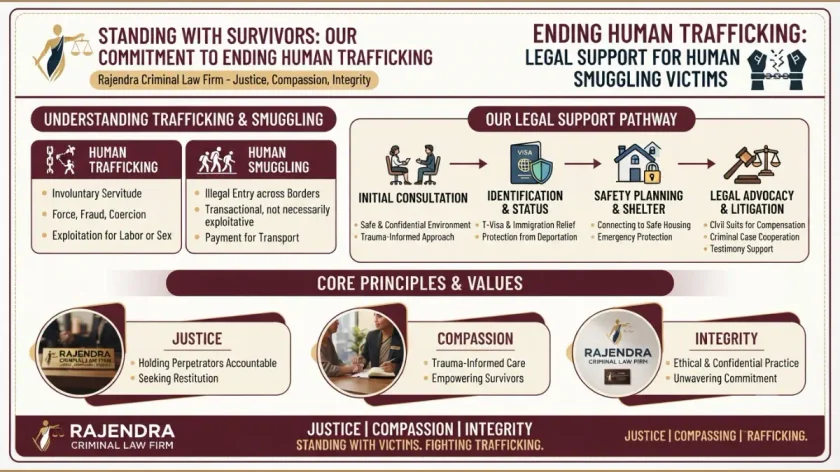
Legal Support, Remedies and Authorities for Victims
Immediate Protection and Rescue Measures
A trafficking victim may require urgent protection before pursuing a complete criminal case. Immediate danger can involve physical violence, confinement, retaliation, forced transportation, or document seizure. Emergency Response Support System 112 provides a nationwide emergency number for reporting emergencies. (Ministry of Home Affairs)
Legal support can help coordinate appropriate representations to police and protection authorities. Depending upon circumstances, useful steps include:
- Contact emergency services when immediate danger exists.
- Approach the nearest police station.
- Request assistance from an Anti Human Trafficking Unit.
- Seek medical examination where necessary.
- Preserve available identification and communication records.
- Seek legal aid through the appropriate Legal Services Authority.
- Request protective measures where threats exist.
The victim’s immediate safety should remain the first practical consideration.
Anti Human Trafficking Units and Police Stations
The Ministry of Home Affairs supports Anti Human Trafficking Units at district level and coordinates law-enforcement responses. The Ministry also works with departments dealing with women and children, external affairs, labour, and railways. (Ministry of Home Affairs)
For Chennai matters, victims can approach the police station having practical access to them. They can also request referral to the relevant Anti Human Trafficking Unit. Nearby police-station selection should depend upon immediate accessibility and case circumstances. BNSS Section 173 allows information concerning cognizable offences irrespective of the area where the offence occurred. (IndiaCode by eCourtsIndia)
Lawyers can assist with:
- FIR preparation.
- Zero FIR representations.
- Evidence preservation.
- Police follow-up.
- AHTU coordination.
- Magistrate applications.
- Protection requests.
- Compensation applications.
A precise police-station choice should follow the victim’s current safety and location.
Child Trafficking and Child Protection Authorities
Child trafficking requires additional safeguards because children receive special protection under Indian law. A child may require intervention by police, the Child Welfare Committee, child-protection authorities, and appropriate legal-services institutions. The legal strategy should prioritise immediate safety, age verification, family assessment, medical care, education, rehabilitation, and protection from further exploitation. Lawyers can also assist when age documents create disputes. Evidence can include birth certificates, school records, hospital records, identity documents, and other legally relevant materials. Where a child appears before a competent authority, counsel can explain the child’s rights and help prevent inappropriate pressure during statements. Moreover, a child’s digital recruitment history may reveal intermediaries and other victims. Authorities should therefore examine communications and financial links while protecting the child’s privacy and dignity.
Labour Exploitation and Forced Labour Claims
Trafficking can overlap with forced labour, wage exploitation, bonded labour, and unlawful employment conditions. Victims may work under threats, debt, confinement, document seizure, or coercive deductions. Legal counsel should therefore examine the employment relationship alongside criminal allegations. Relevant authorities can include State Labour Departments, police authorities, district administration, and other competent agencies. The evidence may include attendance records, wage statements, bank transfers, employment messages, accommodation photographs, and witness accounts. Where bonded labour concerns arise, additional statutory protections may apply. Victims should not assume that immigration status removes all labour protections. Similarly, employers should not treat recruitment debt as unlimited authority over a worker. Lawyers can coordinate criminal complaints with appropriate labour representations where the facts support multiple proceedings. This integrated approach can preserve both criminal evidence and employment-related claims.
Immigration, Passport and Cross-Border Legal Issues
Cross-border trafficking cases can create immigration, passport, nationality, deportation, visa, and consular issues. Foreign nationals may require assistance involving diplomatic representatives and relevant immigration authorities. Indian victims returning from foreign countries may require coordinated assistance involving Indian missions and domestic authorities. A lawyer should distinguish immigration violations from trafficking victimisation. The existence of an immigration irregularity does not automatically resolve whether exploitation occurred. Similarly, a trafficking allegation does not automatically invalidate every immigration proceeding. Each issue requires separate legal analysis. Relevant evidence can include passports, visas, border records, travel tickets, recruitment contracts, immigration communications, and employer records. Cross-border investigations may also require lawful cooperation between authorities. The Ministry of Home Affairs has described international cooperation and bilateral arrangements as part of India’s trafficking-response framework. (Ministry of Home Affairs)
Victim Compensation Under BNSS Section 396
BNSS Section 396 establishes a victim compensation framework for persons suffering loss or injury from crime and requiring rehabilitation. The provision involves State and Central Government coordination. It also permits recommendations or applications through the appropriate Legal Services Authority. (BPRD)
Victims may require compensation for rehabilitation-related needs, depending upon the applicable State scheme and case circumstances. A lawyer can assist with:
- Identifying the applicable State compensation scheme.
- Preparing the compensation application.
- Collecting medical and rehabilitation documents.
- Documenting financial losses.
- Presenting supporting evidence.
- Following up with the DLSA or SLSA.
- Seeking appropriate interim assistance.
The exact compensation amount depends upon the applicable scheme and authority’s assessment. Therefore, victims should obtain case-specific advice before relying upon general compensation figures.
Legal Aid Through DLSA and SLSA
Victims who cannot afford private representation may explore legal services through the District Legal Services Authority or State Legal Services Authority. These institutions can provide legal assistance according to applicable eligibility requirements. Legal aid can become especially important when victims face criminal proceedings, compensation applications, child-protection proceedings, or immigration difficulties. A lawyer can help organise documents before the first legal-aid consultation. Useful records include identification documents, police complaints, medical papers, travel records, employment documents, and communication evidence. However, victims should avoid delaying emergency reporting merely to gather every document. Legal authorities can help obtain evidence through lawful procedures. In addition, legal-services institutions may coordinate with other authorities where appropriate. The objective should remain protection, lawful investigation, rehabilitation, and access to justice.
Witness Protection and Privacy Concerns
Trafficking investigations can involve threats against victims, family members, witnesses, and complainants. Consequently, confidentiality and protection concerns require early attention. Lawyers can raise safety concerns before competent authorities and request appropriate protective measures supported by the facts. Digital privacy also matters because trafficking evidence may contain intimate photographs, medical information, location data, or communications involving vulnerable persons. Victims should avoid publishing such material on social media. Instead, relevant evidence should reach investigators or lawyers through secure and lawful channels. Courts may apply statutory and procedural safeguards depending upon the offence and victim’s circumstances. Counsel should also advise victims about communication with journalists, employers, recruiters, and accused persons. A controlled communication strategy can reduce unnecessary exposure while preserving evidence.
Remedies Against Inadequate Police Action
A trafficking victim may encounter difficulties when authorities delay registration, fail to investigate, overlook evidence, or misunderstand the allegations. BNSS Section 173 provides an important procedural framework for information concerning cognizable offences. (IndiaCode by eCourtsIndia)
Depending upon the circumstances, possible remedies can include:
- Representation to senior police officers.
- Request for Anti Human Trafficking Unit intervention.
- Application before the competent Magistrate.
- Petition before the High Court under appropriate jurisdiction.
- Requests for protection.
- Applications concerning compensation.
- Representations to statutory authorities.
- Complaints before appropriate human-rights institutions.
The correct remedy depends upon the specific procedural failure. Lawyers should therefore review the complaint, FIR, investigation status, available evidence, and previous representations before selecting a forum.
Courts, Forums and Government Departments
Human trafficking matters can cross several institutional boundaries. Police authorities generally investigate criminal allegations. Anti Human Trafficking Units support specialised enforcement responses. Magistrates supervise applicable procedural stages. Sessions Courts may conduct trials for offences assigned to them. High Courts can exercise relevant statutory and constitutional jurisdiction. The Ministry of Home Affairs coordinates national law-enforcement responses. The Ministry of Women and Child Development addresses welfare and rehabilitation aspects within its responsibilities. Labour authorities can address applicable employment and forced-labour concerns. Foreign-affairs authorities may assist with consular or cross-border issues. Child Welfare Committees address relevant child-protection matters. Legal Services Authorities can assist eligible victims with legal aid and compensation processes. This institutional structure means that a trafficking case may require coordinated legal action rather than one isolated complaint.
Evidence Preservation and Case Preparation
Strong evidence preparation can significantly assist a trafficking investigation. Victims should preserve original messages, documents, photographs, payment records, travel information, and contact details whenever doing so remains safe. Lawyers should create a chronological case record covering recruitment, travel, arrival, employment, confinement, exploitation, escape, rescue, reporting, and subsequent threats. A chronology can reveal connections that individual documents may not show. Financial evidence can also identify recruiters and beneficiaries. Similarly, telephone and digital records can establish relationships between different participants. The Bharatiya Sakshya Adhiniyam recognises electronic and digital records subject to its statutory provisions. (India Code)
A practical evidence file may contain:
| Evidence category | Examples |
|---|---|
| Identity | Passport, Aadhaar, birth records |
| Recruitment | Advertisements, chats, contracts |
| Travel | Tickets, visas, border records |
| Financial | Bank transfers, payment receipts |
| Exploitation | Photos, messages, medical records |
| Witnesses | Names, contact details, statements |
| Digital | Emails, social-media records, device data |
Evidence should be preserved lawfully and without unnecessary alteration.
Criminal Prosecution and Strategic Legal Representation
A trafficking prosecution requires more than simply filing an FIR. The investigation must connect suspects with recruitment, transportation, harbouring, transfer, receipt, exploitation, or related offences. Lawyers representing victims can monitor whether important evidence reaches investigators. They can also assist with statements, court appearances, compensation applications, protection requests, and communication with authorities. If accused persons seek bail, counsel may present relevant victim-safety concerns through appropriate legal procedures. If investigation becomes defective, additional remedies may become available. Furthermore, multiple accused persons may have different roles and levels of involvement. The prosecution strategy should therefore identify each person’s alleged conduct separately. Legal representation should remain evidence-based and avoid exaggerating facts. A clear, consistent, and documented case can assist authorities in assessing the allegations fairly.
How Rajendra CriminalLaw Firm Can Assist Victims
Rajendra CriminalLaw Firm can provide legal assistance for trafficking-related criminal complaints, victim protection, investigation monitoring, evidence strategy, and court proceedings. The legal team can assess whether reported conduct indicates trafficking, smuggling, forced labour, sexual exploitation, confinement, fraud, document misuse, or related offences. The firm can also assist with representations before police authorities and appropriate courts. Where necessary, counsel can coordinate issues involving Anti Human Trafficking Units, Magistrates, Sessions Courts, High Courts, Legal Services Authorities, and other competent institutions. Cross-border cases may require additional immigration and consular analysis. Each matter should receive an evidence-based legal assessment because trafficking cases differ significantly in facts and jurisdiction. The firm’s role can include helping victims understand available legal remedies while protecting procedural rights. Immediate danger should be reported to emergency authorities without waiting for a private legal consultation.
Frequently Asked Questions
What is the difference between human trafficking and human smuggling?
Human smuggling generally concerns unlawful movement, while trafficking focuses on exploitation. A smuggling arrangement can later involve trafficking if coercion, deception, or exploitation develops.
Which BNS provision covers human trafficking?
BNS Section 143 addresses trafficking of persons for exploitation. BNS Section 144 separately addresses exploitation of trafficked persons under the current criminal-law framework.
Can a trafficking victim file a Zero FIR?
Yes. BNSS Section 173 permits information about a cognizable offence regardless of where the offence occurred. Legal assistance can help present the complaint clearly.
Can trafficking victims seek compensation?
Yes. BNSS Section 396 provides a victim compensation framework involving State and District Legal Services Authorities, subject to applicable schemes and eligibility.
What evidence helps a trafficking case?
Recruitment messages, travel records, payment details, identity documents, photographs, medical records, witness information, and digital communications may assist investigators.
Where can trafficking victims seek immediate help?
Victims facing immediate danger can contact emergency services through 112. They can also approach police, Anti Human Trafficking Units, Legal Services Authorities, and suitable protection authorities.