
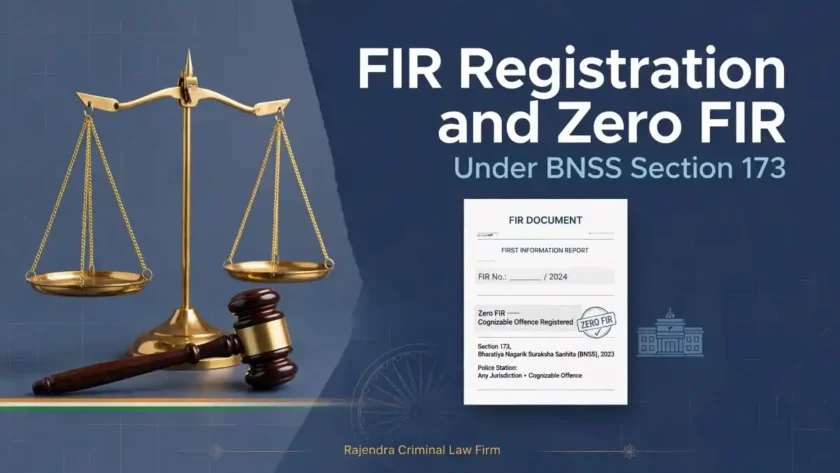
FIR registration is the step that sets criminal law in motion, because a First Information Report (FIR) is the document on which every investigation begins. Under the Bharatiya Nagarik Suraksha Sanhita, 2023 (BNSS), the law on registering an FIR is in Section 173, which replaces Section 154 of the old Code. This guide explains how to lodge an FIR, what a Zero FIR is, and what to do if the police refuse to register your complaint.
What is an FIR?
An FIR is the first written record of information about a cognizable offence given to the police. A cognizable offence is one where the police can arrest without a warrant and start investigation without a Magistrate’s order, such as murder, robbery, rape or serious cheating.
FIR registration under Section 173: step by step
- You can give information orally or in writing at a police station, or electronically (e-FIR).
- If given orally, the officer must reduce it to writing, read it back to you, and you sign it.
- If given electronically, the informant should sign it within three days so that it can be taken on record.
- You are entitled to a free copy of the FIR immediately. Insist on it because it is your proof.
Zero FIR: you can file at any police station
Section 173 makes it clear that the police cannot refuse to record information about a cognizable offence on the ground that the incident happened outside their area. When an FIR is registered at a station that lacks territorial jurisdiction, it is called a Zero FIR. It is then transferred to the correct police station for investigation. This is particularly useful for victims who are away from home, women, and persons in urgent need.
Special rules for offences against women
Where the information relates to certain offences against women, such as sexual offences, it should be recorded by a woman police officer. If the victim is temporarily or permanently mentally or physically disabled, the information is recorded at her residence or a convenient place, in the presence of an interpreter or special educator, and with video recording as the law provides.
Preliminary enquiry
The Supreme Court in Lalita Kumari v. Government of Uttar Pradesh (2014) held that registration of an FIR is mandatory when the information discloses a cognizable offence, and preliminary enquiry is not allowed in such a case. A limited preliminary enquiry is permitted only in specific categories such as matrimonial or family disputes, commercial offences, medical negligence, corruption cases, and cases with abnormal delay. Section 173(3) BNSS now provides a structured route: for offences punishable with three years or more but less than seven years, the officer may, with the prior permission of an officer not below the rank of Deputy Superintendent of Police, conduct a preliminary enquiry within 14 days to decide whether a prima facie case exists.
What if the police refuse to register the FIR?
- Step 1: Send the complaint to the Superintendent of Police. Under Section 173(4), if the officer in charge refuses, you can send the substance of the information in writing and by post (or electronically) to the Superintendent of Police. If satisfied that it discloses a cognizable offence, the SP will investigate or direct an investigation.
- Step 2: Approach the Magistrate. If the SP does not act, you can apply to the Magistrate under Section 175(3), supported by an affidavit. The Magistrate can direct the police to register the FIR and investigate. Under the BNSS, the Magistrate considers the police response before passing orders.
- Step 3: Writ petition. In serious cases of inaction, the High Court can be approached under Article 226.
Delay in filing an FIR
There is no fixed time limit for filing an FIR for a serious offence. However, unexplained delay can weaken the prosecution’s case, so you should file as soon as reasonably possible and explain any delay.
False or exaggerated FIR: what can the accused do?
- Seek anticipatory bail under Section 482 BNSS if arrest is feared.
- Know your rights on arrest.
- Where the FIR does not disclose any offence or is an abuse of process, a petition to quash the FIR can be filed before the High Court.
- Cooperate with the investigation and preserve documents, messages and call records.
Tips for a strong FIR
The full text of Section 173 is available on India Code.
- State the date, time, place and sequence of events clearly.
- Name the accused if known, or describe them if unknown.
- List witnesses and attach documents, photographs and medical records.
- Avoid exaggeration. An FIR should be factual, because it is used later to test the case.
- Check that what the officer writes matches what you said before signing.
What happens after the FIR?
The police investigate, record statements, collect evidence, and may arrest the accused. On completion they file a police report (charge sheet) before the Magistrate. If the police find no case, they file a closure report, and the informant is given notice and can object.
Frequently Asked Questions
Can the police refuse to register an FIR because the crime happened in another area?
No. Under Section 173 they must register a Zero FIR and transfer it to the proper station. Jurisdiction affects only where the case is investigated, not whether it is registered. The station that receives your complaint records it, assigns a number and forwards it to the station with territorial jurisdiction.
Is an online FIR valid?
Yes. Section 173 allows information to be given electronically. The informant must sign the e-FIR within three days for it to be taken on record, so visit or confirm with the police station within that period.
Do I get a copy of the FIR?
Yes. Under Section 173, the informant is entitled to a copy of the FIR free of cost, immediately after registration. Keep it safely, because it carries the FIR number and date that you need for bail, court and insurance purposes.
Can the police conduct an enquiry before registering the FIR?
Only in limited cases. For offences with punishment of three years or more but less than seven years, a preliminary enquiry of up to 14 days is allowed with a senior officer’s permission. For serious cognizable offences, registration is mandatory.
What can I do if the police station does not act on my complaint?
Send the substance of your complaint in writing to the Superintendent of Police under Section 173(4). If there is still no action, apply to the Magistrate under Section 175(3) with an affidavit, and in serious cases approach the High Court under Article 226.
Who records an FIR for sexual offences?
Information about certain offences against women, such as sexual offences, is to be recorded by a woman police officer. For victims with a temporary or permanent mental or physical disability, special procedures apply, including recording at a convenient place with an interpreter or special educator.
Can an FIR be cancelled later?
An FIR can be quashed by the High Court in appropriate cases, or the police may file a closure report. A private settlement does not automatically end a non-compoundable case.
Read More
This article is general legal information and not a substitute for advice on your specific case. Consult an advocate before acting.