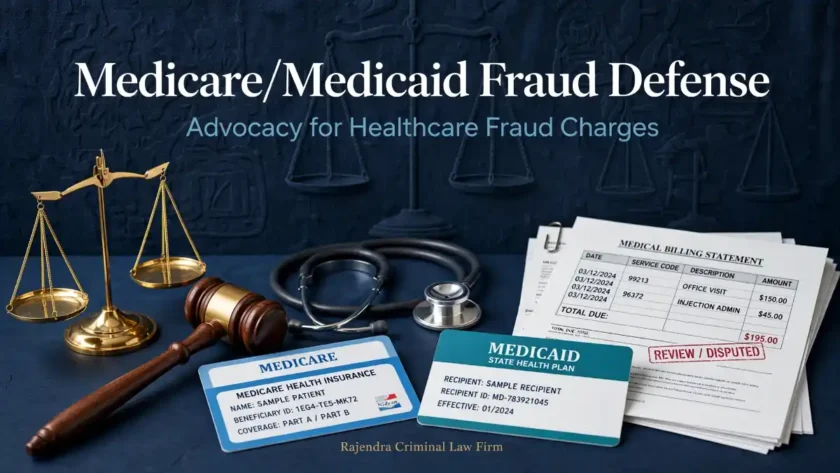
Medicare & Medicaid Fraud Defense: Expert Legal Advocacy: Medicare and Medicaid fraud allegations can involve healthcare providers, clinics, laboratories, pharmacies, billing companies, administrators, and individuals. In fact, These cases may be investigated by government agencies and can involve large claim datasets. The accusation may concern billing, medical necessity, referrals, documentation, or false claims. A defense must distinguish deliberate fraud from coding errors, administrative failures, disputed medical judgment, or conduct performed by another employee.
Jurisdiction note: The legal terms in this article are commonly associated with U.S. financial, healthcare, insolvency, or benefits law. The governing statute, procedure, evidence rules, and penalties depend on the jurisdiction. If the matter is in India, it must be analysed under the applicable Indian law rather than by importing a foreign legal framework.
How a Defense Lawyer Approaches Medicare Medicaid fraud defense
Why Medicare and Medicaid Cases Are Complex
Public healthcare programs operate under detailed eligibility, billing, coding, documentation, and reimbursement rules. An investigation can involve thousands of claims over several years. The defense should identify the exact claims and legal provisions involved rather than responding to broad statistics. A high error rate may require correction, but criminal liability generally depends on legal elements and mental state. The factual record should be analysed at claim level where necessary.
Claim-by-Claim Analysis
A useful defense method is to select representative claims and reconstruct them from patient encounter to payment. Moreover, The analysis can include service provided, clinical note, code selected, person who entered the claim, review process, and reimbursement. This can reveal whether an alleged pattern is genuine or caused by software, billing vendor, template, or misunderstanding. A statistical conclusion should be tested against actual records before being treated as proof of intentional conduct.
Medical Necessity and Documentation
Medical necessity disputes can be difficult because clinical judgment and reimbursement rules do not always align neatly. Counsel should obtain relevant clinical records and professional standards. The question is whether the provider knowingly submitted a false claim or whether the claim reflected a genuine clinical decision or reasonable interpretation of the rules. Missing documentation may create administrative problems, but legal consequences depend on statute and facts.
Referrals and Financial Relationships
Healthcare investigations may examine relationships between providers, laboratories, pharmacies, vendors, and referral sources. Contracts, ownership interests, invoices, consulting arrangements, and communications may become evidence. The defense should determine whether the relationship was disclosed, what services were actually provided, and what compensation was paid. Where government alleges an improper arrangement, the precise legal prohibition and factual connection must be established.
Investigations and Document Requests
Government investigations can involve subpoenas, interviews, audits, searches, and requests for electronic data. The response should be organised and lawful. Counsel should establish preservation protocols, identify custodians, protect privilege where applicable, and prevent accidental destruction of records. Firstly, Staff should not speculate or coordinate accounts. Each person should provide accurate information within their knowledge. A controlled response is safer than an improvised response to a complex investigation.
Experts and Data Review
These cases often require coding experts, physicians, accountants, compliance professionals, and data analysts. Their role may be to test the government’s sample, identify legitimate variations, or explain billing systems. Data analysis should account for missing claims, duplicate entries, software changes, provider turnover, and reimbursement changes. Expert conclusions should be tied to actual evidence and separated from legal conclusions reserved for counsel and court.
Defense and Cross-Border Issues
For a U.S. Medicare or Medicaid case, U.S. law and procedure govern the criminal proceeding. An Indian advocate may assist with Indian or cross-border aspects, but counsel admitted in the relevant U.S. jurisdiction may be required for court representation. This distinction should be made clear at the outset. Early coordination can prevent conflicting advice and help protect professional, financial, and personal interests.
Practical Steps After an Allegation
- Do not delete, alter, or conceal records.
- Preserve emails, messages, financial documents, contracts, and electronic records.
- Obtain the complaint, notice, subpoena, or charge and identify the exact allegation.
- Prepare a dated factual timeline before giving detailed explanations.
- Separate criminal exposure from civil, regulatory, employment, licensing, or administrative disputes.
- Use qualified experts where financial, technical, medical, or digital evidence requires specialist analysis.
Early legal intervention is especially important where an investigation can expand across multiple people, entities, accounts, or jurisdictions. The defense should be evidence-led, not emotion-led. It should test the prosecution theory, identify what the accused actually knew and did, and challenge assumptions that are not supported by reliable evidence. Where the matter is cross-border, the legal team should identify the controlling jurisdiction before giving advice on substantive liability.
Conclusion
An allegation can be serious, but an allegation is not the same as proof. Meanwhile, Effective defense begins with the exact legal elements, a reliable factual timeline, preservation of evidence, and careful analysis of the accused person’s individual conduct and state of mind. In fact, Early representation can protect procedural rights and prevent avoidable mistakes. Rajendra Criminal Law Firm in Chennai handles complex criminal and white-collar matters and can assess Indian or cross-border aspects of a case. Foreign proceedings should also involve counsel qualified in the relevant jurisdiction.
Read More
Frequently Asked Questions About Medicare Medicaid fraud defense
What is Medicare or Medicaid fraud?
It generally involves intentional deception connected with claims, services, records, or payments involving these U.S. healthcare programs, subject to applicable federal or state law.
Can billing mistakes lead to criminal charges?
They can attract investigation, but a mistake is not automatically proof of intentional criminal fraud. The required mental state matters.
Why are individual claims important?
They can show what service occurred, what was documented, who submitted the claim, and whether an alleged pattern is supported by actual records.
Can providers face professional consequences too?
Yes. Criminal allegations may exist alongside licensing, reimbursement, exclusion, employment, or civil proceedings.
Should a provider answer an investigator directly?
Obtain legal advice first, especially where the inquiry concerns possible criminal conduct. Preserve records and avoid speculative explanations.
Can an Indian lawyer represent a U.S. Medicare case in court?
Court representation generally requires admission in the relevant U.S. jurisdiction. Indian counsel can assist with cross-border coordination where appropriate.