

In today’s digital world, technology touches every part of our lives. We shop online, work online, and even socialize online. While this makes life convenient, it also opens the door to new risks. Cyber crimes are increasing every year, affecting individuals, businesses, and even government systems. Because of this, it has become extremely important to understand how cyber crime laws work in India.
At Rajendra Criminal Law Firm, we regularly support victims who suffer online harm and also help individuals who are wrongly accused of cyber offences. This balanced perspective allows us to guide people with clarity and care. In this article, we explain cyber crime laws in simple words, so both victims and accused persons know their rights, responsibilities, and the legal path ahead.
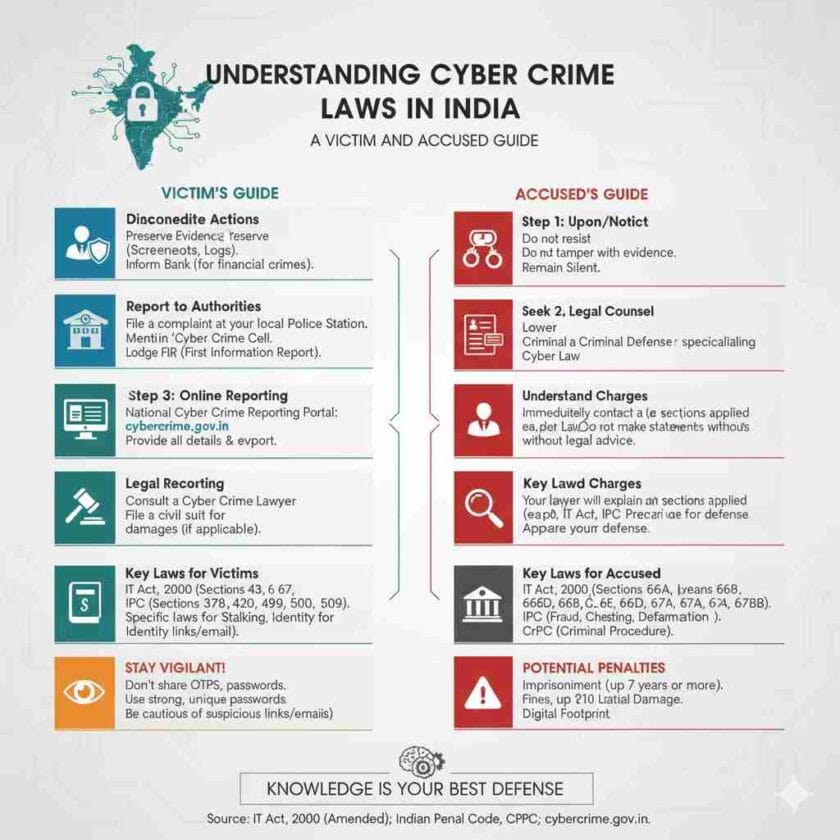
Understanding Cyber Crime Laws in India: A Victim and Accused Guide – Rajendra Criminal Law Firm
What Is Cyber Crime?
Cyber crime is any unlawful activity carried out using computers, networks, or the internet. These crimes may target your personal data, bank information, social media accounts, digital reputation, or even business systems.
Some common forms of cyber crime include:
- Online fraud and cheating
- Identity theft
- Hacking and unauthorized access
- Cyberstalking
- Online harassment and threats
- Data theft
- Phishing attacks
- Online defamation
- Financial cyber scams
Since these crimes often happen invisibly and quickly, victims may not even realize what has happened until it is too late. Therefore, understanding the law becomes essential.
Legal Framework Governing Cyber Crimes in India
India addresses cyber crimes mainly through two laws:
1. Information Technology (IT) Act, 2000
This is the primary law for digital offences. It defines cyber crimes, sets punishments, and establishes procedures for investigation.
2. Indian Penal Code (IPC)
Many cyber crimes involve fraud, cheating, extortion, defamation, or harassment. Therefore, several IPC sections are applied alongside the IT Act.
Together, these laws help police handle online crimes effectively.
Key Cyber Crime Offences Under the IT Act
Understanding the main sections of the IT Act helps both victims and accused persons know what to expect.
Section 66 – Computer-Related Offences
Covers fraud, dishonesty, data theft, and unauthorized access.
Section 66C – Identity Theft
Punishes misuse of someone else’s identity or passwords.
Section 66D – Online Cheating
Deals with fraud committed through emails, fake websites, or digital communication.
Section 67 – Publishing Obscene Content
Relates to sharing or transmitting sexual or obscene material online.
Section 70 – Protected Systems
Protects government computers and critical infrastructure.
Section 72 – Breach of Privacy
Punishes unauthorized disclosure of personal information.
These provisions show how detailed the law is when it comes to digital safety.
Rights and Remedies for Victims of Cyber Crime
When you become a victim of cyber crime, you may feel helpless, confused, or embarrassed. However, the law is on your side, and you have the right to seek justice. At Rajendra Criminal Law Firm, we help victims take the correct steps quickly, because timely action often decides the strength of the case.
1. You Can File a Complaint Anywhere
Cyber crime is borderless. Because of this, you can file your complaint in any city, not just where the crime occurred.
2. You Can Report the Crime Online
The National Cyber Crime Reporting Portal offers a quick and accessible way to report offences, especially those involving women and children.
3. You Can Ask for Data Preservation
Victims have the right to request that service providers preserve digital evidence before it gets deleted.
4. You Can Seek Compensation
If you suffer financial loss or mental harassment, you can claim damages.
5. You Have the Right to Privacy
Your identity will be protected, especially in sensitive cases like online abuse or sexual content.
These rights empower victims and help them regain control.
How Victims Should Respond to Cyber Crimes
Acting quickly and calmly makes a big difference.
Step 1: Secure Accounts
Change passwords, activate two-factor authentication, and freeze compromised accounts.
Step 2: Collect Evidence
Take screenshots, save emails, record transaction IDs, and preserve chat logs.
Step 3: File a Police Complaint
Approach the nearest cyber cell or a regular police station.
Step 4: Inform Banks or Service Providers
They can help block transactions and minimize loss.
Step 5: Consult a Cyber Crime Lawyer
Professional guidance avoids mistakes and strengthens your case.
At Rajendra Criminal Law Firm, we support victims through every step, from filing complaints to pursuing court action.
Rights of an Accused Person in Cyber Crime Cases
Cyber crime allegations can ruin reputations, disrupt careers, and cause emotional stress. Sometimes people are falsely accused due to misunderstandings, technical errors, or misuse of digital platforms. Even then, every accused person has strong legal rights.
1. Right to Legal Representation
You can consult a lawyer at any stage.
2. Right Against Self-Incrimination
You cannot be forced to confess.
3. Right to Bail
Many cyber offences are bailable, depending on the allegations.
4. Right to See the Evidence Against You
You are entitled to know what proof the police have collected.
5. Right to Fair Investigation
Police must follow due process and maintain your dignity.
Our firm assists accused individuals by ensuring the investigation remains lawful and unbiased.
Common Mistakes Accused Individuals Must Avoid
Many people panic and make errors that harm their defence. To protect yourself:
- Do not destroy devices or delete data.
- Do not argue with the complainant.
- Do not give statements without legal advice.
- Do not share the issue publicly on social media.
- Do not ignore summons or notices.
Legal issues become harder if these steps are ignored.
Role of Digital Evidence in Cyber Crime Cases
Digital evidence forms the backbone of cyber crime investigations. It includes:
- Emails
- Mobile data
- Browser history
- IP addresses
- Call logs
- CCTV footage
- Bank transaction details
- Social media activity
Since digital evidence can be deleted easily, both victims and accused should act quickly. Our team helps preserve and present digital evidence in court in the correct format.
How Investigations Work in Cyber Crime Cases
Cyber investigations involve technical analysis. Usually, the police:
- Record the complaint
- Preserve digital evidence
- Trace IP addresses
- Contact service providers
- Analyze devices
- Prepare a charge sheet
Cyber investigations can take time, but cooperating with authorities helps speed up the process.
Preventive Steps to Stay Safe Online
Whether you are a victim or an accused person, prevention is always better. Here are simple steps:
- Use strong, unique passwords
- Avoid clicking unknown links
- Keep your phone and computer updated
- Use secure Wi-Fi connections
- Avoid sharing personal details online
- Install antivirus software
- Enable two-factor authentication
- Be careful while sharing photos or documents
These practices create strong digital security and reduce risks.
Why Legal Guidance Matters
Cyber crime laws are technical, and many people do not understand the procedures. Missteps can weaken the case, whether you are a victim or an accused person. At Rajendra Criminal Law Firm, we provide:
- Legal advice for victims
- Defence support for accused persons
- Assistance in filing complaints
- Help with digital evidence
- Guidance through investigations and trials
With proper legal support, you can navigate the process with confidence and clarity.
Frequently Asked Questions
Cyber crimes in India are mainly covered under the Information Technology (IT) Act, 2000 and the Indian Penal Code (IPC). The IT Act deals with digital offences such as hacking, identity theft, online fraud, data theft, and publishing obscene content. The IPC applies when the crime includes cheating, extortion, harassment, defamation, or threats.
A victim can file a complaint at any cyber crime police station or at the nearest regular police station. They can also report the crime online through the National Cyber Crime Reporting Portal. Victims should collect digital evidence, secure their accounts, and immediately inform banks or service providers. Early action helps prevent further harm and strengthens the case.
An accused person has the right to legal representation, the right to remain silent, and the right to a fair investigation. They also have the right to access the evidence used against them and, in many cases, the right to apply for bail. These rights ensure that the accused is treated lawfully and respectfully throughout the process.
Digital evidence may include emails, call logs, IP addresses, chat messages, social media activity, bank transactions, CCTV footage, and device records. Since digital evidence can be deleted easily, it should be preserved quickly by both victims and accused individuals.
Cyber laws are technical, and mistakes can weaken a case. Legal guidance helps victims file strong complaints and assists accused persons in ensuring due process. Professional support leads to better outcomes.
Conclusion
In conclusion, understanding cyber crime laws in India is essential for everyone. With increasing online risks, both victims and accused individuals must know how the law works, what rights they have, and how the legal system can protect them. Cyber crime cases require quick action, careful handling of digital evidence, and proper legal guidance.
At Rajendra Criminal Law Firm, we are committed to offering clear, strong, and reliable support to anyone facing cyber crime issues. Whether you seek justice as a victim or fair treatment as an accused person, we stand with you at every step. Through awareness, caution, and timely legal help, you can protect your digital life and your legal rights effectively.
Read More
- The Complete Guide to Bail in India: Process, Types, and Your Rights
- Domestic Violence Lawyer Chennai | IPC 498A Defence & Advice
- DUI & Traffic Offence Lawyer in Chennai | Drunk Driving Defence
- Cyber Crime Lawyer in Chennai | IT Act & Online Fraud Defence
- Expert Bail Lawyer in Chennai | Urgent Bail & Anticipatory Bail
- National Cybercrime Reporting Portal (NCRP)