

Discovering that a First Information Report (FIR) has been registered against you can cause immediate anxiety and confusion. Whether it stems from a commercial dispute, personal conflict, or an groundless allegation, panic is your biggest enemy.
Before moving the court for legal remedies such as anticipatory bail or quashing the proceedings, taking methodical, strategic steps is essential. Rajendra Law Office LLP outlines the vital actions you must complete before approaching the courts for legal relief.
FIR Registered Against You: Essential Steps Before Approaching the Court
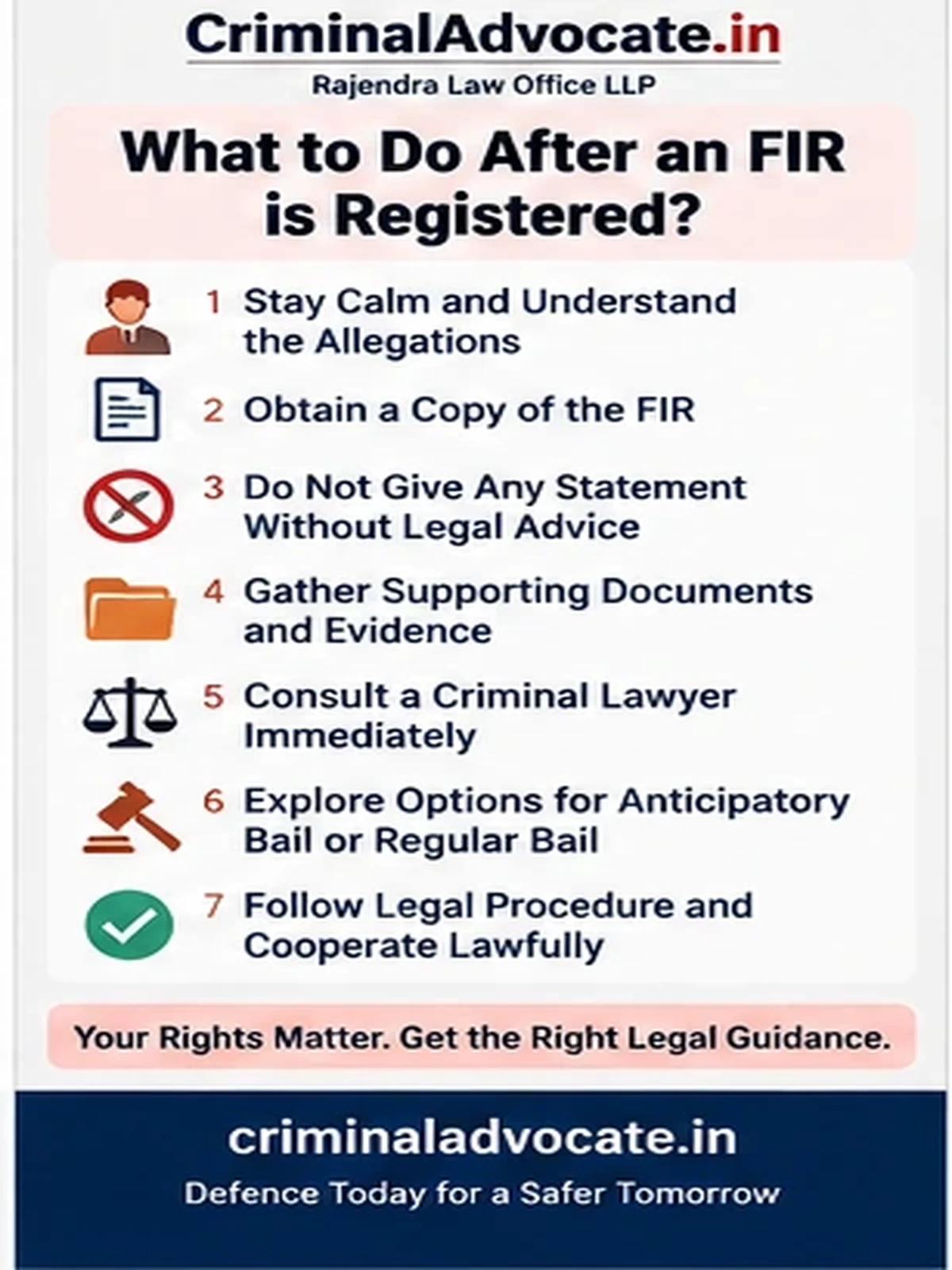
Quick Reference: Immediate Actions After an FIR
| Action Step | Objective / Why It Matters |
| 1. Obtain Certified Copy | Read the exact charges under the Bharatiya Nyaya Sanhita (BNS) / IPC and police station details. |
| 2. Verify Cognizability | Determine if the police can arrest without a warrant (Cognizable vs. Non-Cognizable). |
| 3. Build an Evidence Dossier | Collect physical & digital alibis (call records, CCTV, messages, emails, receipts). |
| 4. Avoid Self-Incrimination | Do not make casual statements to police or post details on social media. |
| 5. Retain Expert Legal Counsel | Consult a criminal defence advocate before appearing at any police station. |
1. Obtain a Certified Copy of the FIR
You cannot defend against accusations you have not read. The first step is securing an official copy of the FIR.
- Online Portals: Most state police departments and High Court portals upload FIRs within 24 to 48 hours (except in sensitive cases like sexual offences or national security).
- Police Station / Magistrate Court: If unavailable online, your advocate or a representative can apply for a certified copy directly from the jurisdiction Magistrate Court or the police station under section provisions of the law.
What to check in the FIR:
- The specific sections invoked under the Bharatiya Nyaya Sanhita, 2023 (BNS) [or Indian Penal Code, 1860 (IPC)].
- The exact time, date, and place of the alleged offence.
- Whether you are named as a primary accused, co-accused, or suspect.
- Any unexplained delays between the alleged incident and the filing of the FIR.
2. Understand whether the Offence is Cognizable & Bailable
Not every FIR gives police the immediate right to arrest. The legal strategy depends on how the alleged offence is classified under the Bharatiya Nagarik Suraksha Sanhita, 2023 (BNSS) [formerly Code of Criminal Procedure (CrPC)]:
- Cognizable Offence: Police can investigate and arrest without a warrant. Immediate steps for protective relief (e.g., Anticipatory Bail under Section 482 BNSS / Sec 438 CrPC) are imperative.
- Non-Cognizable Offence: Police require a court order/warrant to investigate or arrest.
- Bailable vs. Non-Bailable: In bailable offences, bail is a matter of right at the police station itself. In non-bailable offences, bail discretion lies strictly with the Court.
3. Build a Robust Evidence Dossier (Alibi & Defense)
Courts rely on documentary evidence when considering pre-arrest protection or quashing petitions. Before meeting your legal team, compile a chronological file:
- Digital Evidence: WhatsApp chats, text messages, emails, photos, and location history demonstrating your whereabouts or the true context of the dispute.
- Financial Records: Bank statements, UPI transaction histories, invoices, or receipts if the FIR involves cheating, breach of trust, or financial disputes.
- Alibi Proof: CCTV footage, flight/train tickets, hotel check-ins, or call detail records (CDR) proving you were elsewhere at the time of the alleged crime.
- Independent Witness Details: Names and contact details of neutral persons who witnessed the incident or can corroborate your account.
Crucial Tip: Save and back up digital records immediately. Electronic logs, CCTV overwrites, and cellular tower data can be erased within weeks if not preserved early.
4. Exercise Your Right to Silence and Avoid Panic Responses
When faced with a police inquiry or notice:
- Do Not Evade Process Unlawfully: Running away or switching off your phone without legal backing can be used by the prosecution to allege non-cooperation.
- Refrain from Making Unadvised Statements: Do not sign blank papers or make informal admissions to police officers. Statements made to police during custody are generally inadmissible as direct evidence, but signed disclosures can complicate your defence.
- Maintain Social Media Silence: Never post explanations, rants, or counter-accusations online. Prosecutors often use public social media posts to establish state of mind or intent.
5. Know the Statutory Notices: BNSS Sec 35(3) / CrPC Sec 41A
Under modern criminal procedure, for offences punishable with imprisonment up to 7 years, police are generally required to issue a Notice of Appearance (under Section 35(3) BNSS / Section 41A CrPC) rather than effecting an immediate arrest.
- If you receive a statutory notice to appear before the Investigating Officer (IO), do not ignore it.
- Complying with the notice in the presence of or under advice from your advocate demonstrates goodwill and significantly reduces grounds for arrest.
6. Consult a Criminal Defence Advocate to Plan Legal Relief
Once your dossier and FIR copy are ready, your advocate will evaluate the appropriate legal remedy based on the facts:
                      [ FIR Registered ]
                              │
     ┌────────────────────────┴────────────────────────┐
     ▼                                                 ▼
[ Risk of Arrest / Non-Bailable ]               [ Malicious / False FIR ]
     │                                                 │
     ▼                                                 ▼
Apply for Anticipatory Bail               File Quashing Petition in High Court
(Sec 482 BNSS / Sec 438 CrPC)                 (Sec 528 BNSS / Sec 482 CrPC)
- Anticipatory Bail (Pre-Arrest Bail): Filed before the Sessions Court or High Court to secure protection against arrest while agreeing to cooperate with the investigation.
- Quashing the FIR: Filed before the High Court under inherent powers (Sec 528 BNSS / Sec 482 CrPC) if the FIR is blatantly false, malicious, or fails to disclose any criminal offence even on its face (as per State of Haryana v. Bhajan Lal guidelines).
- Interim Stay on Arrest: High Courts may grant interim protection while evaluating a quashing petition.
Frequently Asked Questions (FAQs)
What is the first thing I should do if an FIR is registered against me?
Obtain a certified copy of the FIR immediately to understand the exact allegations and sections invoked under the BNS/IPC. Do not panic or contact the complainant directly without legal advice.
Can police arrest me immediately after an FIR is filed?
Only if the FIR involves a cognizable and non-bailable offence. For offences carrying punishment under 7 years, police must generally issue a Notice of Appearance prior to considering arrest.
How does an Anticipatory Bail protect me?
Anticipatory Bail is a preventive order issued by a Sessions Court or High Court directing that in the event of your arrest, you must be released on bail subject to specified conditions and cooperation with the investigation.
Can a false FIR be cancelled or quashed?
Yes. You can approach the High Court under Section 528 BNSS (formerly Section 482 CrPC) to quash a false FIR if the complaint is politically/personally motivated, lacks evidence, or represents a purely civil dispute given a criminal color.
Seek Professional Legal Representation
Facing criminal allegations requires swift, tactful, and structured legal intervention. Rajendra Criminal Law Firm provides legal counsel and litigation services before Magistrate Courts, Sessions Courts, and the Madras High Court.