
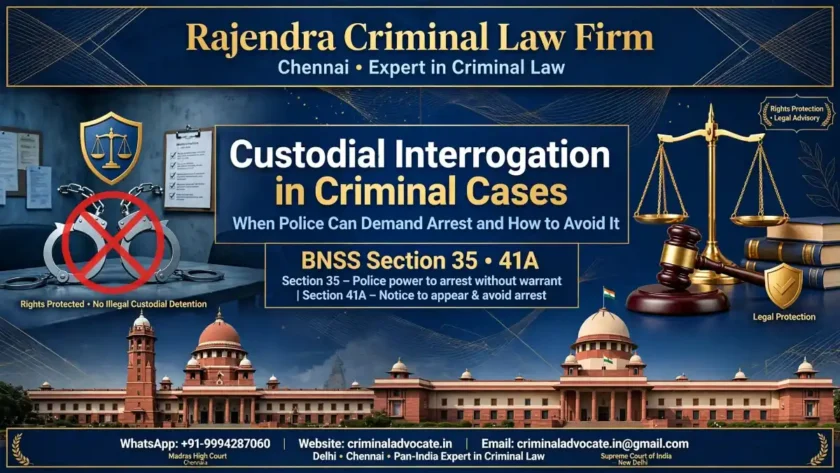
Police argue custodial interrogation proves essential in criminal investigations. However, law strictly limits arrest and interrogation powers protecting individual liberty fundamentally. Understanding custodial interrogation rights prevents unnecessary detention and harassment. Moreover, knowing legal limitations empowers accused persons during police questioning. Additionally, custodial interrogation necessity represents critical bail approval factor. Furthermore, disproving interrogation necessity strengthens anticipatory bail applications substantially. Therefore, comprehensive knowledge of interrogation procedures proves essential. In fact, informed persons prevent police abuse effectively. Consequently, legal understanding protects fundamental rights during investigations. Furthermore, early lawyer consultation during interrogation proves absolutely critical. Therefore, accused persons must understand interrogation rights thoroughly. Importantly, silence constitutes legal right protected absolutely. Consequently, exercising constitutional rights remains essential protection. Moreover, Rajendra Criminal Law Firm provides expert interrogation guidance. Therefore, clients benefit from comprehensive protection throughout proceedings.
Custodial Interrogation Framework and Legal Basis
Understanding Custodial Interrogation and Police Authority Limitations
Definition of Custodial Interrogation Under Criminal Procedure
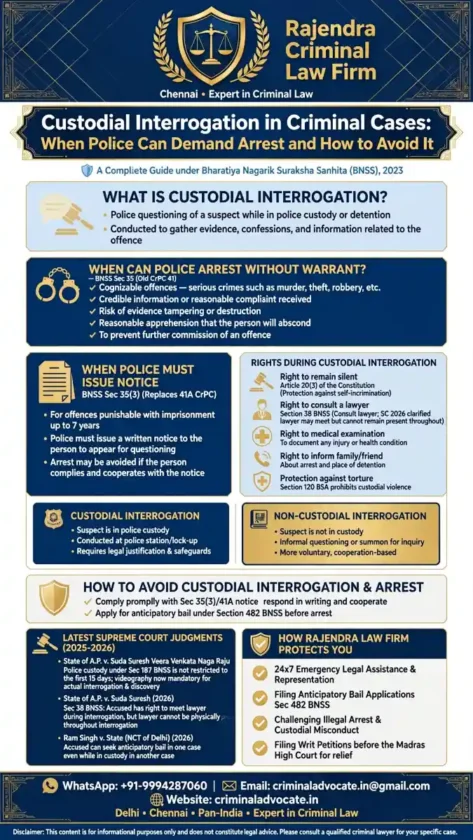
Custodial interrogation means police questioning while person remains detained physically. Police custody restricts freedom of movement during questioning absolutely. Moreover, accused cannot leave police station freely during interrogation. Additionally, police exercise controlling authority over movement completely. Furthermore, custody may last hours or even days. Therefore, custodial interrogation differs from voluntary questioning fundamentally. Consequently, custody triggers enhanced legal protections and safeguards. Moreover, custody status activates constitutional rights automatically. Additionally, detained persons possess special procedural protections. Furthermore, arrest formality establishes interrogation as custodial fundamentally. Therefore, understanding custody definition proves essential for rights protection.
Arrest Authority and Circumstances Justifying Custody Initiation
Police possess arrest authority in specific circumstances only. Bailable offense arrests require valid warrant or FIR typically. Moreover, non-bailable offense arrests involve broader police authority. Additionally, serious crime arrests proceed without warrant authority. Furthermore, reasonable suspicion may justify arrest in certain cases. Therefore, police cannot arrest arbitrarily or without cause. Consequently, arrest requires probable cause or reasonable suspicion. Moreover, custody must relate to legitimate investigation needs. Additionally, harassment-based arrest proves legally unjustifiable. Furthermore, personal vendetta arrests constitute unlawful detention. Therefore, arrest authority faces strict legal limitations. In fact, unauthorized arrest triggers liability and damages. Moreover, wrongful arrest constitutes serious violation. Consequently, police abuse can be challenged legally. Furthermore, experienced lawyers challenge unlawful arrest effectively. Therefore, accused persons possess remedies against wrongful detention.
Section 41 CrPC and Arrest Authority Limitations
Section 41 CrPC strictly limits police arrest authority. Police must follow statutory arrest requirements before custody. Moreover, non-compliance with arrest procedures renders detention unlawful. Additionally, procedural violations trigger habeas corpus remedies. Furthermore, unlawful detention can be immediately challenged. Therefore, arrest procedure compliance proves absolutely essential. Consequently, procedural violations protect accused persons legally. Moreover, proper arrest procedures safeguard individual liberty. Additionally, law requires warrant for many offense arrests. Furthermore, certain arrests require judicial authorization first. Therefore, police cannot arrest without legal justification always. In fact, unlawful arrest constitutes serious violation. Moreover, victims can seek compensation and damages. Consequently, arrest procedures protect fundamental rights effectively. Furthermore, legal protections ensure detention legitimacy.
Reasonable Suspicion Versus Arrest Justification
Reasonable suspicion alone does not justify arrest always. Probable cause represents higher threshold for custody initiation. Moreover, mere suspicion cannot trigger arrest authority. Additionally, concrete evidence strengthens arrest justification. Furthermore, witness statements establish probable cause. Therefore, arrest requires substantial factual foundation. Consequently, weak evidence cannot justify detention. Moreover, speculative arrests prove legally vulnerable. Additionally, insufficient evidence endangers prosecution case. Therefore, strong evidence drives legitimate arrest decisions. In fact, weak cases fail prosecution scrutiny. Consequently, arrest quality determines investigation success. Moreover, unfounded arrests damage prosecution prospects.
Interrogation Without Custody and Voluntary Statement Procedures
Non-Custodial Questioning and Voluntary Statement Procedures
Police can question persons without arrest or custody. Non-custodial questioning remains voluntary by definition fundamentally. Moreover, persons retain freedom to refuse cooperation. Additionally, voluntary statements carry significant probative weight. Furthermore, cooperation demonstrates innocence effectively to courts. Therefore, non-custodial questioning serves investigation purposes. Consequently, innocent persons often cooperate willingly. Moreover, voluntary cooperation strengthens credibility substantially. Additionally, candid answers demonstrate confidence in innocence. Furthermore, evasion suggests guilt suspiciously to investigators. Therefore, strategic non-custodial cooperation proves beneficial. In fact, honest responses often lead to exoneration. Moreover, cooperation demonstrates innocence convincingly. Consequently, early engagement facilitates investigation completion. Furthermore, investigation closure enables bail approval readily. Therefore, strategic voluntary cooperation advances accused interests. In fact, innocent persons benefit from investigation completion through cooperation.
Distinction Between Custodial and Non-Custodial Interrogation Rights
Custodial interrogation triggers enhanced constitutional protections immediately. Non-custodial questioning involves fewer procedural safeguards comparatively. Moreover, Miranda-like rights protect custodial detainees specifically. Additionally, right to silence applies primarily to custody. Furthermore, lawyer right strengthens during custodial interrogation. Therefore, custody status determines rights scope fundamentally. Consequently, detention changes legal protection levels. Moreover, understanding rights distinction proves strategically important. Additionally, custody triggers maximum constitutional safeguards. Furthermore, procedural compliance becomes essential during detention. Therefore, custody status determines interrogation legal framework. In fact, rights understanding empowers accused protection. Moreover, informed accused exercise rights effectively. Consequently, legal knowledge prevents statement coercion. Furthermore, expert guidance protects accused interests comprehensively.
Advantages of Non-Custodial Cooperation and Early Engagement Strategy
Non-custodial cooperation often resolves investigations efficiently and quickly. Early lawyer-guided cooperation demonstrates innocence convincingly. Moreover, voluntary statements establish credibility with investigators. Additionally, prompt cooperation expedites investigation conclusion. Furthermore, investigation completion facilitates bail approval substantially. Therefore, strategic cooperation advances accused interests fundamentally. Consequently, innocent persons benefit from rapid investigation closure. Moreover, speedy resolution prevents prolonged detention. Additionally, investigation completion provides strong bail grounds. Furthermore, investigation status influences bail determination significantly. Therefore, investigation cooperation becomes strategically important tactically. In fact, early cooperation often leads to exoneration. Moreover, innocent persons prove innocence through cooperation. Consequently, strategic engagement benefits guilty and innocent alike. Furthermore, attorney-guided cooperation protects accused interests comprehensively. Therefore, expert lawyers coordinate strategic cooperation effectively.
Custodial Interrogation Rights and Constitutional Protections
Fundamental Rights During Police Custody Under Indian Constitution
Right to Silence and Non-Self-Incrimination Protection
Article 20(3) Constitution guarantees right against self-incrimination fundamentally. Accused persons cannot be forced testifying against themselves. Moreover, silence does not constitute proof of guilt. Additionally, remaining silent protects against interrogation pressure. Furthermore, refusal to answer questions proves lawful absolutely. Therefore, silence represents legitimate constitutional right exercise. Consequently, exercising silence cannot be held against accused. Moreover, courts cannot infer guilt from silence. Additionally, guilt cannot be presumed from interrogation refusal. Furthermore, silence remains protected throughout questioning. Therefore, silence represents strongest protection available. In fact, silence prevents statement misuse and distortion. Moreover, avoiding statements prevents interrogation trap creation. Consequently, silence protects against police manipulation. Furthermore, silence prevents coerced confession creation. Therefore, exercising silence right remains always available option.
Right to Legal Counsel During Police Interrogation
Right to legal counsel activates immediately upon arrest. Accused persons possess constitutional right lawyer consultation. Moreover, police cannot deny lawyer access during custody. Additionally, counsel presence protects rights throughout interrogation. Furthermore, lawyers prevent police abuse and coercion. Therefore, lawyer consultation becomes absolutely essential. Consequently, early lawyer engagement protects accused interests. Moreover, lawyer presence intimidates police misconduct substantially. Additionally, counsel guidance prevents statement errors. Furthermore, lawyers advise interrogation strategy and response approach. Therefore, lawyer presence maximizes protection throughout. In fact, police fear lawyer presence significantly. Moreover, counsel presence prevents confession extraction. Consequently, early lawyer notification proves essential tactic. Furthermore, lawyer presence fundamentally changes interrogation dynamics. Therefore, lawyer consultation remains absolutely essential always.
Freedom from Torture and Inhumane Treatment Protection
Article 21 Constitution prohibits torture and cruel punishment absolutely. Police cannot inflict physical or mental torture fundamentally. Moreover, beatings and violence constitute serious violations. Additionally, psychological torture proves equally prohibited. Furthermore, coercion through threat represents torture. Therefore, any force application violates constitutional protection. Consequently, torture incidents trigger criminal and civil liability. Moreover, torture evidence becomes inadmissible in proceedings. Additionally, confessions obtained through torture prove invalid. Furthermore, torture victims receive compensation and damages. Therefore, torture remains absolutely prohibited always. In fact, torture constitutes serious crime independently. Moreover, police face criminal prosecution for torture. Consequently, torture prevention remains paramount. Furthermore, torture prohibition protects detained persons fundamentally. Therefore, torture remains absolutely prohibited throughout interrogation.
Identifying and Documenting Torture and Police Abuse
Torture documentation requires medical examination and evidence collection. Injuries require immediate medical certification and photography. Moreover, written torture records establish evidence. Additionally, witness statements corroborate torture allegations. Furthermore, medical reports prove abuse convincingly. Therefore, evidence collection proves essential immediately. Consequently, documented torture supports legal claims effectively. Moreover, medical evidence proves abuse conclusively. Additionally, photographs establish injury patterns. Therefore, prompt documentation strengthens torture cases. In fact, contemporaneous evidence proves most persuasive. Moreover, delayed reporting weakens credibility. Consequently, immediate torture reporting remains essential.
Miranda-like Rights and Procedural Protections During Custody
Right to Know Arrest Charges and Investigation Status
Police must inform arrested persons of accusations and charges. Accused possess right knowing interrogation basis fundamentally. Moreover, charge specification enables defense preparation. Additionally, vague or unknown charges prove unjustifiable. Furthermore, investigation basis must be explained. Therefore, police must disclose interrogation purpose. Consequently, unexplained arrest warrants habeas corpus challenges. Moreover, charge disclosure enables strategic response. Additionally, knowing allegations facilitates defense preparation. Furthermore, charge understanding remains absolutely essential. Therefore, demanding charge explanation proves legitimate. In fact, charge disclosure requirement protects rights. Moreover, vague charges prove vulnerable legally. Consequently, demanding specific charge information remains appropriate.
Right to Information on Arrest Legality and Detention Duration
Arrested persons must be informed of arrest reasons. Detention duration limitations apply strictly under law. Moreover, custody periods cannot exceed statutory maximum limits. Additionally, unlawful detention triggers habeas corpus remedies. Furthermore, detention period violations prove serious breach. Therefore, detention duration limitations protect rights fundamentally. Consequently, illegal detention can be immediately challenged. Moreover, detention excess constitutes serious violation. Additionally, extended detention without charges proves illegal. Furthermore, detention review procedures provide protection. Therefore, detention duration limits protect fundamental rights. In fact, detention cannot continue indefinitely unlawfully. Moreover, extended detention damages prosecution case. Consequently, detention period compliance remains essential.
Right to Medical Examination and Health Protection in Custody
Medical examination remains available right during custody. Police cannot deny medical treatment or examination. Moreover, health conditions require medical attention immediately. Additionally, illness or injury demands medical care. Furthermore, medical records establish detention conditions. Therefore, medical examination right proves essential. Consequently, refusing medical access violates rights. Moreover, health deterioration triggers liability. Additionally, medical evidence documents abuse effectively. Furthermore, medical examination protects health fundamentally. Therefore, demanding medical examination remains legitimate always. In fact, medical examination protects health during custody. Moreover, medical records prevent abuse. Consequently, demanding medical attention remains essential.
Custodial Interrogation Necessity and Bail Implications
Interrogation Necessity as Bail Denial Ground in Criminal Cases
When Police Claim Interrogation Necessity and Bail Denial Arguments
Police frequently argue interrogation necessity justifies custody and bail denial. Prosecutors claim investigation cannot proceed without arrest. Moreover, police cite witness statements requiring confrontation. Additionally, investigators argue evidence verification requires interrogation. Furthermore, case complexity supposedly demands custodial interrogation. Therefore, police present interrogation necessity arguments regularly. Consequently, bail courts hear these arguments consistently. Moreover, interrogation necessity proves critical bail factor. Additionally, disproving interrogation necessity strengthens bail applications. Furthermore, removing interrogation necessity removes key bail objection. Therefore, challenging interrogation necessity becomes essential bail strategy. In fact, effective interrogation necessity opposition often secures bail. Moreover, weak interrogation arguments fail prosecution credibility. Consequently, compelling interrogation necessity denial proves persuasive. Furthermore, experienced lawyers effectively counter interrogation arguments. Therefore, expert advocacy defeats police interrogation claims effectively.
Disproving Interrogation Necessity in Bail Applications
Interrogation necessity disproof requires comprehensive evidence presentation. Demonstrating investigation completion negates interrogation necessity. Moreover, available evidence without interrogation strengthens arguments. Additionally, witness statements proving innocence undermine interrogation claims. Furthermore, documentary evidence eliminates interrogation need. Therefore, evidence presentation proves strategically critical. Consequently, strong evidence defeats interrogation necessity arguments. Moreover, investigation documentation supports necessity denial. Additionally, expert opinion negates police necessity claims. Furthermore, timeline evidence disproves necessity arguments. Therefore, comprehensive evidence defeats police positions. In fact, well-presented evidence convinces judges. Moreover, logical arguments undermine prosecution. Consequently, compelling presentation defeats interrogation necessity. Furthermore, experienced lawyers present evidence effectively. Therefore, expert advocacy defeats interrogation necessity claims.
Supreme Court Guidelines on Interrogation Necessity and Bail Discretion
Supreme Court consistently recognizes interrogation necessity limitations. Courts hold interrogation necessity requires substantial justification. Moreover, bare interrogation claims prove insufficient for bail denial. Additionally, specific investigation needs must be demonstrated. Furthermore, generic necessity arguments fail judicial scrutiny. Therefore, police face burden proving interrogation necessity. Consequently, vague necessity arguments prove inadequate. Moreover, specific investigation stage matters significantly. Additionally, investigation completion renders interrogation unnecessary. Furthermore, completed investigations support bail strongly. Therefore, Supreme Court favors bail favorably. In fact, Supreme Court guidelines protect bail rights. Moreover, interrogation necessity requires strong evidence. Consequently, judicial skepticism favors accused interests. Furthermore, Supreme Court emphasizes bail philosophy. Therefore, questioning interrogation necessity remains wise strategy.
Alternative Investigation Methods Without Custodial Interrogation
Non-Custodial Voluntary Questioning and Cooperation Without Arrest
Non-custodial questioning enables investigation without arrest necessity. Voluntary cooperation often achieves investigation purposes entirely. Moreover, innocent persons benefit from voluntary interrogation. Additionally, cooperation demonstrates innocence convincingly. Furthermore, friendly cooperation may expedite investigations. Therefore, voluntary cooperation proves beneficial strategically. Consequently, investigation completion occurs without arrest often. Moreover, early cooperation facilitates quick resolution. Additionally, investigation completion strengthens bail applications. Furthermore, investigation status influences bail determination. Therefore, voluntary cooperation serves accused interests. In fact, early cooperation often leads to exoneration. Moreover, investigation completion enables bail approval readily. Consequently, strategic cooperation advances accused interests fundamentally.
Document Analysis and Technical Evidence Collection Methods
Documentary evidence collection requires no custodial interrogation. Technical analysis proceeds without arrested accused presence. Moreover, forensic examination occurs independently of custody. Additionally, computer analysis and digital investigation continue. Furthermore, witness examination proceeds despite accused detention. Therefore, substantial investigation proceeds without interrogation. Consequently, custody becomes unnecessary often despite police claims. Moreover, investigation completion disproves interrogation necessity. Additionally, technical evidence speaks independently. Furthermore, forensic science removes interrogation need. Therefore, modern investigation technology reduces interrogation necessity. In fact, technology enables investigation without custody. Moreover, evidence collection occurs independently. Consequently, interrogation necessity proves often overstated. Furthermore, modern investigation methods support bail approval. Therefore, technical investigation supports interrogation necessity denial.
Witness Statements and Circumstantial Evidence Establishment
Witness examination proceeds independently of arrested person interrogation. Circumstantial evidence collection requires no custodial questioning. Moreover, witness statements establish facts without interrogation. Additionally, eyewitness testimony proceeds independently. Furthermore, circumstantial facts emerge through investigation. Therefore, substantial evidence collection occurs without custody. Consequently, witness evidence proves interrogation unnecessary. Moreover, independent evidence eliminates interrogation need. Additionally, witness statements strengthen prosecution. Furthermore, independent investigation proves possible and effective. Therefore, witness interrogation removes accused interrogation necessity. In fact, witness evidence often proves sufficient. Moreover, independent investigation proceeds effectively. Consequently, interrogation necessity proves often claimed falsely. Furthermore, witness evidence supports bail approval. Therefore, witness examination supports interrogation necessity denial.
Frequently Asked Questions About Custodial Interrogation
Q1: Can police arrest and interrogate without a warrant in Tamil Nadu?
Police can arrest without warrant only in specific circumstances under Section 41 CrPC. Warrant is typically required for bailable offenses unless statutory exceptions apply. Non-bailable offense arrests proceed without warrant in certain cases. However, arrest requires probable cause and reasonable suspicion always. Police cannot arrest arbitrarily or based on personal vendetta or harassment intentions. Arrest authority faces strict legal limitations protecting individual liberty fundamentals. Unauthorized arrests constitute serious violation triggering habeas corpus remedies immediately. Wrongful arrest victims can seek compensation and damages from police departments. Rajendra Criminal Law Firm challenges unlawful arrests protecting client rights effectively throughout Tamil Nadu.
Q2: What are fundamental rights during police custodial interrogation?
Fundamental rights during custodial interrogation include right to silence, right to legal counsel, and freedom from torture absolutely. Article 20(3) Constitution protects against self-incrimination and silence cannot imply guilt. Accused persons can refuse answering questions and remain silent throughout interrogation. Right to lawyer activates immediately upon arrest enabling counsel consultation. Police cannot deny lawyer access during custody under any circumstances fundamentally. Freedom from torture and cruel treatment remains absolute protection. Article 21 Constitution prohibits physical and mental torture in police custody completely. Confessions obtained through torture prove inadmissible in court proceedings. Torture incidents trigger criminal and civil liability against police officers personally. Expert lawyers protect these fundamental rights throughout custodial interrogation consistently.
Q3: How can interrogation necessity be disproven in bail applications?
Interrogation necessity can be disproven through comprehensive evidence presentation in bail courts. Demonstrating investigation completion negates police interrogation necessity claims substantially. Available documentary evidence eliminating interrogation need strengthens arguments convincingly. Witness statements proving innocence undermine police necessity allegations effectively. Technical evidence and forensic examination proceed without custodial interrogation. Modern investigation methods enable case progress without arrested person interrogation. Supreme Court consistently holds interrogation necessity requires substantial justification and proof. Generic necessity arguments prove insufficient for bail denial in Tamil Nadu courts. Specific investigation needs must be demonstrated for necessity claims. Expert lawyers effectively counter interrogation arguments through strategic evidence presentation. Disproving interrogation necessity often secures bail approval in contentious cases fundamentally.
Q4: What is the difference between custodial and non-custodial interrogation?
Custodial interrogation means police questioning while person remains detained physically and freedom is restricted. Non-custodial questioning enables persons remaining free and able to leave. Custodial interrogation triggers enhanced constitutional protections immediately upon detention. Non-custodial questioning involves fewer procedural safeguards compared to custody situations. Custodial status activates right to silence, lawyer consultation, and anti-torture protection. Non-custodial statements often carry greater probative weight demonstrating voluntary cooperation. Innocent persons often benefit from non-custodial cooperation demonstrating innocence effectively. Voluntary statements establish credibility with investigators and courts substantially. Early lawyer-guided cooperation demonstrates innocence convincingly in investigations. Investigation completion through cooperation facilitates bail approval processes readily and effectively.
Q5: Can accused refuse to answer police questions during interrogation?
Yes, accused persons can refuse answering police questions under constitutional protection absolutely. Article 20(3) Constitution guarantees right against self-incrimination fundamentally. Silence during interrogation represents legitimate constitutional right exercise always. Police cannot force persons testifying against themselves or answering questions. Remaining silent does not constitute proof of guilt under law. Courts cannot infer guilt or draw adverse inferences from silence. Exercising silence right cannot be held against accused in any way. Silence represents strongest protection available during police interrogation. Avoiding statements prevents interrogation trap creation and statement misuse. Silence prevents coerced confession creation through police manipulation. Expert lawyers advise strategic silence in appropriate circumstances protecting rights comprehensively.
Q6: What should someone do when arrested and taken into police custody?
Upon arrest, immediately exercise right to silence and demand lawyer consultation urgently. Inform police clearly that you will not answer questions without lawyer present. Request police to notify your family and lawyer of arrest immediately. Maintain silence regarding facts and investigation details throughout custody. Avoid signing any statements or documents without lawyer review. Demand medical examination and document any injuries or abuse immediately. Report police torture or abuse to medical examiners and lawyers. Comply with lawful police orders while firmly asserting legal rights. Early lawyer consultation proves absolutely essential protecting fundamental rights completely. Lawyer guidance ensures appropriate interrogation strategy and response approach. Expert legal representation prevents police misconduct and protects accused interests fundamentally throughout custody period.
Expert Legal Guidance on Custodial Interrogation Rights
Understanding custodial interrogation protections prevents police abuse and unlawful detention. Rajendra Criminal Law Firm provides expert guidance protecting fundamental rights throughout custody. Our lawyers ensure police compliance with constitutional protections absolutely. Moreover, we represent clients preventing interrogation abuse and torture. Additionally, we disprove interrogation necessity in bail applications effectively. Furthermore, we secure bail through interrogation necessity denial strategies. Therefore, expert representation protects freedom throughout interrogation proceedings. Consequently, clients benefit from comprehensive legal guidance and representation. Importantly, early lawyer consultation prevents irreversible damage to case. In fact, expert guidance proves absolutely critical during custody. Consequently, contact us immediately upon arrest for emergency legal assistance. Moreover, our twenty-four-hour availability ensures immediate legal response always. Therefore, expert representation protects fundamental rights and freedom throughout proceedings.
Contact Information – Rajendra Criminal Law Firm:
📞 Phone: 044-26533389 | 044-47660443
📱 Mobile: +91-9994287060 | +91-9444014096
📍 Office 1: 8/13, 1st Floor, Bharathi Salai, West Mogappair, Chennai – 600037
📍 Office 2: 323/156, Andhra Insurance Building, 2nd Floor, Law Chamber 14, George Town, Chennai – 600001
📧 Email: rajendralawoffice@gmail.com | sarav@lawyerchennai.com
🌐 Website: https://criminaladvocate.in
Related Articles and Criminal Law Resources
- Anticipatory Bail in Tamil Nadu: Strategies That Work in Madras High Court – Comprehensive guide to anticipatory bail applications protecting fundamental liberty rights fundamentally.
- Bail Conditions in Criminal Cases: Residential Restrictions and Compliance – Expert guidance on bail conditions, reporting obligations, and compliance requirements protecting freedom.
- How to Quash a False FIR Under Section 482 CrPC in Madras High Court – Strategic approaches for FIR quashing protecting innocent persons from wrongful prosecution.
- Supreme Court Guidelines on Arrests and Bail: What Every Accused Must Know – Essential guidelines on arrest procedures and fundamental rights protection during custody.
- Can You Approach the Supreme Court Directly for Fundamental Rights Violation? – Direct Supreme Court remedies protecting fundamental rights and preventing abuse of authority.
- Landmark Judgments of Supreme Court in Criminal Law (2024–2025) – Critical Supreme Court decisions protecting interrogation rights and preventing police abuse fundamentally.