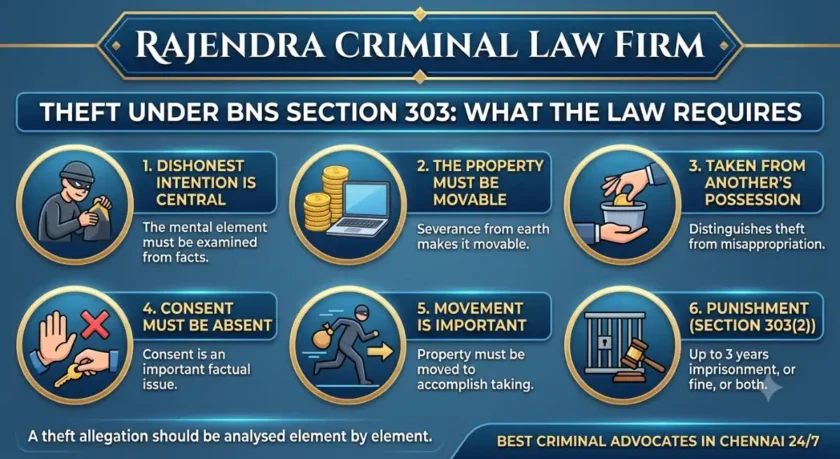

Theft Under BNS Section 303: What the Law Requires
Understand theft under BNS Section 303, its essential elements, punishment, investigation, evidence, bail, jurisdiction, and legal remedies.
Theft Defined
Dishonest taking of movable property from another person’s possession without consent.
Dishonest Intention
The prosecution must establish the required dishonest intention from the circumstances.
BNSS Framework
Police investigation, Magistrate proceedings, bail, evidence, and trial follow current criminal procedure.
BSA 2023
CCTV, messages, electronic records, documents, witnesses, and seizure records can become important.
Understanding Theft Under BNS Section 303
The Statutory Framework and Essential Ingredients
What Section 303 Actually Defines
Dishonest Intention Is Central to Theft
Section 303 BNS begins with the mental element of dishonest intention. The accused must intend to take property dishonestly from another person’s possession. Therefore, the surrounding facts matter when investigators assess the alleged offence. Mere possession of another person’s property does not automatically establish theft. The prosecution must connect the accused with the required dishonest purpose. Circumstances can include conduct before taking, during movement, and after possession changed. For example, concealment, false explanations, disposal, or attempts to avoid recovery may become relevant evidence. However, each circumstance requires proper evaluation within the complete factual record. A genuine mistake about ownership can create a different legal question. Similarly, an authorised temporary use may affect the analysis of dishonest intention. Therefore, lawyers should examine communications, agreements, payments, permissions, and previous dealings. The accused’s explanation should also be assessed against independent evidence. Ultimately, Section 303 requires an element-based analysis rather than reliance upon the allegation of theft alone.
Movable Property Must Be the Subject of Taking
Section 303 applies to movable property, which forms a specific part of the statutory definition. Property attached to earth does not initially qualify while it remains attached. However, the statute recognises circumstances where severance makes property capable of theft. Therefore, the factual nature of the property requires careful examination. A physical object can plainly qualify as movable property. Certain attached items can also become movable after lawful or unlawful severance. The statutory explanations further recognise movement caused indirectly. Consequently, the prosecution need not always prove ordinary hand-to-hand movement. An accused may cause movement by removing an obstacle or separating property from another thing. The provision also addresses movement involving animals through induced movement. These explanations prevent overly narrow interpretations of the movement requirement. However, the remaining statutory ingredients must still exist. Counsel should therefore identify the property, its location, its possession, and the alleged movement. Photographs, inventory records, ownership documents, and recovery records can assist that analysis. This distinction becomes important in property disputes involving fixtures, equipment, goods, materials, or other physical assets.
Possession Matters More Than Simple Ownership
Section 303 focuses on taking movable property out of another person’s possession. Therefore, ownership and possession should not be treated as identical concepts. A person may possess property without holding formal legal ownership. For example, an employee may possess company equipment during employment. A tenant may possess household goods within leased premises. A bailee may lawfully hold goods belonging to another person. Consequently, the prosecution must examine who possessed the property when the alleged taking occurred. This distinction can also separate theft from dishonest misappropriation and criminal breach of trust. Where property reached the accused through lawful entrustment, different provisions may become relevant. The factual history of delivery, custody, authority, and subsequent conduct therefore matters greatly. Documents can establish who controlled the property at the relevant time. Witnesses may also explain custody arrangements and permitted use. Furthermore, electronic access records can establish possession of digital devices or business assets. Counsel should therefore analyse possession carefully before accepting the section cited in an FIR. A correct classification can materially affect investigation, bail strategy, charges, and trial preparation.
Consent Can Be Express or Implied
Section 303 expressly recognises consent within its statutory definition of theft. Consent may arise expressly or through circumstances supporting implied authority. Therefore, the prosecution must examine whether the person in possession authorised the relevant taking. Authority can also come from another person possessing express or implied authority. Messages, emails, agreements, workplace instructions, access permissions, and previous conduct can become relevant. For example, permission to use an item can affect whether an unauthorised taking occurred. However, permission to use property does not automatically authorise permanent removal. The scope, duration, conditions, and purpose of consent therefore require examination. A dispute may arise when parties remember an oral permission differently. In such cases, surrounding circumstances can become especially important. Witness testimony may support one version, while electronic communications may support another. Therefore, defence counsel should preserve every record concerning permission or access. The same approach applies to family disputes, workplace disputes, business transactions, and property conflicts. Ultimately, consent analysis requires factual precision rather than assumptions based solely upon possession or ownership.
Movement Completes the Statutory Taking Element
Movement Can Occur Through Different Acts
Section 303 requires movement of the property in order to accomplish the dishonest taking. The statutory explanations broaden the meaning of movement beyond simple physical carrying. Removing an obstacle can cause the necessary movement in appropriate circumstances. Separating property from another thing can also satisfy the statutory explanation. The provision further addresses movement caused through an animal. Therefore, the factual act alleged against the accused must receive careful scrutiny. Investigators should identify the precise conduct that allegedly moved the property. CCTV footage can sometimes establish that movement directly. Witnesses may describe the sequence of events and the accused’s conduct. Recovery evidence can also connect the alleged movement with subsequent possession. However, recovery alone should not replace analysis of the statutory ingredients. Defence counsel should examine whether the alleged movement occurred with consent or authority. The timing of movement can also matter when assessing intention. Consequently, a strong theft analysis connects intention, possession, consent, property, and movement into one coherent factual sequence.
Distinguishing Theft From Related Property Offences
Theft, Dishonest Misappropriation, and Criminal Breach of Trust
Theft should be distinguished from dishonest misappropriation and criminal breach of trust. Theft generally concerns dishonest taking from another person’s possession without consent. Dishonest misappropriation can involve property that lawfully came into the person’s possession. Criminal breach of trust involves entrustment and subsequent dishonest use, conversion, or disposal. Therefore, the manner in which the accused initially received property becomes significant. A business dispute may involve competing allegations under different property offences. For example, an employee receiving company funds for a defined purpose may raise entrustment issues. Conversely, taking cash directly from another person’s possession may raise theft concerns. The correct provision depends upon evidence rather than the complainant’s preferred label. Counsel should examine contracts, custody arrangements, account records, messages, and authority documents. Furthermore, the FIR should be compared with the actual factual allegations. Investigators may add provisions when evidence develops during investigation. Therefore, early legal review can identify incorrect classification and relevant defence grounds. This distinction also affects punishment, bail, compounding, trial procedure, and the available legal strategy.
Theft and Snatching Are Not Identical Offences
The BNS separately addresses snatching under Section 304. Therefore, not every sudden taking from a person should automatically receive the same statutory classification. Snatching concerns a distinct factual pattern involving sudden, quick, or forcible taking from a person. Theft under Section 303 follows its own statutory ingredients and structure. The precise conduct therefore determines which provision applies. Counsel should examine whether force, suddenness, physical contact, or specific circumstances occurred. CCTV footage can become particularly important in street theft and snatching allegations. Witness statements can also clarify how the property left the complainant’s possession. Mobile-phone theft, chain incidents, wallet incidents, and vehicle-related allegations require fact-specific analysis. Furthermore, aggravated property offences may apply when the theft occurs in specified locations. Section 305 addresses theft in certain houses, transportation, and places of worship. Section 306 addresses theft by a clerk or servant involving property in the employer’s possession. Section 307 addresses theft after preparation for causing death, hurt, or restraint. Therefore, accurate classification requires reviewing the entire incident rather than selecting Section 303 automatically.
Punishment, Bail Classification, and Special Consequences
Ordinary Punishment Under Section 303(2)
Section 303(2) provides the general punishment framework for theft under the BNS. Ordinary theft can attract imprisonment extending to three years, fine, or both. The provision also creates enhanced consequences for a second or subsequent conviction. Such repeat conviction can attract rigorous imprisonment from one year up to five years. A fine also accompanies the enhanced punishment. Therefore, previous conviction status can materially affect sentencing exposure. The prosecution must establish the relevant previous conviction when enhanced punishment is invoked. Counsel should verify court records and conviction particulars rather than relying on informal assertions. The statutory schedule also affects whether the offence is cognizable and bailable. Ordinary theft under the schedule is treated differently from the specified petty-theft category. Therefore, the property value can become procedurally important in some cases. Defence strategy should consequently address both the ingredients and applicable classification. Bail advice must consider the precise subsection and factual allegations. A lawyer should also review whether additional BNS provisions have been included. Punishment analysis should therefore begin with the FIR and statutory schedule, not assumptions about theft cases generally.
First-Time Theft Below Five Thousand Rupees
Section 303(2) contains a specific proviso for certain first-time theft cases. It applies where the stolen property has a value below five thousand rupees. The person must also be convicted for the first time. Additionally, the property must be restored or its value returned. When those conditions apply, the statute prescribes community service. Therefore, lawyers should verify value, previous conviction status, and restoration separately. The special rule does not mean every theft below five thousand rupees automatically ends without proceedings. The statutory conditions still require careful application to the facts. The BNSS schedule separately classifies the specified petty-theft category as non-cognizable and bailable. Consequently, police procedure can differ from ordinary theft allegations. A Magistrate’s role can become important where the offence is non-cognizable. Counsel should therefore examine the exact property value and procedural classification. Restoration can also require documentation showing what was returned and when. A proper legal strategy should avoid promising a particular outcome before conviction and statutory conditions. The provision creates an important distinction, but its application remains fact-specific.
Investigation, FIR, Police Procedure, and Evidence
FIR, Police Station Jurisdiction, and Magistrate Proceedings
How Police Investigation Can Begin
Police procedure depends upon the classification of the alleged theft under the BNSS schedule. Ordinary theft is treated as cognizable and non-bailable under the schedule. The specified petty-theft category has different treatment when statutory conditions apply. For a cognizable offence, BNSS Section 175 permits police investigation without prior Magistrate permission. Section 174 governs investigation of non-cognizable cases and requires Magistrate authorisation. Therefore, the precise classification should be checked before advising a complainant or accused. A person reporting theft should preserve evidence and provide a clear factual account. The complaint should identify the property, approximate value, location, time, possession, and circumstances. CCTV footage and witness details should be mentioned promptly. If a police station refuses to record cognizable information, BNSS Section 173 provides further procedural routes. The informant can approach the Superintendent of Police under the statutory mechanism. A Magistrate application may also become available in appropriate circumstances. Consequently, police procedure should follow the current BNSS rather than older CrPC terminology alone.
Evidence, Seizure, Recovery, and Digital Records
CCTV, Mobile Data, Messages, and Electronic Evidence
Theft investigations increasingly depend upon digital evidence and electronic records. CCTV footage can establish movement, presence, timing, and surrounding circumstances. Mobile phones can contain location information, messages, photographs, or communication records. Access-control systems can also establish entry and exit events. The Bharatiya Sakshya Adhiniyam, 2023 provides the current evidentiary framework for electronic records. Therefore, digital evidence should be preserved in a reliable and legally usable form. Businesses should avoid overwriting CCTV systems before relevant footage is secured. Individuals should preserve original messages instead of relying only upon screenshots. Investigators may also examine device records, transaction data, and other electronic material. Defence counsel should examine the source, integrity, relevance, and manner of production. The BSA contains specific provisions governing admissibility of electronic records. Consequently, digital evidence requires more than simply producing a screenshot. Proper preservation can affect credibility, authenticity, and evidentiary value. A criminal lawyer should therefore request relevant electronic records early. Timely preservation can prevent critical evidence from disappearing through routine deletion or system retention limits.
Defence Strategy, Remedies, and Criminal Proceedings
Common Defence Issues in Section 303 Cases
A Section 303 defence should begin by testing every statutory ingredient against the evidence. The first question concerns dishonest intention and the circumstances supporting that allegation. Next, counsel should identify the property’s nature, possession, value, and alleged movement. Consent and authority require separate examination because both can materially change the analysis. The defence should then compare the FIR with witness statements and recovery records. Contradictions can become relevant when they affect essential facts. Ownership disputes may also require examination of possession rather than title alone. Entrustment can raise questions concerning criminal breach of trust instead of theft. Genuine mistakes may affect the alleged dishonest intention. Payment disputes can also produce criminal allegations that require careful factual classification. Therefore, counsel should separate commercial disagreement from genuine criminal conduct. The defence may seek bail, discharge, appropriate quashing relief, or trial-based acquittal depending upon circumstances. Each remedy has different legal requirements and procedural routes. Consequently, a defence strategy should follow the evidence and procedural stage rather than use one standard template.
Courts, Forums, Government Departments, and Legal Remedies
The appropriate forum depends upon the procedural stage and nature of the legal issue. Theft investigations generally involve the police, Magistrate, and criminal courts. Bail applications usually proceed before the competent criminal court under the BNSS framework. Trial jurisdiction depends upon the applicable statutory schedule and court competence. High Courts can exercise relevant statutory and constitutional powers in appropriate cases. The Superintendent of Police can become relevant when cognizable information is not properly recorded. A Magistrate can also become involved in procedural directions and complaint proceedings. Government departments may become relevant when stolen property belongs to a public authority. Special statutes can create separate offences involving electricity, railway property, customs, or other regulated property. Therefore, counsel should identify the governing statute before choosing a remedy. Potential remedies can include bail, discharge, quashing, defence during investigation, trial defence, recovery applications, compounding where legally permitted, and appeals. Civil remedies may also arise from connected ownership or possession disputes. The Code of Civil Procedure can become relevant to separate civil proceedings. Thus, criminal and civil strategies should be coordinated when the facts justify both.
Practical Criminal-Law Support in Chennai
How a Criminal Advocate Can Assist
A criminal advocate can review the FIR, complaint, seizure records, witness material, and available defence evidence. The first stage involves identifying the exact BNS sections invoked by the police. Next, counsel should compare those sections with the factual allegations and statutory ingredients. The lawyer can then assess bail, investigation, evidence preservation, and possible procedural remedies. Chennai matters may involve local police stations, Magistrate Courts, Sessions Courts, or the Madras High Court. The correct forum depends upon the relief sought and procedural stage. Counsel can assist complainants with complaint preparation, evidence organisation, and follow-up representations. Accused persons can receive defence advice, bail assistance, document review, and representation. Businesses may require internal investigation before responding to theft allegations involving employees. Property owners may need coordinated criminal and civil advice when possession is disputed. Therefore, legal support should remain evidence-based and proportionate to the allegations. Emergency assistance becomes particularly important after arrest, seizure, search, or imminent criminal proceedings. A structured consultation helps identify the immediate procedural step without prejudging the eventual outcome.
Practical Checklist for a Theft Complaint or Defence
Use a structured checklist whenever a theft allegation arises under BNS Section 303. First, obtain the FIR or complaint and identify every invoked statutory provision. Second, record the property description, ownership, possession, value, location, and alleged movement. Third, preserve CCTV footage, photographs, messages, emails, transaction records, and witness details. Fourth, collect seizure mahazars, recovery records, notices, statements, and relevant police communications. Fifth, verify whether the allegation involves ordinary theft or another property offence. Sixth, check whether the petty-theft proviso or repeat-conviction provision can affect the case. Seventh, identify the competent police station, Magistrate, criminal court, or High Court remedy. Eighth, examine bail requirements and any urgent protection required. Ninth, preserve digital evidence under the current BSA framework. Tenth, obtain advice before giving detailed statements or making settlement commitments. The checklist can also identify related civil claims involving possession or ownership. Therefore, early legal review can prevent procedural mistakes. Most importantly, every decision should follow the actual evidence and statutory requirements.
| Issue | Relevant Legal Focus | Possible Forum or Remedy |
|---|---|---|
| Basic theft allegation | BNS Section 303 | Police investigation and competent Magistrate |
| Petty first-time theft | Value below ₹5,000 and statutory restoration condition | BNSS procedure and Magistrate |
| Repeat theft conviction | Enhanced punishment under Section 303(2) | Competent criminal court |
| Police refusal | BNSS complaint and escalation procedure | Superintendent of Police or Magistrate |
| Arrest concern | Bail and procedural safeguards | Competent criminal court |
| Digital evidence | BSA electronic-record provisions | Investigation and criminal court |
| Property possession dispute | Criminal and civil issues may overlap | Criminal court and appropriate civil forum |
| Related aggravated theft | BNS Sections 304–307 | Competent criminal court |
Frequently Asked Questions About BNS Section 303 Theft
What is theft under BNS Section 303?
Section 303 covers dishonest taking of movable property from another person’s possession without consent, accompanied by movement for that taking.
What is the punishment for theft under Section 303?
Ordinary theft may attract up to three years, fine, or both. Repeat convictions can attract one to five years’ rigorous imprisonment.
What happens when stolen property is worth below ₹5,000?
A first-time conviction can attract community service after restoration or return of the property’s value under the statutory proviso.
Is theft under BNS Section 303 bailable?
Ordinary theft is classified as non-bailable. The specified petty-theft category has separate bailable treatment under the BNSS schedule.
Can CCTV prove a theft allegation?
CCTV can provide important evidence about movement, presence, timing, and conduct. Its evidentiary treatment depends upon applicable BSA requirements.
Can a theft case be challenged before the High Court?
Appropriate High Court remedies may arise depending upon the facts, procedural stage, evidence, and statutory grounds available in the individual case.