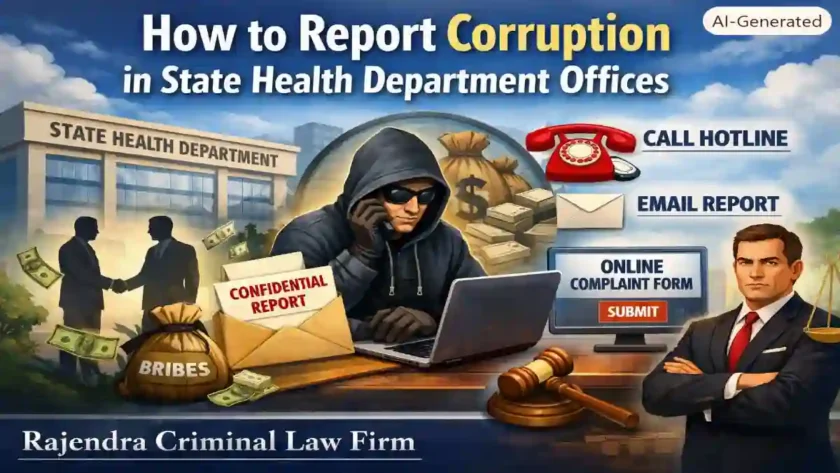
Report Corruption in State Health – Corruption within State Health Department offices affects public trust, healthcare delivery, and lawful governance. Therefore, citizens should report illegal demands without unnecessary delay. Common allegations include bribery, misuse of public funds, fraudulent procurement, illegal appointments, and abuse of official authority. Rajendra Criminal Law Firm assists complainants, whistleblowers, public servants, companies, NGOs, and NRIs facing corruption-related legal issues. Professional legal guidance strengthens complaint drafting and evidence preservation. Citizens should understand applicable criminal laws before initiating proceedings. The Prevention of Corruption Act, 1988, Bharatiya Nyaya Sanhita, 2023, Bharatiya Nagarik Suraksha Sanhita, 2023, and Bharatiya Sakshya Adhiniyam, 2023 provide an important legal framework. Proper documentation improves investigation quality. Timely reporting also protects public resources while promoting accountability. Courts, Special Judges, Vigilance authorities, Anti-Corruption Bureaus, Lokayuktas, and constitutional courts provide appropriate legal oversight where necessary.
How to Report Corruption in State Health Department Offices – Rajendra Criminal Law Firm
Legal Framework Governing Corruption Complaints
Indian law provides several statutory remedies against corruption involving public officials and government departments. Consequently, complainants should understand every available legal option before filing allegations. The Prevention of Corruption Act criminalizes bribery, criminal misconduct, and abuse of official position. Bharatiya Nyaya Sanhita addresses related offences involving forgery, cheating, criminal breach of trust, intimidation, and conspiracy wherever applicable. Bharatiya Nagarik Suraksha Sanhita governs investigation, arrest, search, seizure, and trial procedures. Bharatiya Sakshya Adhiniyam regulates admissibility and appreciation of evidence during criminal proceedings. Constitutional remedies remain available before High Courts and the Supreme Court. Citizens should avoid false accusations because malicious complaints may attract legal consequences. Professional criminal lawyers evaluate evidence carefully before initiating proceedings. Strong legal preparation improves credibility before investigating agencies and competent criminal courts.
Authorities Accepting Corruption Complaints
Different government authorities investigate corruption depending upon the nature of allegations and departmental jurisdiction. Accordingly, complainants should identify the appropriate authority before filing complaints. Serious allegations against public servants generally reach Vigilance Departments, Anti-Corruption Bureaus, Lokayuktas, or specialized investigating agencies. Local police stations may register cognizable offences whenever jurisdiction permits under applicable criminal law. Consider these authorities:
| Authority | Primary Function | Jurisdiction |
|---|---|---|
| State Vigilance Department | Departmental vigilance | State Government |
| Anti-Corruption Bureau | Corruption investigation | State Level |
| Lokayukta | Public servant complaints | State Jurisdiction |
| Police Station | Criminal investigation | Local Jurisdiction |
| Special Court | Corruption trials | Criminal Justice |
Correct forum selection accelerates investigation while reducing procedural complications. Legal advice helps determine the most appropriate authority according to applicable facts.
Evidence Required Before Filing a Complaint
Reliable evidence strengthens corruption complaints and supports lawful investigation by competent authorities. Therefore, complainants should preserve every relevant document immediately after discovering misconduct. Documentary records often provide valuable corroboration during investigation. Digital evidence should remain unaltered throughout legal proceedings. Useful supporting material generally includes:
- Written communications.
- Official letters and notices.
- Audio or video recordings obtained lawfully.
- Bank transaction records.
- Witness details.
- Tender documents.
- Medical procurement records.
- File movement records.
- Photographs where legally obtained.
- Electronic correspondence.
Evidence collection should always comply with applicable law. Professional legal review ensures documentary material remains admissible before criminal courts. Organized records also improve investigative efficiency while protecting complainants against unnecessary procedural objections.
Common Forms of Corruption in Health Departments
Health departments manage substantial public resources, procurement contracts, licensing activities, and recruitment processes. Hence, corruption allegations may arise across several administrative functions. Illegal gratification during hospital approvals creates serious criminal liability. Procurement fraud involving medicines, medical equipment, or infrastructure frequently attracts investigation. Fake billing, forged records, and financial irregularities may constitute criminal offences. Abuse of official authority affecting appointments, transfers, or public welfare schemes also requires immediate scrutiny. Companies and contractors sometimes encounter unlawful demands during licensing procedures. NGOs may identify irregularities while implementing government-funded healthcare projects. Whistleblowers should document factual circumstances carefully before approaching authorities. Where criminal conduct appears established, investigative agencies may initiate prosecution before Special Courts having jurisdiction under applicable criminal legislation.
Reporting Procedures and Legal Remedies Against Health Department Corruption
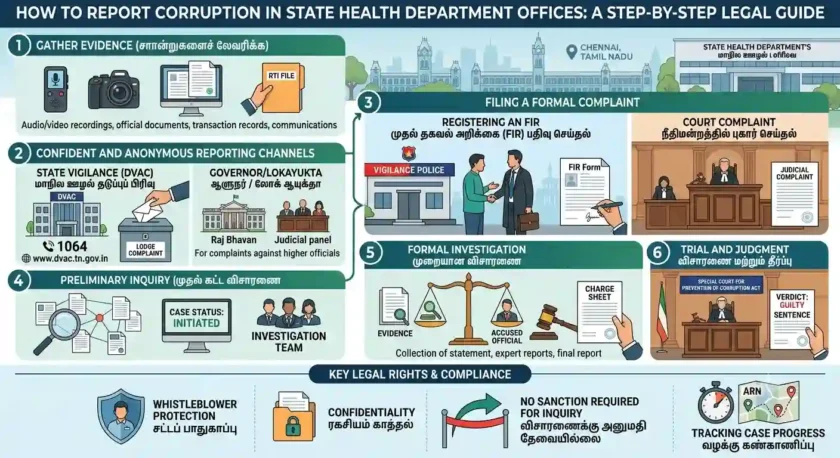
Citizens should follow structured legal procedures while reporting corruption involving State Health Department officials. Therefore, every complaint should present facts clearly without exaggeration or speculation. Complainants should identify the accused officer, describe the incident, specify dates, and attach supporting evidence. Authorities examine factual accuracy before initiating investigation. Anonymous complaints may receive limited consideration unless accompanied by credible material. Professional legal drafting strengthens complaint quality considerably. Timely reporting prevents destruction of evidence and protects public interest. Rajendra Criminal Law Firm assists complainants throughout investigation, prosecution, and judicial proceedings. Our lawyers also advise companies, NGOs, healthcare institutions, and NRIs regarding corruption-related legal risks. Effective legal representation enhances procedural compliance while safeguarding complainants against retaliatory actions. Proper legal strategy ultimately promotes transparent governance and accountability within public healthcare administration.
Complaint Filing Before Competent Authorities
Different complaints require different procedural approaches depending upon applicable statutes and departmental jurisdiction. Consequently, complainants should verify the competent authority before submitting allegations. Written complaints should include complete factual details supported by documentary evidence. Electronic complaint portals may also accept corruption reports where available. Authorities generally acknowledge complaints before initiating preliminary scrutiny. Investigating agencies may record witness statements and collect official records during inquiry. Citizens should preserve complaint acknowledgements carefully for future proceedings. Legal representatives monitor investigation progress and respond to procedural developments promptly. Where authorities fail to act lawfully, constitutional remedies may become available before jurisdictional High Courts. Professional legal guidance ensures compliance with procedural requirements while protecting complainants throughout criminal investigations and related administrative proceedings.
Legal Remedies Available to Complainants
Indian law provides several remedies against corruption involving public officials and government departments. Accordingly, complainants should evaluate every available legal option with professional assistance. Administrative remedies often complement criminal proceedings effectively. Courts also protect legitimate whistleblowers wherever applicable law permits. Common legal remedies include:
- Complaint before State Vigilance Department.
- Representation before Anti-Corruption Bureau.
- Complaint before Lokayukta.
- Criminal complaint before jurisdictional police station.
- Petition before Special Court where legally maintainable.
- Writ petition before the High Court.
- Appeal before higher judicial forums according to law.
- Departmental disciplinary proceedings against delinquent officials.
Strategic legal advice identifies the most effective remedy according to available evidence and applicable statutory provisions. Early legal intervention frequently improves investigation outcomes.
Investigation, Trial, and Judicial Forums
Corruption investigations follow statutory procedures ensuring fairness, transparency, and evidentiary compliance. Therefore, investigating agencies collect documentary evidence, financial records, electronic data, and witness statements carefully. Bharatiya Nagarik Suraksha Sanhita governs criminal investigation procedures wherever applicable. Bharatiya Sakshya Adhiniyam regulates admissibility and appreciation of documentary, oral, and electronic evidence. Special Courts constituted under the Prevention of Corruption Act conduct corruption trials. High Courts supervise constitutional legality through writ jurisdiction where necessary. The Supreme Court settles substantial questions of law affecting national importance. Civil Procedure Code may become relevant during connected civil proceedings arising from contractual or administrative disputes. Nearby police stations investigate cognizable offences according to territorial jurisdiction. Professional criminal lawyers represent complainants, accused persons, witnesses, and affected organizations throughout every procedural stage.
Preventive Compliance and Institutional Risk Management
Government departments, hospitals, contractors, suppliers, and healthcare institutions should establish strong compliance systems preventing corruption risks proactively. Hence, organizations should implement transparent procurement policies, internal audits, and ethical reporting mechanisms. Employee awareness programs strengthen institutional accountability significantly. Digital record management improves transparency while reducing opportunities for manipulation. Companies dealing with public healthcare authorities should maintain complete contractual documentation. NGOs administering healthcare projects should preserve financial records supporting every expenditure. Internal whistleblower mechanisms encourage early reporting before misconduct escalates. Periodic legal compliance reviews identify regulatory weaknesses requiring corrective action. Rajendra Criminal Law Firm advises organizations regarding anti-corruption compliance, internal investigations, criminal defence, departmental proceedings, and regulatory risk management. Preventive legal planning protects institutional reputation while strengthening lawful public administration and responsible healthcare governance.
Rajendra Criminal Law Firm’s Criminal Law Expertise
Reporting corruption requires careful legal strategy, credible evidence, and strict procedural compliance. Therefore, Rajendra Criminal Law Firm provides comprehensive criminal law services for corruption-related matters across India. Our advocates advise individuals, companies, NGOs, healthcare professionals, public servants, and NRIs regarding complaint preparation, evidence preservation, and legal remedies. We draft detailed complaints supported by statutory provisions and documentary evidence. Our team also represents clients before Vigilance Departments, Anti-Corruption Bureaus, Lokayuktas, Police Authorities, Special Courts, High Courts, and the Supreme Court. Legal assistance extends to anticipatory bail, regular bail, criminal defence, departmental proceedings, and constitutional remedies wherever necessary. Early legal consultation minimizes procedural mistakes while strengthening legitimate complaints. Our practical legal approach protects clients’ rights and promotes accountability within public institutions through effective representation and strategic criminal litigation.
Why Choose Rajendra Criminal Law Firm
Experienced criminal lawyers provide significant advantages during corruption investigations and related judicial proceedings. Moreover, professional legal guidance improves procedural compliance and evidentiary presentation. Rajendra Criminal Law Firm carefully evaluates every complaint before initiating legal action. Our advocates examine documentary evidence, electronic records, witness statements, and statutory provisions comprehensively. Clients receive strategic advice regarding investigation procedures, prosecution, defence, departmental inquiries, and appellate remedies. We also assist organizations in strengthening anti-corruption compliance frameworks. Regular legal updates keep clients informed about amendments affecting criminal investigations and public administration. Transparent communication ensures confidence throughout every legal stage. Strong courtroom advocacy protects clients before Special Courts, Sessions Courts, High Courts, and the Supreme Court. Practical legal solutions reduce unnecessary litigation while safeguarding constitutional rights and ensuring fair criminal justice administration.
Conclusion
Corruption within State Health Department offices undermines public confidence and weakens essential healthcare administration. Consequently, timely reporting supported by reliable evidence serves both individual rights and public interest. Citizens should understand applicable criminal laws before approaching investigative authorities. Proper documentation significantly improves investigation quality and judicial outcomes. Professional legal guidance strengthens complaint preparation while minimizing procedural risks. The Prevention of Corruption Act, Bharatiya Nyaya Sanhita, Bharatiya Nagarik Suraksha Sanhita, and Bharatiya Sakshya Adhiniyam provide an effective legal framework. Courts, Vigilance authorities, Anti-Corruption Bureaus, Lokayuktas, and nearby police stations perform important statutory functions. Rajendra Criminal Law Firm offers comprehensive legal support from complaint drafting through final judicial proceedings. Our dedicated representation protects legal rights while promoting transparency, accountability, and lawful governance throughout India’s public healthcare system.
Frequently Asked Questions
Q1. How can I report corruption in a State Health Department office?
Answer: Submit a detailed complaint with supporting evidence before the State Vigilance Department, Anti-Corruption Bureau, Lokayukta, or jurisdictional police authority.
Q2. What evidence should support a corruption complaint?
Answer: Preserve documents, electronic records, financial transactions, communications, witness details, photographs, and other legally obtained evidence supporting the allegations.
Q3. Can I complain anonymously about corruption?
Answer: Anonymous complaints may receive limited consideration. However, credible evidence substantially improves the possibility of a lawful investigation and appropriate action.
Q4. Which court hears corruption cases against public servants?
Answer: Special Courts constituted under the Prevention of Corruption Act generally conduct corruption trials, subject to applicable jurisdiction and statutory provisions.
Q5. Can companies and NGOs report corruption involving government officials?
Answer: Yes. Companies, NGOs, contractors, healthcare institutions, and affected organizations may file legally supported complaints before competent authorities.
Q6. Why should I engage Rajendra Criminal Law Firm?
Answer: Our firm provides strategic criminal defence, complaint drafting, investigation support, court representation, bail assistance, and corruption litigation before all competent forums.
Read More
- Complaint Process for State Education Department Officials
- Accused in a Cybercrime You Didn’t Commit? 5 Urgent Steps to Take
- POCSO Defence: What Most Parents Don’t Know Until It’s Too Late
- Top 10 Reasons People Lose Criminal Cases – And How We Fix That
- NDPS Bail in Tamil Nadu: How our Senior Advocates Has Fought Complex Cases
- Central Vigilance Commission (CVC)