

An arrest can be one of the most frightening moments in a person’s life. Suddenly, everything feels uncertain. Questions rush in. What will happen next? What should you say? Who can help you? Most importantly, what are your legal rights after an arrest in India?
At Rajendra Criminal Law Firm, we strongly believe that knowledge is power. Therefore, this step-by-step guide explains your rights clearly and simply. Whether you are an individual, a family member, or someone helping an accused person, this article will help you stay calm, confident, and legally protected.
Your Rights After an Arrest in India: A Step-by-Step Legal Guide – Rajendra Criminal Law Firm
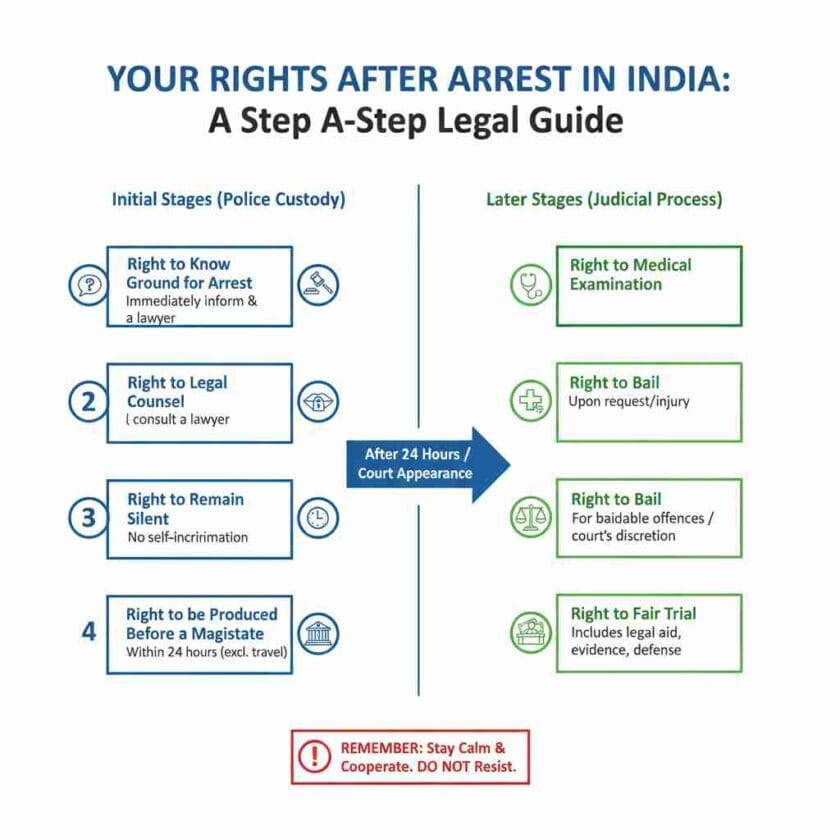
Step 1: Understand What an Arrest Really Means
First of all, an arrest is not a conviction. The police arrest a person to ensure investigation, prevent escape, or stop further offence. However, an arrest does not mean you are guilty.
Under Indian law, the police must follow strict procedures. If they fail to do so, the arrest itself can become illegal. Hence, understanding the legal process from the beginning is crucial.
Step 2: Right to Know the Grounds of Arrest
Immediately after arrest, you have the right to know why you are being arrested. According to Article 22(1) of the Constitution of India and the Criminal Procedure Code (CrPC), the police must clearly inform you of the charges or reasons.
Moreover, in case of a non-cognizable offence, the police cannot arrest without a warrant. Therefore, always ask politely but firmly about the reason for arrest.
Step 3: Right to Legal Representation
Next and most importantly, you have the right to consult and be defended by a lawyer of your choice. You do not need permission from the police to contact a lawyer.
If you cannot afford a lawyer, the State must provide free legal aid. This right ensures that no one is left helpless during the legal process.
At Rajendra Criminal Law Firm, we often advise clients to speak to a lawyer immediately and avoid giving statements without legal guidance.
Step 4: Right to Remain Silent
Another vital right is the right against self-incrimination. This means you are not bound to answer questions that may harm your case.
While you must cooperate with basic identification, you do not have to confess or explain anything under pressure. Remember, silence cannot be treated as guilt.
Therefore, stay calm, respectful, and assert your rights politely.
Step 5: Right to Inform a Friend or Relative
After arrest, the police must inform one friend, family member, or well-wisher about your arrest and place of detention.
This safeguard prevents illegal detention and ensures transparency. Additionally, the police must record this information in the station diary.
As a result, your family can take immediate steps to arrange legal help.
Step 6: Right to Medical Examination
Every arrested person has the right to a medical examination. This right protects you from custodial violence or ill-treatment.
If you feel unwell or injured, you can demand a medical check-up by a government doctor. The medical report becomes an important legal record.
Furthermore, women must be examined only by female medical practitioners.
Step 7: Special Rights for Women After Arrest
Indian law provides extra safeguards for women. Generally, women cannot be arrested at night, except in exceptional circumstances with written permission from a magistrate.
Additionally, women have the right to be searched only by female police officers and detained separately.
These protections ensure dignity, safety, and fairness during the arrest process.
Step 8: Rights of Juveniles and Older People
If the arrested person is a juvenile (below 18 years), the police must follow the Juvenile Justice Act. Children cannot be kept in police lock-ups and must be produced before the Juvenile Justice Board.
Similarly, Older people, sick persons, and disabled individuals deserve special care and humane treatment during custody.
Step 9: Right to Be Produced Before a Magistrate
Within 24 hours of arrest, the police must produce the accused before the nearest magistrate. This time excludes travel time.
The magistrate reviews whether the arrest is lawful and decides on police custody, judicial custody, or bail. If the police fail to follow this rule, the detention becomes illegal.
Therefore, this step acts as a crucial check on police power.
Step 10: Understanding Police Custody vs Judicial Custody
Many people confuse these terms. Police custody means the accused stays with the police for interrogation. Judicial custody means the accused stays in jail under court supervision.
Police custody is usually granted for limited days and only when necessary. A lawyer can argue strongly against unnecessary police custody.
Step 11: Right to Apply for Bail
Bail is not a privilege; it is a legal right in many cases. In bailable offences, bail must be granted as a matter of right. In non-bailable offences, bail depends on judicial discretion.
Factors such as nature of offence, criminal history, and cooperation matter. Early legal advice increases your chances of bail significantly.
At Rajendra Criminal Law Firm, we focus on quick and effective bail strategies to protect personal liberty.
Step 12: Protection Against Illegal Arrest and Custodial Abuse
If police violate your rights, courts take such misconduct seriously. Illegal arrest, torture, or harassment can lead to departmental action and compensation.
The Supreme Court has issued clear arrest guidelines in the D.K. Basu case, which every police officer must follow.
Therefore, knowing your rights helps prevent abuse and strengthens your legal defence.
Step 13: Rights During Interrogation
During questioning, you have the right to meet your lawyer at intervals, though not throughout interrogation.
The police cannot use force, threats, or inducement. Any confession made to police has no evidentiary value unless recorded before a magistrate.
Thus, never sign documents without understanding them.
Step 14: Rights of NRIs and Foreign Nationals
NRIs and foreign nationals have additional rights. The police must inform their consulate or embassy after arrest.
Language barriers, travel restrictions, and passport issues require special legal handling. Therefore, experienced legal representation becomes even more important.
Step 15: What Family Members Should Do After an Arrest
Family members should immediately contact a criminal lawyer, gather arrest details, and arrange bail documents.
Avoid panic. Instead, act quickly and legally. Early intervention often changes the outcome of the case.
Why Early Legal Help Matters
Every minute after arrest matters. Delayed legal advice can lead to unnecessary custody, harsh conditions, or weak defence.
At Rajendra Criminal Law Firm, we provide immediate legal support, bail assistance, court representation, and rights protection at every stage.
Frequently Asked Questions
After arrest, stay calm and cooperate without resisting. First, ask the police to clearly state the grounds of arrest. Then, exercise your right to contact a lawyer and inform a family member or friend. Avoid making any forced statements.
Yes, police can arrest without a warrant in cognizable offences. However, they must still follow legal procedures, inform you of the reasons, and produce you before a magistrate within 24 hours.
No. Any confession made to police is not admissible in court. Only confessions made voluntarily before a magistrate have legal value under Indian law.
In bailable offences, you have a legal right to bail. In non-bailable offences, bail depends on the court’s discretion, nature of the offence, and surrounding facts.
Women have special protections. They should not be arrested at night, must be searched by female officers, and have the right to dignity and medical care at all times.
Conclusion: Your Rights Are Your Shield
An arrest does not end your life, reputation, or future. Indian law strongly protects personal liberty, dignity, and fairness.
However, rights work best when you know them and assert them calmly. With proper legal guidance, you can face the situation with confidence.
If you or your loved one faces arrest, remember—you are not alone. Rajendra Criminal Law Firm stands ready to protect your rights and guide you through every legal step.
Read More
- How to Fight a Cheque Bounce Case: A Guide to Section 138 NI Act
- Professional FEMA Compliance Services for Businesses & NRIs
- Chennai’s No.1 FEMA Consultancy for RBI, ODI & FDI Compliance
- Understanding Cyber Crime Laws in India: A Victim and Accused Guide
- The Complete Guide to Bail in India: Process, Types, and Your Rights
- civil vs criminal law differences
- NHRC (National Human Rights Commission) Guidelines (PDF)