

Introduction: Building a Strong Defense Against Tax Evasion Allegations
Tax Evasion Defense Requires Early Legal Review
Understanding Tax Evasion Allegations
Compliance Failures Can Become Criminal Proceedings
Tax compliance protects taxpayers from assessment disputes, penalties, prosecution, and tax evasion charges. Therefore, businesses and individuals should address discrepancies before they become criminal allegations. Tax evasion generally involves deliberate conduct intended to conceal taxable income or evade lawful tax obligations. However, every tax mismatch does not automatically establish criminal intent. Authorities may examine returns, books, bank records, invoices, statements, digital records, and third-party information. Consequently, a taxpayer needs a structured defense based on documents, explanations, and applicable statutory provisions. The Income Tax Act, 2025 now governs tax years beginning from 1 April 2026. Proceedings concerning earlier tax years generally continue under the Income Tax Act, 1961 through transitional provisions. (Income Tax Department) A criminal defense lawyer can coordinate with tax professionals while protecting procedural rights. Key legal issues may include suppression allegations, false statements, unexplained transactions, inaccurate returns, and alleged fraudulent claims.
Keywords for Tax Evasion Defense
- tax evasion defense lawyer in Chennai
- tax evasion criminal case defense
- income tax prosecution lawyer Chennai
- tax compliance legal advice
- tax fraud defense advocate
- Income Tax Department prosecution
- tax evasion notice response
- income tax search and seizure defense
- tax penalty and prosecution defense
- tax investigation lawyer Chennai
- prosecution under Income Tax Act
- tax evasion bail assistance
- economic offences defense
- tax appeal lawyer Chennai
- Income Tax Appellate Tribunal representation
- High Court tax prosecution petition
- tax compliance investigation
- false income tax statement defense
- undisclosed income defense
- unexplained transaction defense
- tax litigation advocate Chennai
- criminal tax litigation India
- tax prosecution legal remedies
- tax department summons response
- assessment dispute defense
- reassessment proceedings defense
- tax records and digital evidence
- tax fraud investigation response
- tax compounding application assistance
- Chennai tax criminal lawyer
These keywords should appear naturally throughout the page rather than through repetitive keyword stuffing. Furthermore, search engines increasingly value clear answers, topical depth, entity relevance, and useful legal explanations. Accordingly, headings should address actual taxpayer questions.
Understanding Tax Evasion Charges Under Indian Law
Difference Between Tax Disputes and Criminal Allegations
Assessment Disputes Need Separate Legal Analysis
A Tax Addition Does Not Automatically Mean Evasion
A tax assessment can create additional liability without automatically establishing a criminal offence. The Assessing Officer may make additions because documents remain incomplete or explanations appear insufficient. However, criminal prosecution involves separate statutory requirements and procedural safeguards. Taxpayers should therefore distinguish assessment proceedings, penalty proceedings, and prosecution proceedings. This distinction helps lawyers develop a focused defense strategy. For earlier tax years, the Income Tax Act, 1961 can continue governing proceedings after 1 April 2026. The Income Tax Department confirms that proceedings involving tax years beginning before that date continue under transitional provisions. (Income Tax Department) For tax years beginning from 1 April 2026, the Income Tax Act, 2025 applies. Therefore, the applicable statute should be identified before preparing any response. A lawyer should review the notice, assessment year, alleged conduct, evidence, and statutory provision before advising the taxpayer.
Common Forms of Alleged Tax Evasion
Undisclosed Income and False Statements
Authorities may investigate several forms of suspected tax non-compliance. These allegations can arise from return discrepancies, unexplained credits, concealed assets, inaccurate declarations, or unsupported deductions. Moreover, information can originate from financial institutions, reporting entities, business records, or digital information. Common allegations may involve:
- Suppression of taxable receipts or income.
- Incorrect or fabricated supporting documents.
- Unexplained cash deposits or financial transactions.
- False statements submitted during proceedings.
- Improper claims for deductions, exemptions, or losses.
- Failure to comply with statutory reporting requirements.
The defense should address each allegation separately instead of providing a broad denial. Supporting evidence can include invoices, contracts, bank statements, ledgers, tax returns, correspondence, audit reports, and accounting records. Additionally, professional advice may help distinguish accounting errors from intentional conduct.
Statutory Framework and Criminal Liability
Income Tax Prosecution and Applicable Provisions
Old Act Proceedings Require Transitional Analysis
Tax prosecution can arise under specific provisions of the income-tax legislation. Historically, sections 276C and 277 of the Income Tax Act, 1961 addressed wilful attempts to evade tax and false statements. The Income Tax Act, 2025 replaces the 1961 framework from 1 April 2026. However, the Department confirms that earlier tax-year proceedings continue under the repealed Act through savings provisions. (Income Tax Department) Consequently, lawyers should never apply new provisions mechanically to an older assessment year. The relevant tax year, notice date, proceeding type, and statutory transition provision require careful review. Recent legislative materials also contain amendments affecting prosecution-related provisions. (Income Tax Department) Therefore, current legal advice should rely on the applicable enacted provision and effective date. A defense lawyer can examine whether the alleged conduct satisfies every statutory ingredient required for prosecution. This approach helps identify factual, procedural, evidentiary, and jurisdictional defenses.
False Statements and Evidentiary Issues
False statement allegations can create significant criminal exposure when authorities allege deliberate misrepresentation. However, the prosecution must establish the relevant statutory ingredients through admissible evidence. The Bharatiya Sakshya Adhiniyam, 2023 governs evidence law from 1 July 2024. It specifically recognizes electronic and digital records subject to statutory requirements. (India Code) Therefore, emails, accounting software records, electronic invoices, messages, spreadsheets, and digital ledgers may become relevant. Lawyers should preserve original records and document their source and context. Furthermore, unexplained alterations or incomplete exports can create avoidable evidentiary disputes. A proper defense therefore examines both the substantive allegation and the evidence supporting it. Where appropriate, counsel can challenge unreliable documents, incomplete records, unsupported assumptions, or improperly interpreted financial data.
Investigation, Summons, Searches and Evidence
Responding to Income Tax Department Proceedings
Handling Notices and Summons Carefully
Initial Notice Review
A tax investigation often begins with a notice, questionnaire, summons, verification communication, or information request. Taxpayers should avoid ignoring official communications because missed deadlines can complicate later defense efforts. First, counsel should identify the issuing authority, statutory provision, tax year, response deadline, and requested documents. Next, the taxpayer should preserve all relevant financial and electronic records. The response should remain factual and consistent with the underlying accounts. Furthermore, unsupported explanations should not replace documentary evidence. A lawyer may coordinate with a chartered accountant when accounting reconstruction becomes necessary. However, legal representation remains important when the matter contains prosecution risks. The response should also avoid unnecessary admissions or speculative statements. A carefully prepared response can clarify genuine mistakes while preserving the taxpayer’s legal position. Therefore, early representation can help prevent an administrative discrepancy from developing into a wider criminal dispute.
Search and Seizure Defense
Search and seizure proceedings require immediate attention because authorities may collect extensive financial and digital material. Lawyers should examine the authorization, scope, procedure, inventory, statements, seized documents, and subsequent notices. The defense strategy may involve challenging procedural irregularities where legally sustainable. Additionally, counsel should preserve copies of available records and maintain a detailed chronology. The taxpayer should avoid destroying, altering, or concealing evidence after receiving official communications. Such conduct can create additional legal complications. A practical defense file should contain:
- Search authorization and related communications.
- Seizure inventories and panchnamas.
- Statements recorded during proceedings.
- Bank statements and accounting ledgers.
- Digital records and device information.
- Earlier returns and assessment orders.
Consequently, evidence management becomes central to both tax litigation and criminal defense. The Income Tax Department’s transitional guidance also explains that searches initiated before 1 April 2026 can remain governed by the earlier framework. (Income Tax Department)
Responding to Departmental Summons
A summons requires careful attention because it can demand attendance, documents, or information. The taxpayer should verify its authenticity and statutory basis before responding. Thereafter, counsel can determine whether personal attendance, written submissions, or document production is required. Lawyers should prepare the taxpayer before any statement is recorded. The preparation should focus on factual accuracy and consistency with existing records. Moreover, taxpayers should avoid guessing answers when they genuinely lack information. They can explain that additional records require verification before providing a complete response. Counsel can also organize documents according to the questions raised by the authority. This approach reduces confusion during lengthy investigations. If multiple entities or family members are involved, lawyers should separately analyze each person’s role. Therefore, individualized representation can prevent one person’s accounting explanation from being incorrectly attributed to another person.
Forums, Courts and Authorities
Income Tax Authorities and Appellate Forums
Assessing Officer and Principal Authorities
The Assessing Officer generally plays a central role in assessment and related tax proceedings. Depending on the matter, taxpayers may also interact with senior departmental authorities, appellate authorities, and specialized forums. The Income Tax Department provides dedicated processes for assessments, reassessments, appeals, revisions, penalties, and tax forms. (Income Tax Department) Therefore, the correct forum depends upon the specific order and statutory remedy. A tax lawyer should identify whether the immediate issue concerns assessment, reassessment, penalty, prosecution, or recovery. These categories can involve different limitation periods and procedural requirements. Furthermore, criminal prosecution may proceed separately from the underlying tax dispute. Accordingly, taxpayers should not assume that filing an income-tax appeal automatically resolves every criminal consequence. Legal strategy should coordinate the tax and criminal sides without confusing their distinct procedures.
Income Tax Appellate Tribunal and Higher Courts
The Income Tax Appellate Tribunal can hear specified tax appeals arising from departmental and appellate orders. Further remedies may involve the High Court when statutory requirements for substantial questions of law are satisfied. The Supreme Court can become relevant in matters reaching the highest appellate jurisdiction. Meanwhile, criminal proceedings may involve competent criminal courts and constitutional jurisdiction before the High Court. The appropriate remedy depends upon the impugned order, statutory provision, procedural stage, and relief sought. Therefore, taxpayers should obtain advice before selecting a forum. A defective filing can create limitation problems or unnecessary litigation. Lawyers should examine whether the matter requires appeal, revision, rectification, stay, writ proceedings, discharge, bail, or another statutory remedy. Consequently, forum selection should form part of the initial defense strategy rather than an afterthought.
Criminal Procedure and Defense Strategy
BNSS, BNS and BSA in Tax-Related Cases
Understanding the New Criminal Laws
Bharatiya Nagarik Suraksha Sanhita
The Bharatiya Nagarik Suraksha Sanhita, 2023 replaced the Code of Criminal Procedure framework from 1 July 2024. It consolidates criminal procedure and contains provisions governing investigation, arrest, bail, inquiry, trial, and related processes. (India Code) However, tax prosecution primarily depends upon the special tax statute creating the alleged offence. Therefore, lawyers must determine how the special legislation interacts with general criminal procedure. BNSS provisions can become relevant where criminal courts consider arrest, custody, bail, investigation, evidence collection, or trial procedure. Counsel should assess whether arrest is legally necessary and whether procedural safeguards apply. The BNSS also contains statutory requirements concerning arrest decisions in specified circumstances. (India Code) Consequently, taxpayers facing criminal proceedings should obtain prompt legal advice rather than treating a tax notice as an ordinary accounting issue.
Bharatiya Nyaya Sanhita
The Bharatiya Nyaya Sanhita, 2023 is India’s principal general penal statute from 1 July 2024. It consolidates and amends laws relating to offences and related matters. (India Code) Yet tax offences often arise under special fiscal legislation rather than automatically under BNS. Therefore, lawyers must identify the exact charging provisions before describing the alleged offence. Other criminal allegations can sometimes arise from the factual circumstances surrounding financial transactions. For example, separate allegations may involve cheating, forgery, conspiracy, or document-related misconduct when supported by applicable facts. However, such allegations require independent legal analysis. A defense lawyer should avoid assuming that every accounting irregularity constitutes a BNS offence. Instead, counsel should map each allegation against its statutory ingredients and available evidence. This approach keeps the defense focused on legally relevant facts and avoids unnecessary criminal exposure.
Bharatiya Sakshya Adhiniyam and Digital Evidence
Digital evidence increasingly affects tax investigations because financial records now exist across electronic platforms. The Bharatiya Sakshya Adhiniyam recognizes electronic or digital records subject to its statutory conditions. (India Code) Consequently, taxpayers should preserve original electronic records rather than relying solely upon printed summaries. Relevant material can include accounting databases, emails, invoices, payment records, cloud files, messaging applications, and audit trails. Furthermore, metadata and system logs can help establish chronology and authenticity. Lawyers should examine how authorities obtained, preserved, interpreted, and presented digital evidence. Where appropriate, technical experts may assist with forensic examination. A defense can challenge evidentiary gaps when the prosecution cannot establish the required legal foundation. Therefore, digital evidence preservation should begin immediately after receiving a serious tax investigation notice.
Legal Remedies and Defense Measures
Building a Structured Tax Defense
Assessment and Reassessment Remedies
Taxpayers can use statutory remedies against assessment and reassessment actions when the applicable legislation permits them. These remedies can include objections, appeals, rectification, revision, stay applications, and further appellate proceedings. The exact remedy depends on the order and applicable tax year. The Income Tax Department confirms that reassessment provisions under the Income Tax Act, 2025 apply to Tax Year 2026-27 onward. (Income Tax Department) Earlier tax years remain subject to the old Act under transitional provisions. Therefore, limitation and forum selection require careful calculation. A lawyer should review the notice date, service date, assessment year, order date, and statutory deadline. Moreover, the defense should distinguish factual disputes from legal interpretation issues. A well-prepared appeal should identify each disputed addition and connect supporting evidence with the applicable statutory provision.
Penalty and Prosecution Defense
Penalty proceedings and prosecution proceedings can have different legal consequences and require separate strategies. A taxpayer should therefore avoid assuming that payment of tax automatically eliminates every prosecution risk. Depending on the applicable law, statutory immunity, compounding, settlement, or other relief may be available. Recent legislative materials concerning the Income Tax Act, 2025 address immunity from penalty and prosecution under specified conditions. (Income Tax Department) However, eligibility depends upon the statutory requirements and factual circumstances. Counsel should examine whether the taxpayer qualifies for any available relief. Additionally, the defense should address intent, evidence, procedural compliance, disclosure history, and the precise statutory ingredients. If prosecution has commenced, the lawyer should evaluate available criminal remedies at the relevant procedural stage. Thus, coordinated tax and criminal representation can reduce inconsistent positions across proceedings.
Bail and Criminal Court Remedies
Where an applicable tax prosecution creates arrest or custody concerns, immediate criminal-law advice becomes important. Counsel should determine the alleged offence, court jurisdiction, arrest status, summons history, and statutory procedure. Depending on the circumstances, available remedies may include anticipatory bail, regular bail, discharge, quashing, revision, or constitutional relief. The precise remedy depends upon the governing statute and procedural stage. Furthermore, lawyers should distinguish a departmental summons from a criminal arrest warrant. These documents carry different legal consequences. A taxpayer should also maintain all correspondence with investigators and counsel. Therefore, a chronological case file can assist the defense during urgent hearings. Criminal courts evaluate cases according to applicable law and evidence, while tax forums address statutory tax disputes. Coordinating both proceedings can help prevent contradictory factual positions.
Practical Compliance Measures and Local Legal Support
Preventing Escalation Through Better Compliance
Documentation and Internal Controls
Maintaining Reliable Tax Records
Strong records provide the foundation for effective tax compliance and defense. Businesses should maintain invoices, contracts, bank statements, ledgers, payroll records, expense documents, tax returns, audit reports, and statutory filings. Furthermore, internal controls should identify unusual transactions before filing returns. Regular reconciliation can reveal mismatches between books, bank records, reported turnover, and third-party information. Businesses should also preserve supporting documents according to applicable retention requirements. When an error appears, management should obtain professional advice before changing records retrospectively. Corrections should remain transparent and properly documented. Therefore, tax compliance should operate as an ongoing process rather than an annual filing exercise. Companies can also conduct periodic legal reviews when transactions involve related parties, international payments, substantial cash movement, or complex structures. Such measures can reduce preventable disputes and strengthen the evidentiary foundation of any future defense.
Internal Tax Compliance Checklist
An internal compliance checklist can help taxpayers identify weaknesses before authorities raise questions. The checklist should cover reporting, documentation, reconciliations, approvals, and statutory deadlines. Additionally, senior management should review significant tax positions periodically. A practical checklist may include:
- Reconcile books with bank and financial records.
- Verify reported income against invoices and contracts.
- Review deductions and supporting documents.
- Check TDS and other withholding obligations.
- Reconcile third-party information and tax statements.
- Preserve electronic records and audit trails.
- Track notices and response deadlines.
- Obtain legal advice for high-risk transactions.
These measures do not guarantee that authorities will never raise a query. However, they can improve accuracy and response quality. The Income Tax Department continues to provide dedicated online resources for returns, forms, TDS, reassessment, appeals, and related compliance processes. (Income Tax Department)
Police Stations and Criminal Complaints
Tax disputes generally involve specialized tax authorities and statutory forums rather than ordinary police stations. However, a related criminal complaint may sometimes create interaction with police authorities. The taxpayer should identify whether the allegation arises directly from tax legislation or from separate criminal provisions. Nearby Chennai police stations should not become the default forum for every tax dispute. Instead, counsel should determine the competent authority from the complaint, statute, and alleged offence. If police involvement occurs, taxpayers should preserve the complaint copy, notices, summons, and relevant correspondence. Furthermore, they should avoid informal statements that conflict with formal tax submissions. Legal counsel can assess whether the matter requires police representation, criminal court proceedings, or parallel tax litigation. Consequently, forum identification remains essential for protecting procedural rights and avoiding unnecessary confusion.
Integrated Legal Support from Rajendra CriminalLaw Firm
Coordinating Tax and Criminal Representation
Tax Investigation and Prosecution Assistance
Rajendra CriminalLaw Firm can structure legal support around the actual stage of the tax dispute. Assistance may begin with notice analysis and document review. It can then extend to departmental representation, prosecution defense, criminal court proceedings, bail strategy, and appellate remedies. The legal team can coordinate with tax professionals where accounting analysis is necessary. Furthermore, counsel can develop a chronology connecting transactions, notices, statements, assessments, and evidence. This chronology can expose factual inconsistencies or clarify legitimate explanations. Legal support may cover:
- Tax evasion allegation assessment.
- Income-tax summons preparation.
- Search and seizure response.
- Prosecution and penalty strategy.
- Criminal court representation.
- Bail and procedural remedies.
- Digital evidence review.
- Appeals and higher-court proceedings.
The appropriate service depends upon the facts and applicable law. Therefore, taxpayers should provide complete information before selecting a defense strategy. Early consultation can help preserve evidence and identify procedural deadlines.
Chennai Jurisdiction and Court Representation
Chennai taxpayers may face proceedings involving Income Tax Department offices, appellate authorities, tribunals, criminal courts, and the Madras High Court. Jurisdiction depends upon the taxpayer, assessment, authority, statutory provision, and nature of proceedings. Therefore, a lawyer should verify territorial and statutory jurisdiction before filing any proceeding. The Income Tax Appellate Tribunal may handle eligible tax appeals, while the High Court can exercise jurisdiction in matters meeting applicable statutory or constitutional requirements. Criminal proceedings may involve the competent criminal court depending upon the offence and procedural framework. Moreover, different proceedings can progress simultaneously. A coordinated strategy should therefore maintain consistency between tax submissions and criminal pleadings. This is particularly important where statements, accounting records, and digital evidence overlap. Consequently, Chennai-based legal representation can assist taxpayers who need coordinated handling across tax and criminal forums.
Government Departments and Relevant Authorities
Tax compliance matters can involve multiple government bodies depending upon the transaction and allegation. The Income Tax Department remains central to direct-tax administration. The Central Board of Direct Taxes oversees direct-tax administration and policy functions. Other authorities may become relevant when allegations involve corporate filings, customs, GST, financial transactions, or suspected proceeds. Therefore, lawyers should identify every authority involved before deciding the defense scope. The applicable statute also determines the authority’s investigative and adjudicatory powers. Furthermore, taxpayers should verify official communications through authorized government channels. The Income Tax Department’s official portal provides current information regarding the Income Tax Act, 2025, forms, appeals, reassessment, and compliance. (Income Tax Department) Proper authority identification helps prevent missed deadlines and incorrect responses.
Complete Legal Remedy Roadmap
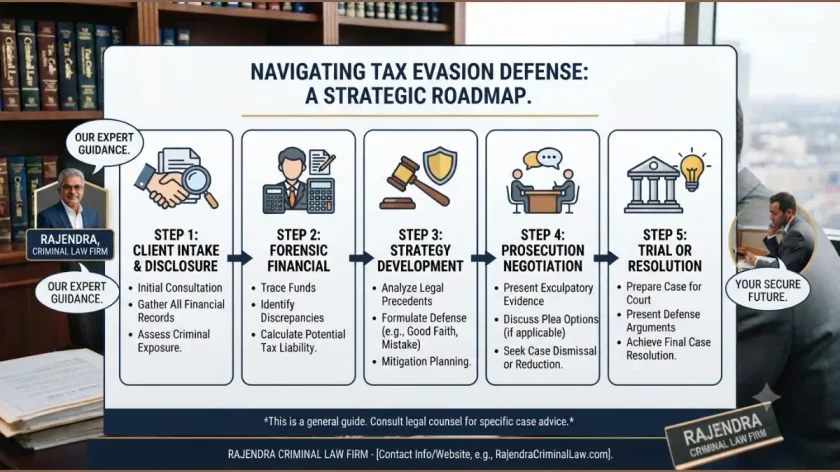
A tax evasion defense should follow a structured roadmap rather than isolated responses. First, lawyers should identify the applicable tax year and governing legislation. Second, they should classify the matter as assessment, penalty, prosecution, or another proceeding. Third, counsel should preserve relevant evidence and establish a factual chronology. Fourth, the lawyer should identify the correct forum and limitation period. Fifth, the defense should address the statutory ingredients of each allegation. Finally, counsel should evaluate available remedies and future compliance measures. The roadmap can include:
| Stage | Key Legal Action | Possible Forum |
|---|---|---|
| Notice | Review and response | Income Tax Authority |
| Assessment | Evidence and objections | Tax Authority |
| Appeal | Challenge disputed findings | Appellate Authority |
| Tax Appeal | Legal and factual grounds | ITAT |
| Prosecution | Criminal defense | Competent Criminal Court |
| Constitutional Remedy | Procedural or jurisdictional challenge | High Court |
| Further Appeal | Statutory issues | Supreme Court |
This sequence supports informed decision-making without treating every case identically.
Why Early Legal Representation Matters
Early legal representation can help taxpayers avoid inconsistent explanations and prevent avoidable procedural mistakes. A lawyer can review the first notice before the taxpayer makes substantive admissions. Furthermore, early evidence preservation can protect records that may later become important in court. Counsel can also coordinate tax, accounting, forensic, and criminal-law inputs. If the matter progresses to prosecution, the defense already has an organized factual record. Additionally, early review may identify statutory remedies before limitation periods expire. Taxpayers should therefore treat serious tax allegations as legal matters rather than routine accounting queries. The defense should remain truthful, evidence-based, and consistent with the applicable law. Ultimately, the objective is to protect procedural rights while addressing legitimate tax obligations. Rajendra CriminalLaw Firm can assist with tax investigation defense, prosecution representation, criminal litigation, and related legal remedies in Chennai and applicable jurisdictions.
Frequently Asked Questions
Can a Tax Dispute Become a Criminal Case?
A tax dispute can involve criminal prosecution when statutory ingredients exist. However, an assessment addition alone does not automatically establish criminal liability.
Does the Income Tax Act, 2025 Apply to Older Tax Years?
Generally, earlier tax years remain governed by the 1961 Act under transitional provisions. The Department confirms this continuation after 1 April 2026.
Can I Challenge a Tax Evasion Prosecution?
A taxpayer can explore available statutory and criminal remedies based on the case stage. These may include appeals, discharge, bail, revision, or High Court relief.
Is BNS Applicable to Every Tax Evasion Case?
Not automatically. Tax offences generally arise under special tax legislation. BNS may become relevant only where separate offences satisfy its statutory requirements.
Can Digital Tax Records Be Used in Court?
Yes. The Bharatiya Sakshya Adhiniyam recognizes electronic and digital records subject to statutory requirements. Proper preservation and authentication can therefore become important.
Why Hire a Criminal Lawyer for Tax Evasion Charges?
Criminal prosecution can create consequences beyond tax liability. A criminal lawyer can address prosecution strategy, evidence, bail, court proceedings, and coordination with tax litigation.