
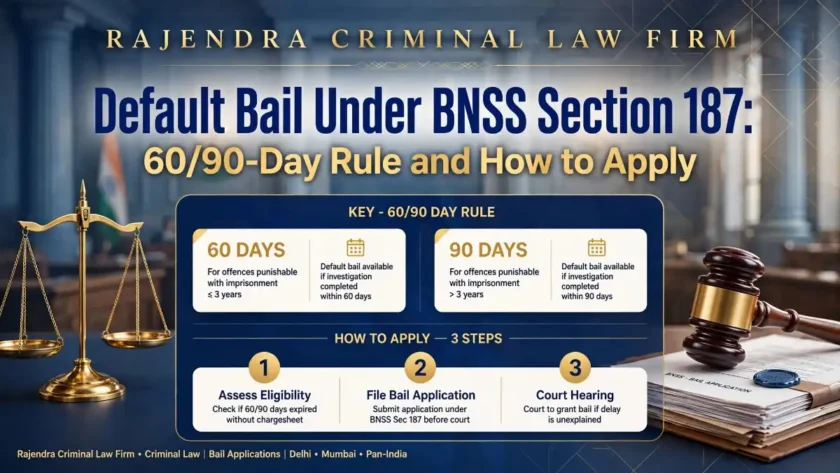
Default bail (also called statutory bail) is the right of an arrested person to be released on bail if the police fail to file a charge sheet within 60 or 90 days of remand. Under the Bharatiya Nagarik Suraksha Sanhita, 2023 (BNSS), this right is found in Section 187, which replaced Section 167 of the Code of Criminal Procedure. Meanwhile, The right is not a favour from the court. It exists because personal liberty under Article 21 cannot be held hostage to a slow investigation.
Many accused persons, and even some families, do not know that this remedy exists. In fact, They wait for the investigation to finish, pay repeated visits to the jail and watch the days pass. A well-timed application can end that wait. This guide explains how the 60-day and 90-day limits work, who qualifies, what the Supreme Court has said about the right, and the exact steps to claim it. It also lists the mistakes that cost accused persons their default bail.
What Is Default Bail Under BNSS Section 187?
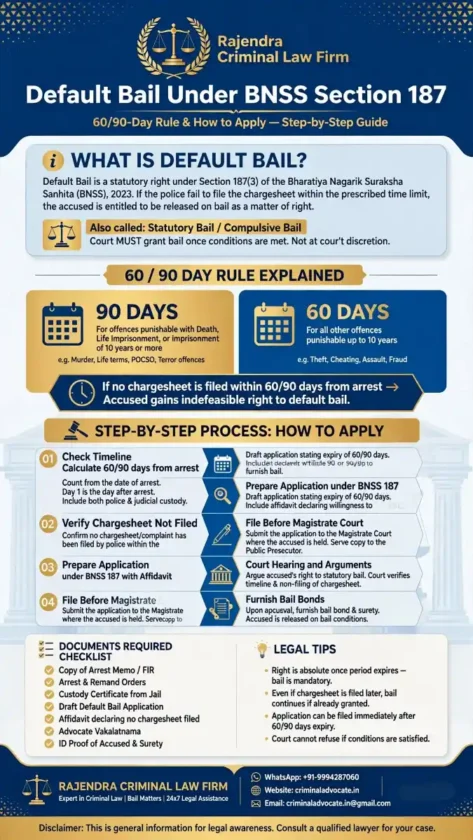
When the police arrest a person and the investigation cannot be completed within 24 hours, the accused must be produced before a Magistrate, who may remand the person to custody. The law does not allow that remand to continue indefinitely. Section 187 sets an outer limit on pre-charge-sheet detention. If the investigating agency does not file its final report (the charge sheet) within that limit, the accused becomes entitled to be released on bail, provided the person is prepared to furnish bail.
The key feature is that the court does not weigh the seriousness of the allegation at this stage. The right arises from the delay itself. That is why courts call it an indefeasible right: it cannot be defeated by the strength of the prosecution case, the gravity of the offence or the likelihood of conviction. The accused still has to apply, and still has to furnish a bond and sureties, but the court has no discretion to refuse once the conditions are met.
The 60-Day and 90-Day Limits
The limit depends on the punishment attached to the offence under investigation. For offences punishable with death, imprisonment for life, or imprisonment for a term of not less than ten years, the limit is 90 days. For every other offence, the limit is 60 days. The period is counted for the total detention authorised by the Magistrate, in police custody and judicial custody together.
| Category of offence | Detention limit without charge sheet | Result on expiry |
|---|---|---|
| Death, life imprisonment, or minimum 10 years | 90 days | Right to default bail |
| Any other offence (including offences punishable up to 10 years) | 60 days | Right to default bail |
| NDPS Act, commercial quantity (as extended by Section 36A) | Up to 180 days, extendable to one year | Right to default bail after the extended period |
| UAPA offences (as extended by Section 43D) | Up to 180 days on report of the Public Prosecutor | Right to default bail after the extended period |
Always check the exact punishment clause of the offence charged. An offence whose maximum is ten years but whose minimum is lower falls in the 60-day category, which is a point that is frequently argued in court. Also remember that special statutes can extend the period, as the table shows.
How Default Bail Differs From Regular and Anticipatory Bail
Regular bail is discretionary. The court looks at the nature of the offence, the evidence, the risk of flight and the chance of tampering with witnesses. Anticipatory bail is sought before arrest. Default bail is different in kind. It is purely a consequence of the investigating agency missing its deadline, and the court asks only whether the period has expired and whether the charge sheet has been filed. For a broader comparison of the three routes, read our complete guide to bail in India and the explainer on anticipatory bail.
| Feature | Default bail | Regular bail | Anticipatory bail |
|---|---|---|---|
| Legal basis | BNSS Section 187 | BNSS provisions on bail in non-bailable cases | BNSS Section 482 |
| Stage | After arrest, before charge sheet | After arrest, any stage | Before arrest |
| Court discretion | None once conditions are met | Wide discretion | Wide discretion |
| Merits examined | No | Yes | Yes |
| Main ground | Delay in filing charge sheet | Facts and circumstances | Apprehension of arrest |
Step-by-Step: How to Claim Default Bail
The procedure is simple, but timing matters. The steps below reflect the usual practice in Magistrate courts and Sessions courts in Tamil Nadu. Your advocate will adapt them to the court and the case.
- Fix the date of first remand. Courts have generally counted the 60 or 90 days from the date on which the Magistrate first authorised detention, not from the moment of arrest. Obtain the remand order and mark day one.
- Identify the correct category. Read the FIR and the sections invoked. Decide whether the 60-day or 90-day limit applies, and whether a special law extends it.
- Confirm that no charge sheet has been filed. Check with the court registry and the case status. Filing on or before the last day defeats the right.
- File a written application on the first day after expiry. The application is addressed to the Magistrate (or the Sessions Court if the case is before it) and cites BNSS Section 187. Do not wait.
- Press for an immediate hearing. The court should dispose of the application the same day. A pending application is protected if the prosecution files a charge sheet later, as the Supreme Court has explained.
- Furnish bail. Once the order is passed, the accused must be ready with sureties and a bond. Release depends on this step.
- Comply with conditions. Attend court, do not leave the jurisdiction without permission, and do not contact witnesses.
What the Application Should Contain
- Case details: FIR number, police station, sections invoked and the court.
- Date of arrest and the dates of each remand order, with copies attached.
- A clear statement that the 60-day or 90-day period has expired and that no charge sheet has been filed.
- A statement that the accused is ready and willing to furnish bail.
- A prayer for release under BNSS Section 187 and a request for hearing on the same day.
What the Supreme Court Has Said About Default Bail
The right has been shaped by a line of decisions that continue to guide courts under the new code, because the language of Section 187 follows Section 167 closely. A few points are settled.
| Case | Principle |
|---|---|
| Uday Mohanlal Acharya v. State of Maharashtra (2001) | A Constitution Bench held that the right accrues on expiry of the period and is lost only if the accused fails to apply before the charge sheet is filed. |
| Rakesh Kumar Paul v. State of Assam (2017) | Explained the 60-day and 90-day categories and held that the right is part of the guarantee of personal liberty. |
| Bikramjit Singh v. State of Punjab (2020) | Confirmed that default bail is a fundamental right under Article 21 and not merely a statutory one. |
| M. Ravindran v. Directorate of Revenue Intelligence (2020) | A three-judge Bench held that the right is enforceable if the application is made before the charge sheet, and that the court must decide it promptly. |
Please verify citations and the latest rulings with your advocate before relying on them in a petition. Courts continue to refine how the rule applies where a charge sheet is filed but later said to be incomplete, and where the accused is held in connection with more than one case.
Common Mistakes That Cost Accused Persons Default Bail
- Waiting for the court to act on its own. The right must be claimed. If the accused or counsel is silent and the charge sheet is filed, the right is generally gone.
- Counting from the wrong date. Miscounting by even a day gives the prosecution room to file in time.
- Seeking time or adjournments. Requests for adjournment made by the defence can be argued as consent to continued detention. Avoid them when the period has expired.
- Ignoring special statutes. In NDPS or UAPA cases, the longer period applies, and applying too early wastes the opportunity.
- Failing to arrange sureties. Even after an order is passed, release depends on furnishing bail. Prepare documents in advance.
Can Default Bail Be Cancelled?
Default bail is not a finding on guilt. If the charge sheet is filed after release, the prosecution may apply for cancellation on grounds recognised in law, such as misuse of liberty, tampering with evidence or threatening witnesses. Cancellation is not automatic merely because the charge sheet has been filed. As a matter of fact, The court looks at conduct after release, not the delay that originally gave rise to the right.
Default Bail and Related Remedies
Default bail is one tool among several. Where the case is built on weak evidence, other remedies may be better or may be used along with it. Moreover, You may seek regular bail on merits, as discussed in the Supreme Court guidelines on arrests and bail. You may also question the arrest itself using the safeguards set out in our guide to your rights after arrest. In drug cases, special rules apply, which we explain in our NDPS defence guide.
To understand firstly where the charge sheet fits in the larger process, see the criminal court process from FIR to judgment. For a summary of the changes introduced by the new codes, read BNS and BNSS explained. If you are in Chennai and need urgent help, our bail lawyers in Chennai can examine the remand dates and prepare the application at short notice.
An Illustrative Timeline
Consider a hypothetical case. A person is arrested on 1 March for an offence punishable with seven years of imprisonment and is first remanded by the Magistrate on 2 March. The 60-day limit applies. If counting begins from the first remand date, the sixtieth day falls at the end of 30 April. Firstly, If no charge sheet has been filed by the close of that day, the accused may apply on 1 May. If the police file the charge sheet on 30 April, even late in the evening, the right does not arise. This is why advocates monitor the court registry closely on the last days of the period and file the application at the first opportunity.
Now change one fact. If the offence carries a minimum sentence of ten years, the 90-day limit applies and the right matures at the end of May. Because every day matters, it is wise to ask counsel for a written calculation at the very start of the remand period rather than at the end.
Special Situations Courts Often Examine
- Several cases against the same person. Default bail in one case does not free the accused from custody in another case. Moreover, Each case has its own clock, and the accused must claim the right separately where needed.
- Sections added later. If the police add a more serious section during investigation, the applicable limit can change from 60 to 90 days. Courts look at the sections actually invoked when the question arises.
- Incomplete charge sheets. The prosecution sometimes files a charge sheet and says that investigation continues against others. Whether this defeats default bail depends on the facts, and the law on this point has developed in recent years. Take advice before assuming either outcome.
- Additional accused. Each accused has an individual right, calculated from the date of that person’s own remand.
- Absconding co-accused. Their absence does not extend the time for those already in custody.
Why the Law Protects This Right
The rule exists to balance two interests. The State is allowed time to investigate serious crime, and the law gives the police a generous period, but it does not allow that time to be unlimited. Meanwhile, Prolonged pre-trial detention without a charge sheet harms the presumption of innocence, damages livelihoods and can pressure an accused person into an unwanted settlement. Section 187 therefore acts as a disciplined deadline for the investigating officer. Finally, The Supreme Court has repeatedly said that this protection flows from Article 21 and that courts must guard it even in cases involving grave allegations.
Practical Checklist for Families
- Firstly, Collect every remand order and note the date of the first remand.
- Secondly, Ask the lawyer to calculate the 60-day or 90-day date and to diarise the filing.
- Confirm with the court office, on the expiry date, whether a charge sheet has been filed.
- Thereafter, Keep surety documents ready: identity proof, address proof, property or bank documents as the court requires.
- Finally, Do not rely on assurances from the police. Rely on the court record.
Read More
- Protecting Financial Markets: Legal Support for Securities Fraud Defense
- Ending Human Trafficking: Legal Support for Human Smuggling Victims
- Money Smuggling Defense: Legal Representation for Money Smuggling Charges
Key Takeaways
Default bail under BNSS Section 187 is a time-bound right that depends on three facts: the date of first remand, the category of the offence and the date on which the charge sheet is filed. Meanwhile, Missing any one of them can change the outcome. The right is strongest when it is claimed promptly, supported by the remand orders and backed by ready sureties. It does not decide guilt or innocence, and it does not stop the trial. It simply ensures that nobody stays in jail longer than the law permits while the police complete their work. If you or a family member is in custody and the 60-day or 90-day mark is approaching, speak to a criminal defence lawyer immediately and ask for the dates to be calculated in writing. Most of all, This article is general information and not a substitute for legal advice on your case.