
Appeal Against Maintenance Order – Maintenance laws play a very important role in protecting spouses, children, and parents who cannot support themselves. For decades, Section 125 of the Criminal Procedure Code (CrPC) guided maintenance cases in India. However, with the introduction of the Bharatiya Nagarik Suraksha Sanhita (BNSS), the legal framework has changed. As a result, many people now feel confused about appeals against maintenance orders.
Therefore, this article clearly explains how maintenance worked under the old CrPC, how it works under BNSS, and how appeals against maintenance orders are handled today. At Rajendra Criminal Law Firm, we believe that understanding the law empowers people to protect their rights effectively.
Appeal Against Maintenance Order: BNSS vs Old CrPC Explained – Rajendra Criminal Law Firm
Understanding Maintenance Law in Simple Terms
Maintenance means financial support provided by one person to another who is legally dependent on them. In most cases, it involves a husband supporting his wife, children, older people. The law ensures that no dependent person is left without basic needs like food, shelter, clothing, and medical care.
Earlier, Section 125 of CrPC governed maintenance. Now, BNSS has replaced CrPC and introduced updated provisions while keeping the core purpose intact. However, the procedure, structure, and appeal process have evolved.
Maintenance Under Section 125 CrPC: The Old System
Section 125 CrPC was designed as a quick and effective remedy. It aimed to prevent vagrancy and destitution. Importantly, it was not about punishment but about social justice.
Who Could Claim Maintenance Under CrPC?
Under Section 125 CrPC, the following persons could claim maintenance:
- A legally wedded wife
- Minor children (legitimate or illegitimate)
- Major children with physical or mental disabilities
- Parents who could not maintain themselves
As long as the claimant proved neglect or refusal to maintain, the court could grant monthly maintenance.
How Maintenance Orders Were Passed Under CrPC
The Magistrate had the power to pass maintenance orders after hearing both parties. The court considered:
- Income and earning capacity
- Lifestyle during marriage
- Reasonable needs of the claimant
- Ability of the respondent to pay
Once the order was passed, it became legally binding.
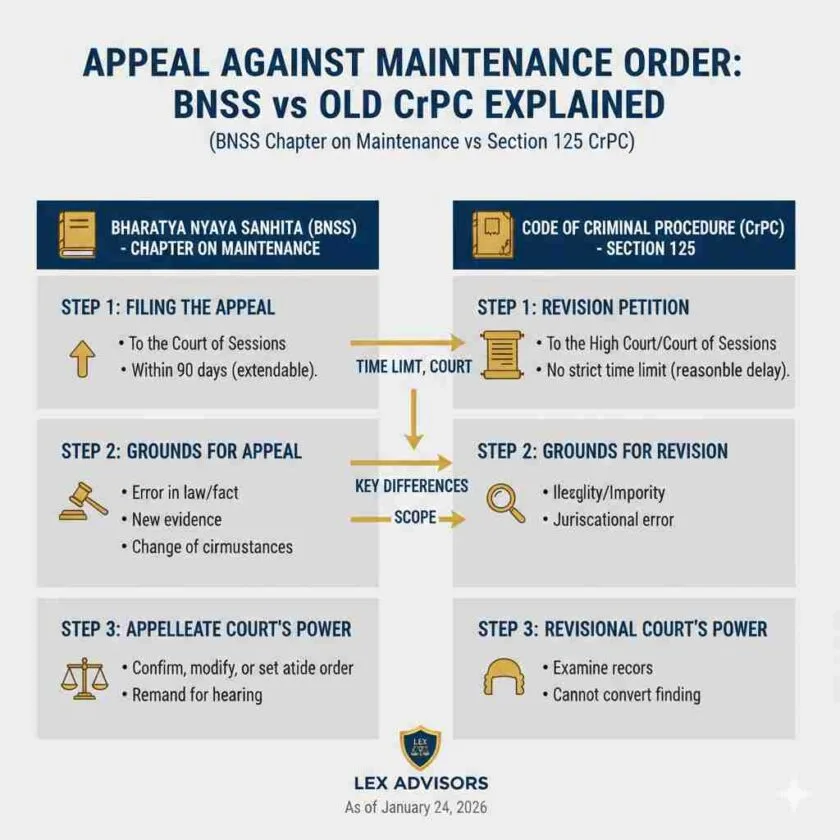
Appeal Against Maintenance Order Under Old CrPC
Under the old CrPC system, Section 125 orders were not directly appealable. Instead, the aggrieved party had to file:
- A criminal revision petition before the Sessions Court or High Court
This created confusion and delays. Moreover, many litigants misunderstood whether an appeal or revision was the correct remedy. As a result, procedural complications increased.
Introduction of BNSS: A New Criminal Procedure Framework
The Bharatiya Nagarik Suraksha Sanhita (BNSS) replaced the CrPC to modernize criminal procedure laws. While the purpose of maintenance remains the same, BNSS introduces clarity, structure, and speed in handling cases.
Importantly, BNSS places maintenance provisions in a separate chapter. This change itself reflects the importance of maintenance as a social welfare measure.
BNSS Chapter on Maintenance: What Has Changed?
The BNSS chapter on maintenance largely retains the spirit of Section 125 CrPC but improves procedural clarity.
Key Improvements Under BNSS
- Clearer timelines for disposal
- Better enforcement mechanisms
- Defined remedies against maintenance orders
- Reduced ambiguity between appeal and revision
As a result, litigants now find it easier to understand their legal options.
Appeal Against Maintenance Order Under BNSS
One of the most significant changes under BNSS is the clearer appellate structure.
Under BNSS, maintenance orders passed by the Magistrate can be challenged through:
- A proper appeal mechanism, as specified
- Higher judicial scrutiny with defined jurisdiction
This change ensures transparency and fairness. Moreover, it reduces unnecessary procedural hurdles.
BNSS vs Section 125 CrPC: Key Differences Explained
1. Procedural Clarity
Earlier, CrPC relied heavily on revisions. Now, BNSS clearly distinguishes between appeal and revision.
2. Speed of Justice
BNSS focuses on faster disposal of maintenance cases, which benefits both claimants and respondents.
3. Enforcement Mechanism
BNSS strengthens enforcement by introducing more structured recovery methods.
4. Reduced Litigation Confusion
Previously, parties often filed the wrong remedy. Under BNSS, remedies are clearer and better defined.
Can Maintenance Orders Be Stayed During Appeal?
Under both CrPC and BNSS, filing an appeal does not automatically stay the maintenance order. The appellant must specifically seek a stay.
However, under BNSS, courts emphasize interim compliance. This means partial payment or conditional relief may be ordered to balance interests.
Grounds for Appeal Against Maintenance Order
A maintenance order can be challenged on valid legal grounds, such as:
- Incorrect assessment of income
- Ignoring actual financial liabilities
- Granting excessive maintenance
- Lack of proper evidence
- Procedural irregularities
- Failure to consider the respondent’s ability to pay
At Rajendra Criminal Law Firm, we carefully analyze each case before advising an appeal.
Common Mistakes While Filing Maintenance Appeals
Many people make avoidable mistakes, including:
- Missing limitation periods
- Filing incorrect remedies
- Ignoring interim orders
- Suppressing income details
- Filing appeals without legal grounds
Therefore, professional legal guidance becomes essential.
Maintenance Appeals: Rights of Men, Women, and Parents
Maintenance law is gender-neutral in many respects. While wives commonly file claims, husbands, parents, and even children may also seek legal protection under appropriate circumstances.
Similarly, appeals can be filed by:
- Husbands challenging excessive orders
- Wives challenging inadequate amounts
- Parents denied rightful support
BNSS ensures fairness for all parties.
Enforcement During Appeal: What Happens?
Even during appeal, maintenance orders remain enforceable unless stayed. Courts may:
- Order attachment of salary
- Issue recovery warrants
- Impose penalties for non-compliance
Therefore, ignoring maintenance orders can result in serious legal consequences.
Role of Criminal Courts Under BNSS
BNSS reinforces the role of Magistrates while strengthening oversight by higher courts. This balanced structure helps maintain consistency in decisions and protects constitutional rights.
As a result, both claimants and respondents benefit from a more predictable legal system.
Why Legal Strategy Matters in Maintenance Appeals
Maintenance appeals require careful legal planning. Courts expect detailed financial disclosures and honest pleadings. Emotional arguments alone do not succeed.
At Rajendra Criminal Law Firm, we focus on:
- Strong documentation
- Accurate income analysis
- Procedural compliance
- Strategic interim relief applications
This approach improves success rates.
How Rajendra Criminal Law Firm Helps in Maintenance Appeals
Our firm provides:
- Clear legal advice on BNSS vs CrPC
- Drafting and filing of appeals
- Stay petitions and interim relief
- Enforcement defense strategies
- Representation before Sessions Courts and High Courts
Most importantly, we focus on practical solutions, not just technical arguments.
Frequently Asked Questions
Section 125 CrPC earlier governed maintenance as a quick relief measure to prevent neglect of wives, children, and parents. Under BNSS, maintenance provisions are placed in a dedicated chapter with clearer procedures. While the purpose remains social justice, BNSS improves clarity on jurisdiction, timelines, and remedies, including how maintenance orders can be challenged.
Yes. Unlike the old CrPC system where parties mainly relied on revision petitions, BNSS provides better clarity on appellate remedies. An aggrieved party can challenge a maintenance order through the appropriate appellate forum as prescribed, making the process more structured and less confusing than before.
No. Filing an appeal does not automatically stay the maintenance order under either CrPC or BNSS. The appellant must specifically seek a stay from the appellate court. Until a stay is granted, the respondent must continue paying maintenance as ordered to avoid legal consequences.
A maintenance order can be challenged if the court wrongly assessed income, ignored financial liabilities, granted an excessive or inadequate amount, relied on insufficient evidence, or violated procedural requirements. Appeals must focus on legal and factual errors rather than emotional arguments.
BNSS strengthens enforcement mechanisms. Even during appeal, courts can enforce maintenance through salary attachment, recovery warrants, or other lawful methods unless a stay is granted. This ensures that dependents are not left without support while legal proceedings continue, promoting fairness and accountability.
Conclusion: Moving Forward Under BNSS
The transition from Section 125 CrPC to BNSS marks an important shift in maintenance law. While the objective remains social justice, the procedure has become clearer and more structured.
Appeals against maintenance orders are now easier to understand, better regulated, and more transparent. However, success depends on correct legal strategy and timely action.
Read More
- Understanding the NDPS Act: Defence Strategies for Drug Cases
- The Criminal Court Process in India: From FIR to Judgment
- Your Rights After an Arrest in India: A Step-by-Step Legal Guide
- Professional FEMA Compliance Services for Businesses & NRIs
- Chennai’s No.1 FEMA Consultancy for RBI, ODI & FDI Compliance
- Bharatiya Nagarik Suraksha Sanhita, 2023 (BNSS)