
Interim maintenance is a lifeline for many spouses, children, and parents who cannot support themselves during a pending criminal or matrimonial case. At the same time, for the person directed to pay, an unfair or excessive interim maintenance order can cause serious financial hardship. Therefore, the law provides remedies to challenge such orders before the High Court.
With the coming into force of the Bharatiya Nagarik Suraksha Sanhita (BNSS), which replaced the Code of Criminal Procedure (CrPC), the procedural framework for criminal cases has changed. However, the right to seek interim maintenance and the right to challenge it still continue, though the route and strategy require careful legal understanding.
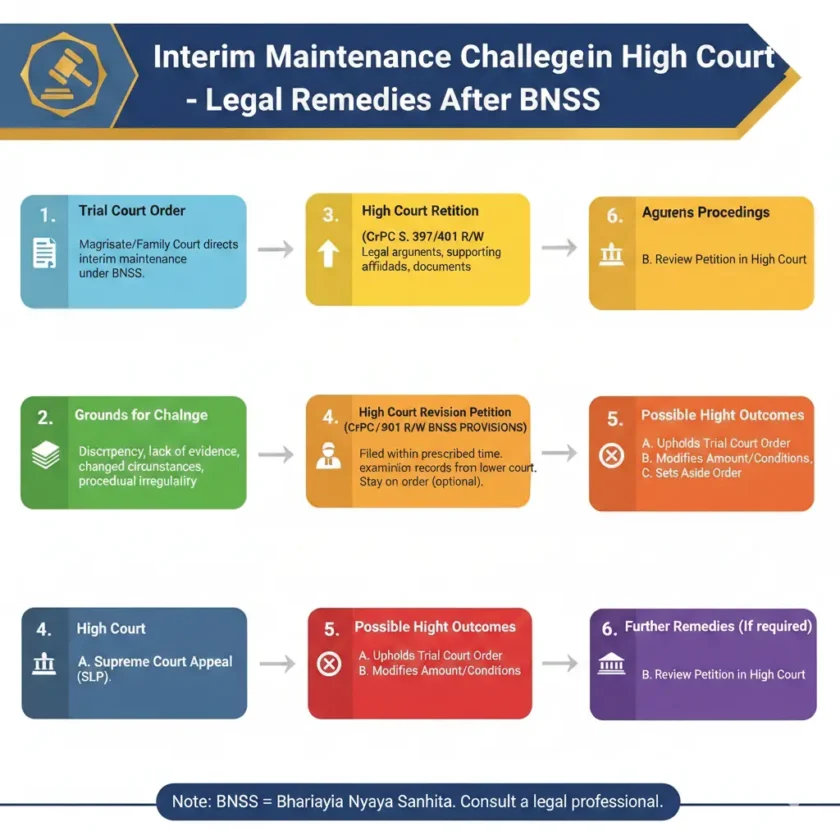
Interim Maintenance Challenge in High Court – Legal Remedies After BNSS: Rajendra Criminal Law Firm
What Is Interim Maintenance?
Interim maintenance is temporary financial support granted during the pendency of a case. Courts grant it to prevent hardship until final disposal. In criminal law matters, maintenance is generally claimed by:
- Wife
- Minor children
- Dependent parents
Earlier, such claims were commonly filed under Section 125 of the CrPC. Now, similar provisions exist under the BNSS. The objective remains the same: to prevent destitution and ensure basic survival.
Importantly, interim maintenance is not a final decision. It is only a temporary arrangement. However, even a temporary order can have a significant impact. Therefore, courts must pass such orders carefully and after considering income, liabilities, and living standards.
How BNSS Affects Maintenance Proceedings
Although the BNSS has replaced the CrPC, the basic principles governing maintenance have not changed drastically. The right to claim maintenance continues. However, procedural aspects, timelines, and documentation may vary.
For example:
- Digital filing and electronic records have gained importance.
- Courts may follow stricter timelines.
- Service of notice and procedural compliance must be properly ensured.
Therefore, while the substance of maintenance law remains similar, procedural mistakes can affect your challenge. That is why proper legal guidance becomes crucial.
When Can You Challenge Interim Maintenance?
You can challenge an interim maintenance order in the following situations:
- The court did not consider your actual income.
- The order was passed without proper opportunity of hearing.
- The amount fixed is excessive and unrealistic.
- The applicant suppressed material facts.
- There is duplication of maintenance in multiple proceedings.
- The court failed to consider your liabilities, such as loans or dependent parents.
In addition, if the court passes the order mechanically without proper reasoning, the High Court can interfere.
However, you cannot challenge simply because you feel unhappy. You must show legal error, procedural irregularity, or perversity.
Legal Remedies Before the High Court After BNSS
Now let us understand the remedies available.
1. Criminal Revision Petition
A Criminal Revision Petition is one of the most common remedies. If the trial court passes an interim maintenance order that is legally incorrect, you can approach the High Court through a revision.
In a revision petition, the High Court does not re-hear the entire case. Instead, it checks:
- Whether the lower court acted within its jurisdiction.
- Whether there is legal error.
- Whether the order is perverse or arbitrary.
Therefore, revision is a powerful remedy but limited in scope.
2. Petition Under Section 482 (Inherent Powers)
Under the old CrPC, parties approached the High Court under Section 482 for inherent powers. Similar inherent powers continue under the BNSS framework.
You can invoke inherent powers when:
- There is gross injustice.
- The order causes abuse of process of law.
- No alternative remedy is effective.
However, courts use this power sparingly. Therefore, you must establish exceptional circumstances.
3. Writ Petition Under Article 226/227
In certain cases, parties file writ petitions under Articles 226 or 227 of the Constitution before the High Court.
This remedy becomes useful when:
- There is violation of natural justice.
- The order was passed without jurisdiction.
- There is procedural irregularity.
However, High Courts usually discourage writ petitions if revision is available. Therefore, choosing the correct remedy is very important.
Grounds Commonly Accepted by High Courts
Over time, High Courts across India have laid down principles while interfering with interim maintenance orders. They generally consider:
1. Non-Application of Mind
If the trial court fixes maintenance without examining income documents, bank statements, or affidavits, the High Court may interfere.
2. Excessive Quantum Without Basis
Courts must calculate maintenance based on actual income and reasonable expenses. If the amount is disproportionate, it can be reduced.
3. Failure to Consider Husband’s Liabilities
Courts must consider:
- Dependent parents
- Existing loans
- Other children
- Medical expenses
If the court ignores these, the order may be modified.
4. Parallel Proceedings
Sometimes, the wife files cases under multiple laws. For example:
- Maintenance under criminal law
- Interim alimony in matrimonial proceedings
- Relief under the Protection of Women from Domestic Violence Act
If the court fails to adjust overlapping amounts, it may lead to unfair duplication. The High Court can correct this.
Important Supreme Court Guidelines
The Supreme Court of India has issued important guidelines regarding maintenance. It has directed parties to file detailed affidavits of income and assets. These guidelines ensure transparency.
Therefore, when challenging interim maintenance, accurate financial disclosure becomes critical. If you hide income, the High Court may dismiss your petition.
Can the High Court Stay the Interim Maintenance Order?
Yes, the High Court can grant stay. However, stay is not automatic.
Usually:
- The court may direct partial payment.
- The court may reduce the amount temporarily.
- The court may impose conditions.
Therefore, you must act quickly after the order is passed. Delay can weaken your case.
Time Limit to Challenge
Although there is no strict universal time limit like an appeal, revision petitions must be filed within a reasonable period. Generally, parties approach the High Court within 90 days.
If there is delay, you must file a delay condonation petition explaining sufficient cause.
Hence, prompt action is always advisable.
Practical Strategy Before Filing Challenge
Before rushing to the High Court, you must:
- Collect income proof.
- Prepare a detailed liability statement.
- Review the trial court order carefully.
- Identify clear legal errors.
- Consult an experienced criminal lawyer.
Moreover, sometimes filing an application for modification before the same court may be more practical than directly approaching the High Court.
Therefore, strategy matters more than emotion.
For Wives and Claimants: When Can They Challenge?
Not only husbands, but wives can also challenge interim maintenance orders if:
- The amount granted is too low.
- The court ignored the standard of living.
- The husband concealed income.
- The court delayed the order unreasonably.
In such cases, the High Court can enhance the amount.
Thus, the remedy works both ways.
Role of Rajendra Criminal Law Firm
At Rajendra Criminal Law Firm, we understand that interim maintenance disputes often create emotional and financial stress. However, we approach each case with legal clarity and strong documentation.
We:
- Analyze income affidavits in detail.
- Identify procedural lapses.
- Draft strong revision petitions.
- Seek interim stay where necessary.
- Ensure compliance with BNSS provisions.
Most importantly, we provide honest advice. If the order is reasonable, we suggest compliance. If it is legally flawed, we challenge it aggressively.
Common Mistakes to Avoid
Many litigants make serious mistakes while challenging interim maintenance:
- Filing incomplete documents.
- Hiding income.
- Ignoring court notices.
- Delaying filing.
- Filing wrong type of petition.
These mistakes can lead to dismissal. Therefore, professional drafting and proper legal planning are essential.
Frequently Asked Questions
Yes, you can challenge an interim maintenance order before the High Court even after the implementation of the Bharatiya Nagarik Suraksha Sanhita (BNSS). Although the procedural law has changed, the right to question an incorrect or excessive order continues. Generally, you can file a Criminal Revision Petition. In rare and exceptional cases, you may also invoke the inherent powers of the High Court. However, the High Court will interfere only if there is a clear legal error, lack of jurisdiction, or serious injustice in the trial court’s order.
The High Court usually interferes when the lower court fails to consider income documents, ignores liabilities, or fixes an excessive amount without proper reasoning. If the order was passed without giving proper opportunity of hearing, it may also be set aside. Additionally, if there is duplication of maintenance in parallel proceedings, the court may modify the amount.
Yes, the High Court can grant a stay. However, stay is not automatic. The court may direct partial payment or impose conditions. Therefore, you must show urgency and genuine hardship to obtain interim relief.
There is no strict fixed period, but you must file within a reasonable time, usually within 90 days. If there is delay, you must file a delay condonation petition explaining valid reasons.
Yes. If the amount granted is too low or the husband’s income was not properly considered, she can approach the High Court seeking enhancement of interim maintenance.
Conclusion
The transition from the CrPC to the Bharatiya Nagarik Suraksha Sanhita (BNSS) has brought procedural changes, but the right to maintenance and the right to challenge unjust orders continue.
Interim maintenance orders are temporary, yet they significantly affect both parties. Therefore, if the trial court passes an unfair or legally flawed order, the High Court offers effective remedies through revision, inherent powers, or constitutional jurisdiction.
Read More
- Appeal Against Maintenance Order: BNSS vs Old CrPC Explained (BNSS Chapter on Maintenance vs Section 125 CrPC)
- Understanding the NDPS Act: Defence Strategies for Drug Cases
- The Criminal Court Process in India: From FIR to Judgment
- Professional FEMA Compliance Services for Businesses & NRIs
- Your Rights After an Arrest in India: A Step-by-Step Legal Guide
- Official BNSS Bare Act (Government of India) – Section 144 (Maintenance & Interim Maintenance)