
Appeal a Criminal Conviction – A criminal conviction can affect liberty, employment, reputation, and family life. Therefore, Indian law grants a statutory right of appeal in many cases. Appeals challenge errors in facts, evidence, procedure, or law. The Bharatiya Nagarik Suraksha Sanhita, 2023 governs criminal appeal procedures. High Courts examine trial court records carefully before granting relief. Convicted persons may challenge findings, sentence severity, or procedural irregularities. Legal representation becomes crucial during appellate proceedings. Courts evaluate evidence under the Bharatiya Sakshya Adhiniyam, 2023. Criminal offences remain governed by the Bharatiya Nyaya Sanhita, 2023. Furthermore, appellate courts protect constitutional and statutory rights. Common legal issues include wrongful conviction, inadequate defense, evidentiary errors, and sentencing mistakes. Relevant forums include Sessions Courts, High Courts, and the Supreme Court. Early legal action often improves outcomes. Consequently, skilled appellate advocacy can significantly strengthen the chances of obtaining relief.
How to Appeal a Criminal Conviction in the High Court – Rajendra Criminal Law Firm
Who Can File a Criminal Appeal
Several categories of persons may file criminal appeals. Convicted individuals commonly challenge convictions and sentences. Additionally, complainants may appeal against acquittals in permitted circumstances. State authorities may also challenge acquittal orders through appropriate procedures. Jurisdiction depends upon the trial court and applicable provisions. Appeals generally require certified copies of judgments and relevant records. Lawyers examine trial proceedings before identifying appeal grounds. Common appeal issues include:
• Wrong appreciation of evidence
• Violation of procedural safeguards
• Excessive punishment
• Improper admission of evidence
• Misapplication of legal provisions
Timely filing remains essential because limitation periods apply. Therefore, litigants should seek legal advice immediately after conviction. Proper drafting helps present strong grounds effectively. Consequently, appellate courts receive a clear explanation of alleged judicial errors.
Grounds for Challenging a Conviction
A successful appeal requires legally sustainable grounds. High Courts do not overturn convictions automatically. Instead, judges assess records, evidence, and applicable laws carefully. Common grounds include factual errors, legal misinterpretation, procedural violations, and unreliable evidence. The court may also consider constitutional concerns affecting fairness. Lawyers identify weaknesses in prosecution evidence strategically. Relevant issues often include:
- Contradictory witness statements.
- Improper investigation procedures.
- Defective charge framing.
- Lack of corroborative evidence.
- Violation of fair trial rights.
- Unlawful confession reliance.
Moreover, appellate courts evaluate whether errors influenced the outcome materially. Minor irregularities may not justify interference. Therefore, strong legal analysis remains essential. Effective grounds improve the likelihood of obtaining acquittal, retrial, sentence reduction, or other judicial remedies.
Important Documents Required
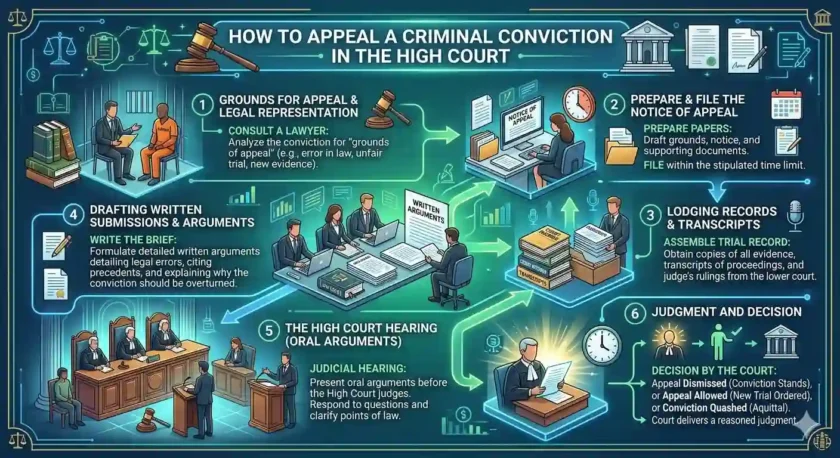
Document preparation forms the foundation of a criminal appeal. High Courts require complete and accurate records. Missing documents often create avoidable delays. Therefore, litigants should organize records carefully.
| Document | Purpose |
|---|---|
| Trial Judgment | Challenge conviction findings |
| Sentencing Order | Review punishment |
| Charge Sheet | Examine allegations |
| Witness Depositions | Assess evidence |
| Exhibits | Verify documentary proof |
| Bail Orders | Support interim relief |
Additionally, lawyers may obtain certified copies from trial courts. Proper documentation strengthens appeal arguments significantly. Courts rely heavily upon official records. Furthermore, organized submissions improve judicial efficiency. Effective document management supports strategic appellate advocacy. Consequently, litigants enhance their prospects of securing favorable outcomes.
Filing an Appeal Before the High Court
The appeal process begins with legal evaluation and drafting. Lawyers review evidence, judgments, and procedural history carefully. Thereafter, they prepare appeal memoranda highlighting substantial errors. High Courts require compliance with procedural rules and filing requirements. Registry scrutiny ensures documentation remains complete. Courts may condone delays when justified appropriately. Relevant forums often include criminal appellate benches and special jurisdictions. Furthermore, appellants may seek suspension of sentence during appeal. Bail applications frequently accompany appeals. Nearby police stations may provide records where investigations occurred. Government departments sometimes maintain relevant documents. Therefore, coordinated legal preparation becomes important. Strong pleadings improve judicial understanding. Consequently, litigants position themselves effectively for appellate consideration and relief.
Remedies Available in Criminal Appeals
High Courts possess extensive powers in criminal appeals. Relief depends upon case facts and legal findings. Courts may reverse convictions where evidence appears insufficient. Alternatively, judges may order retrials in appropriate situations. Sentence modifications also occur frequently. Available remedies include:
• Acquittal
• Conviction reversal
• Sentence reduction
• Fresh trial orders
• Bail pending appeal
• Compensation directions where applicable
Additionally, appellate courts address violations of procedural fairness. Lawyers present oral and written arguments supporting relief requests. Courts evaluate prosecution and defense submissions carefully. Therefore, detailed preparation remains essential. Effective advocacy often influences outcomes significantly. Consequently, appellants gain meaningful opportunities to challenge unjust convictions through lawful procedures.
Suspension of Sentence and Bail
Conviction does not automatically prevent bail consideration. Therefore, appellants may request suspension of sentence pending appeal. High Courts examine the offence, evidence, and appeal merits. Judges also consider custody duration and public interest factors. Legal representation becomes critical during these hearings. Common supporting materials include conviction records, appeal grounds, and personal circumstances. Furthermore, courts may impose conditions before granting relief. Compliance with court directions remains essential. Bail does not determine final appeal results. Instead, it offers temporary liberty during proceedings. Lawyers prepare persuasive applications supported by legal precedents. Consequently, eligible appellants may obtain interim protection while awaiting final adjudication.
Role of Evidence Under BSA 2023
Evidence frequently determines appellate outcomes. The Bharatiya Sakshya Adhiniyam, 2023 establishes principles governing admissibility and reliability. High Courts examine witness testimony, documentary records, and electronic evidence carefully. Therefore, evidentiary errors often become significant appeal grounds. Lawyers assess inconsistencies and credibility concerns strategically. Relevant considerations include authenticity, relevance, and corroboration. Courts also review whether trial judges applied evidentiary principles correctly. Additionally, digital evidence requires proper legal compliance. Strong evidentiary analysis strengthens appellate arguments substantially. Judges evaluate whether evidence proves guilt beyond reasonable doubt. Consequently, deficiencies in prosecution evidence may support conviction reversal or sentence modification.
Legal Forums and Authorities Involved
Criminal appeals involve several judicial and administrative bodies. Understanding their roles assists litigants significantly. Important forums and authorities include:
- Trial Courts.
- Sessions Courts.
- High Courts.
- Supreme Court.
- Police Departments.
- Prison Authorities.
Additionally, prosecution agencies participate during appellate hearings. Court registries process filings and procedural requirements. Government departments may supply official records where necessary. Furthermore, legal aid authorities assist eligible applicants. Lawyers coordinate interactions with relevant institutions efficiently. Proper forum selection remains essential for jurisdictional compliance. Therefore, litigants should seek professional guidance before initiating proceedings. Strategic case management improves procedural efficiency and legal outcomes.
Common Mistakes During Appeals
Many appeals fail because of avoidable mistakes. Therefore, litigants should understand common risks before filing. Delayed action frequently weakens appellate opportunities. Incomplete documentation also causes procedural complications. Common mistakes include:
• Missing limitation periods
• Weak appeal grounds
• Incomplete records
• Ignoring legal advice
• Poor evidence analysis
Furthermore, inconsistent statements may damage credibility. High Courts expect structured legal arguments supported by records. Lawyers identify weaknesses before filing. Proper preparation reduces procedural obstacles significantly. Consequently, appellants improve their chances of securing meaningful judicial relief and protecting their legal rights.
Why Choose Rajendra Criminal Law Firm
Rajendra Criminal Law Firm provides strategic appellate representation across criminal matters. Our team handles conviction appeals, sentence challenges, bail applications, and criminal revisions. We analyze evidence, procedural compliance, and legal issues thoroughly. Furthermore, we represent clients before High Courts and related forums. Every appeal receives individualized legal attention and detailed preparation. Strong drafting often enhances appellate effectiveness. We also assist with certified copies, record collection, and interim applications. Therefore, clients receive comprehensive legal support throughout proceedings. Our objective remains protecting rights and securing lawful remedies. Effective advocacy, procedural precision, and legal knowledge guide every appeal strategy. Consequently, clients receive professional representation at every stage of criminal litigation.
FAQs
Can I appeal every criminal conviction?
Most convictions permit appeals. However, eligibility depends upon statutory provisions, sentence type, and court jurisdiction.
How soon should I file an appeal?
File immediately after conviction. Limitation periods apply, though courts may condone justified delays.
Can I get bail after conviction?
Yes. High Courts may suspend sentences and grant bail pending appeal in suitable cases.
What remedies can the High Court grant?
The court may acquit, reduce sentences, order retrials, suspend sentences, or modify findings.
Does new evidence help in appeal proceedings?
Courts may consider additional evidence in limited circumstances where justice requires such consideration.
Do I need a criminal appeal lawyer?
Professional representation improves legal strategy, procedural compliance, evidence analysis, and appellate advocacy.
Read More
- What is the Punishment for Financial Fraud in India?
- Understanding Forensic Evidence in Criminal Trials
- The Role of a Criminal Lawyer in Your Defence
- What is Anticipatory Bail? Everything You Need to Know
- How to Handle a False Criminal Case: A Legal Strategy
- Department of Justice, Ministry of Law & Justice