
Drug Policy Reform – Drug paraphernalia possession requires careful analysis under India’s Narcotic Drugs and Psychotropic Substances Act, 1985. The NDPS Act regulates narcotic drugs, psychotropic substances, controlled substances, manufacture, possession, consumption, trafficking, and related conduct. However, ordinary possession of an object does not automatically establish an NDPS offence. Prosecutors must connect seized articles with prohibited conduct or substances through legally admissible evidence. Therefore, a pipe, foil, lighter, container, weighing device, or similar object requires contextual examination. The Narcotics Control Bureau coordinates central and State enforcement agencies under the NDPS framework. Moreover, State Police, Excise authorities, Customs, and other empowered agencies can investigate relevant offences.
Drug Policy Reform: Advocacy for Drug Paraphernalia Possession Defense – Rajendra Criminal Law Firm
Why Paraphernalia Can Become Criminal Evidence
Indian courts may examine alleged paraphernalia alongside recovered substances, statements, forensic results, and surrounding circumstances. Consequently, possession of an object can become significant when authorities allege consumption, preparation, manufacture, or trafficking. The prosecution must establish the statutory ingredients of the charged offence. Mere suspicion should not replace proof of legally relevant facts. Furthermore, the defence can challenge assumptions about an object’s purpose, ownership, control, and connection with alleged contraband. Search records, seizure documentation, independent witnesses, laboratory reports, photographs, and chain-of-custody records therefore require careful review. Courts may also distinguish personal-use circumstances from commercial allegations when the evidence supports that distinction. Hence, experienced NDPS defence counsel should examine the complete prosecution theory rather than focusing on one recovered article.
Section 27 and Personal Consumption Defence
Section 27 of the NDPS Act addresses punishment for consumption and certain small-quantity consumption circumstances. Therefore, allegations involving paraphernalia may require examination of whether authorities allege consumption rather than possession alone. The quantity, substance identity, laboratory findings, and surrounding circumstances can materially affect the legal position. However, lawyers should never assume that small quantity automatically guarantees release or acquittal. The prosecution may invoke additional provisions depending on the alleged facts. Moreover, Section 35 creates a statutory presumption regarding culpable mental state after foundational facts arise. Section 54 similarly concerns presumptions from possession of illicit articles. Consequently, early defence strategy remains important. A lawyer should assess recovery, possession, search legality, forensic evidence, statements, and applicable statutory presumptions before selecting remedies. Relevant Supreme Court jurisprudence also recognises personal-consumption issues in appropriate factual circumstances. (National Judicial Academy)
Building a Strong Paraphernalia Possession Defence
Challenging Search and Seizure Procedures
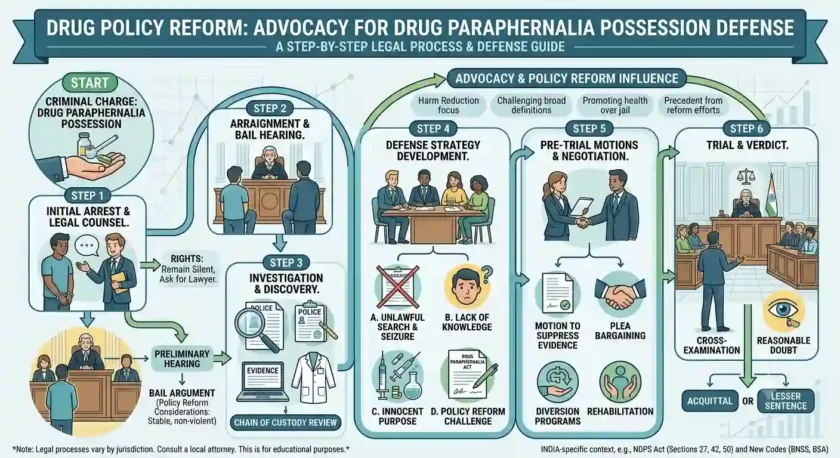
Search and seizure compliance forms a central part of many NDPS defence strategies. Sections 42, 43, 49, 50, 52A, 55, and 57 can become relevant depending upon circumstances. The defence should examine whether officers possessed lawful authority and followed mandatory safeguards. Additionally, timing, location, written information, search witnesses, sealing, inventory, sampling, and reporting require scrutiny. Personal searches raise specific considerations under Section 50. Courts have repeatedly treated statutory safeguards seriously because NDPS penalties can become severe. Therefore, defence counsel should compare seizure mahazars, station records, case diaries, laboratory documents, and witness testimony. Any material contradiction may support an appropriate procedural challenge. The Supreme Court has discussed statutory safeguards governing NDPS searches, seizures, custody, and reporting requirements. (Sci API)
Testing Conscious Possession and Ownership
Conscious possession remains a critical issue when authorities attribute seized articles or substances to an accused. Possession generally requires more than mere physical proximity to an article. Courts examine knowledge, control, custody, surrounding circumstances, and the prosecution’s evidence. Therefore, defence lawyers should identify whether the accused actually controlled the premises, vehicle, bag, room, or container. Shared accommodation can create particularly important factual questions. Likewise, articles found in common areas may require stronger evidence connecting them to one person. The defence can challenge unsupported assumptions through witness cross-examination and documentary evidence. Furthermore, statutory presumptions do not remove every foundational requirement from the prosecution. Consequently, the defence should first test whether prosecution evidence establishes possession before addressing presumptions concerning culpable mental state. (Indian Kanoon)
Separating Possession From Trafficking Allegations
Drug paraphernalia allegations sometimes appear alongside accusations involving possession, sale, transportation, conspiracy, or financing. Each allegation carries separate statutory requirements and evidentiary considerations. Therefore, defence counsel should prevent investigators from converting suggestive circumstances into unsupported trafficking conclusions. A weighing scale, packaging material, mobile phone, cash, or multiple containers may receive evidentiary significance. Yet none automatically proves trafficking without supporting circumstances. Moreover, Section 27A carries particularly serious consequences where financing illicit traffic or harbouring offenders is alleged. Section 29 can create additional exposure when conspiracy or abetment is charged. The defence should therefore examine financial records, communications, call records, recovery locations, forensic evidence, and witness statements separately. Recent judicial decisions have also examined whether financial transactions alone establish financing under Section 27A. (Supreme Today AI)
Using Forensic and Digital Evidence
Modern NDPS investigations increasingly depend upon electronic records and forensic material. Consequently, mobile phones, CCTV footage, location information, chats, photographs, and call records may become important evidence. The Bharatiya Sakshya Adhiniyam, 2023 governs evidentiary principles, including electronic and digital records. Sections 61 and 63 specifically address electronic records and their admissibility requirements. Therefore, defence counsel should examine authenticity, source, integrity, extraction methods, metadata, and statutory compliance. Laboratory reports also require careful assessment regarding sampling, identification, seals, storage, and chain of custody. Furthermore, contradictions between forensic findings and prosecution testimony may materially affect the case. A defence strategy should avoid accepting electronic or scientific evidence merely because investigators produced printouts. Instead, lawyers should test whether the evidence satisfies applicable legal requirements before relying upon it or challenging it. (India Code)
Bail and Interim Legal Remedies
Bail strategy depends upon the charged provisions, recovered quantity, evidence, antecedents, and statutory restrictions. NDPS cases involving commercial quantities can trigger the stringent requirements of Section 37. Consequently, ordinary bail arguments may require additional statutory analysis. The BNSS 2023 now governs general criminal procedure and contains provisions concerning bail before Magistrates, Sessions Courts, and High Courts. Section 483 recognises special bail powers of High Courts and Courts of Session. Therefore, defence counsel should select the appropriate forum based on custody status and case circumstances. Other remedies may include discharge applications, quashing petitions, revision, appeals, or constitutional remedies where legally sustainable. Importantly, each remedy requires a distinct factual and procedural foundation. Early representation can also help preserve CCTV footage, seizure records, electronic evidence, and other material supporting the defence. (India Code)
Role of BNS, BNSS and BSA in NDPS Cases
The Bharatiya Nyaya Sanhita, 2023, Bharatiya Nagarik Suraksha Sanhita, 2023, and Bharatiya Sakshya Adhiniyam, 2023 now form India’s principal general criminal-law framework. However, the NDPS Act remains a special statute governing narcotic drugs and psychotropic substances. Therefore, lawyers must identify which special provisions control the substantive allegation and which general provisions govern procedure or evidence. BNS provisions may become relevant when allegations include forgery, intimidation, obstruction, conspiracy, or other separate offences. BNSS provisions govern important procedural matters, subject to special statutory provisions. BSA provisions regulate proof, including digital evidence. Consequently, defence counsel should avoid treating an NDPS prosecution like an ordinary criminal case. Instead, the strategy should integrate the special statute with applicable general criminal laws. India Code identifies these three 2023 enactments as current central criminal-law statutes. (India Code)
Police Station and Investigation Stage Defence
The police station stage can significantly influence the later trial. Therefore, an accused should seek qualified criminal-law assistance immediately after detention, questioning, or seizure. Defence counsel can examine the FIR, seizure documents, arrest memo, grounds of arrest, medical records, and remand papers. Additionally, counsel can monitor compliance with statutory safeguards and challenge unlawful investigative practices. In Chennai, NDPS investigations may involve local police authorities, NCB, Customs, or other empowered agencies. The NCB currently maintains a Chennai zone, alongside other zonal and sub-zonal offices. Consequently, jurisdiction depends upon the investigating agency, place of occurrence, and specific statutory circumstances. Lawyers should identify the correct police station, investigating authority, Special Court, and appellate forum before filing remedies. Prompt representation can also protect against unnecessary procedural prejudice during the investigation stage.
Special Courts and Trial Strategy
NDPS prosecutions generally proceed before designated courts having jurisdiction under the applicable statutory framework. Therefore, defence preparation should begin before the first substantive hearing rather than waiting for trial. Counsel should obtain prosecution papers and identify inconsistencies among witnesses, seizure records, laboratory reports, and electronic material. Moreover, cross-examination should test knowledge, possession, search authority, sampling, custody, and identification. Where appropriate, the defence may challenge defective sanction, improper search, unreliable recovery, or inadmissible evidence. Trial courts can evaluate the total evidentiary record rather than isolated allegations. Consequently, the defence should present a coherent factual alternative supported by admissible evidence. Appeals may proceed before the appropriate High Court when conviction or other appealable orders arise. Strategic litigation therefore requires knowledge of NDPS law, criminal procedure, evidence law, and local court practice.
Constitutional Safeguards and Fair Investigation
Every accused retains constitutional protections despite serious allegations under special criminal statutes. Article 21 protects personal liberty and requires legally fair procedure. Article 22 also provides important protections concerning arrest and detention. Therefore, investigators must operate within statutory and constitutional limits. Defence counsel can scrutinise arrest procedure, search practices, detention records, and access to legal assistance. Furthermore, courts can intervene where investigative conduct violates established legal safeguards. However, every alleged irregularity does not automatically invalidate an entire prosecution. The defence must establish the legal significance of the particular violation. Consequently, lawyers should connect procedural defects with prejudice, statutory requirements, evidentiary consequences, or constitutional protections. A disciplined approach helps courts distinguish genuine safeguards from technical objections lacking legal impact. This strategy supports effective advocacy while respecting the seriousness of India’s drug-control framework.
Drug Policy Reform and Proportionate Defence
Drug policy reform advocacy should distinguish between trafficking threats and low-level possession circumstances. India’s official policy combines enforcement with prevention, treatment, rehabilitation, and demand-reduction measures. The NCB describes drug control as involving multiple central and State agencies. Meanwhile, health and social-welfare authorities participate in demand-reduction initiatives. Therefore, criminal defence advocacy can support proportionate treatment while respecting statutory restrictions. Personal consumption allegations may require different legal analysis from commercial trafficking allegations. Likewise, first-time accused persons may present circumstances requiring careful consideration during bail and sentencing stages. However, advocates cannot replace statutory requirements with policy arguments alone. Instead, reform-oriented advocacy should supplement strong legal analysis with evidence concerning quantity, conduct, role, antecedents, and rehabilitation. The NCB’s current policy activities also include awareness and coordinated drug-control initiatives.
Legal Remedies Available to Accused Persons
Available remedies depend upon the investigation stage and specific allegations. These may include anticipatory bail, regular bail, statutory bail, discharge, quashing, revision, appeal, acquittal, and constitutional relief. However, NDPS restrictions can significantly affect bail applications involving commercial quantities. Therefore, lawyers should assess Section 37 before promising any bail outcome. Applications may proceed before the Magistrate, Special Court, Sessions Court, or High Court, depending upon jurisdiction. Furthermore, unlawful search or defective seizure may support evidentiary challenges at appropriate stages. Appeals can challenge convictions, sentences, or legally appealable orders. Revision may apply where statutory conditions permit. Consequently, remedy selection should follow a written assessment of the FIR, seizure, forensic report, custody status, and charged sections. Effective legal support requires timely intervention rather than generic criminal-law advice.
Evidence Preservation for Defence
Evidence preservation should begin immediately after learning about the alleged offence. CCTV footage can disappear through automatic deletion, while digital messages may change or become inaccessible. Therefore, defence lawyers should identify relevant electronic and physical evidence early. Potential material includes location records, travel documents, purchase invoices, rental agreements, ownership records, surveillance footage, and witness communications. Additionally, photographs can help establish where and how an article was allegedly recovered. The BSA recognises electronic and digital records subject to applicable statutory requirements. Consequently, lawyers should preserve original devices and relevant metadata whenever legally available. Independent witnesses can also become important when prosecution witnesses provide conflicting recovery accounts. Moreover, laboratory and seizure documents should receive certified copies where appropriate. A structured evidence-preservation plan can strengthen applications, cross-examination, and eventual trial arguments. (India Code)
Defence for Students, Professionals and First-Time Accused
A paraphernalia allegation can create serious consequences for education, employment, travel, reputation, and family relationships. Therefore, defence strategy should consider consequences beyond immediate custody. Students may face disciplinary proceedings, while professionals can encounter workplace or licensing concerns. NRIs may face immigration, employment, and travel complications following Indian criminal proceedings. Consequently, accused persons should disclose relevant practical circumstances to their lawyer early. Counsel can then coordinate criminal defence with necessary employment, educational, immigration, or consular considerations. However, these consequences do not alter the statutory ingredients of an NDPS offence. The defence must first address the criminal allegations through legally recognised remedies. Furthermore, privacy-sensitive evidence should receive careful handling during litigation. Prompt advice can prevent unnecessary admissions, missed deadlines, and avoidable procedural complications. A tailored strategy remains preferable to standardised defence advice.
Defence Support for NRIs Facing NDPS Allegations
NRIs facing NDPS allegations in India may require representation despite living outside the country. Courts can impose appearance, bail, passport, travel, or other conditions depending upon circumstances. Therefore, an NRI should obtain Indian criminal-law advice immediately after learning about an FIR or summons. Counsel can assess jurisdiction, warrant status, bail options, and permissible representation. Additionally, overseas documents may require proper authentication or certification before Indian courts accept them. Consular assistance can provide limited support, but it does not replace Indian legal representation. Furthermore, NRIs should avoid informal communication with investigators without understanding the legal consequences. Digital communications may later become evidence under the BSA. Consequently, counsel should coordinate documentation, court filings, appearance requirements, and evidence preservation. Cross-border criminal defence requires careful attention to both Indian procedure and the accused person’s overseas circumstances.
Why Choose Rajendra Criminal Law Firm
Rajendra Criminal Law Firm can assist accused persons facing drug paraphernalia and NDPS-related allegations. Our legal approach focuses on evidence, statutory compliance, procedural safeguards, and appropriate criminal remedies. We examine FIRs, seizure records, arrest documents, forensic reports, electronic evidence, and prosecution allegations. Furthermore, our defence strategy can address bail, discharge, quashing, trial preparation, appeals, and related proceedings. We also consider the distinction between personal-use allegations and trafficking-related accusations. Where necessary, counsel can challenge improper searches, doubtful possession, unreliable recovery, or evidentiary defects. Clients may require representation before police authorities, Special Courts, Sessions Courts, or High Courts. Therefore, early consultation can help preserve evidence and identify suitable remedies. Legal advice should remain fact-specific because NDPS prosecutions carry serious statutory consequences. Professional representation can help protect procedural rights while presenting a focused and lawful defence.
Frequently Asked Questions
Is possessing drug paraphernalia automatically an NDPS offence?
No. The legal consequences depend upon the object’s purpose, surrounding evidence, recovered substance, and charged NDPS provisions.
Can police arrest someone for a pipe or lighter?
Police may investigate circumstances suggesting an NDPS offence. However, an object alone does not establish every required offence.
Can I obtain bail in a paraphernalia-related NDPS case?
Bail depends on the charged sections, quantity, evidence, custody status, and statutory restrictions, especially Section 37.
Can an unlawful search support my defence?
Potentially. Lawyers can examine statutory compliance, search authority, witnesses, documentation, seizure procedures, and resulting evidentiary consequences.
Does BNSS apply to NDPS proceedings?
BNSS governs general criminal procedure, while NDPS remains the special statute. Courts apply relevant provisions according to statutory requirements.
Can an NRI defend an NDPS case from abroad?
An NRI may obtain Indian legal representation, subject to court directions regarding appearance, bail, passport, and other conditions. (India Code)
Read More
- Fighting Narcotics Charges: Legal Support for Narcotics Possession Cases
- Defending Your Rights: Advocacy for Drug Trafficking Charges
- Protecting Second Amendment Rights: Legal Aid for Unauthorized Firearms Possession
- Filing Complaints Against Bureaucratic Misconduct in India: Central & State Tips
- Where and How to Lodge Complaints About Government Officials in India
- Narcotics Control Bureau (NCB), Ministry of Home Affairs