
Filing Complaints Against Bureaucratic Misconduct – Bureaucratic misconduct involves unlawful, arbitrary, negligent, discriminatory, or corrupt conduct by public officials. Common examples include deliberate delay, refusal to perform statutory duties, harassment, favouritism, forged records, illegal demands, and abuse of authority. Moreover, misconduct may affect citizens, companies, NGOs, employees, and NRIs dealing with government departments. A complaint should identify the official, department, conduct, relevant dates, and resulting harm. Importantly, distinguish administrative inefficiency from conduct suggesting criminality, corruption, or deliberate disobedience. The Bharatiya Nyaya Sanhita, 2023 contains specific offences involving public servants. Sections 198, 199, and 201 address certain forms of unlawful conduct. Therefore, legal assessment should consider the facts, statutory duty, evidence, jurisdiction, and available remedy. A criminal lawyer can also determine whether departmental, vigilance, Lokayukta, Lokpal, police, tribunal, or court proceedings provide the strongest route.
Filing Complaints Against Bureaucratic Misconduct in India: Central & State Tips – Rajendra Criminal Law Firm
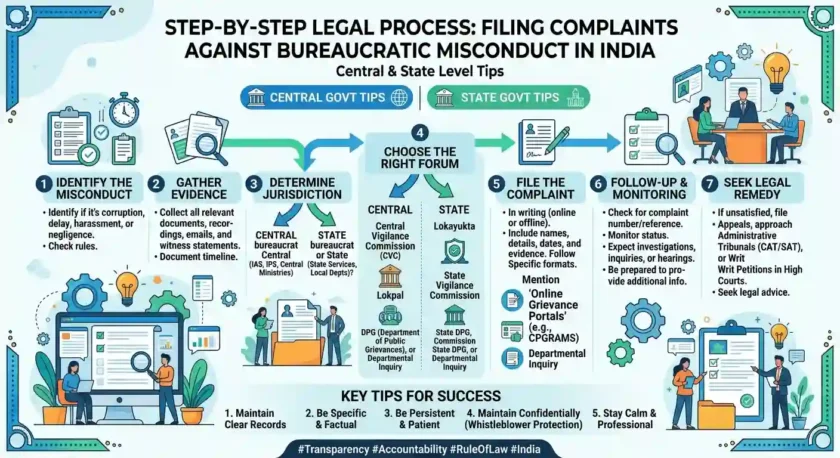
Collect Evidence Before Complaining
Strong evidence improves the credibility and practical value of a bureaucratic misconduct complaint. Preserve applications, acknowledgements, orders, notices, emails, messages, file references, photographs, recordings, and relevant government communications. Furthermore, maintain a chronological timeline showing each interaction with the concerned official. Identify witnesses who directly observed the alleged misconduct, where appropriate. Avoid submitting exaggerated allegations without supporting material because credibility can weaken quickly. Electronic records should retain original metadata wherever possible. Certified copies can strengthen challenges involving official records or administrative decisions. If information remains unavailable, consider lawful information-access mechanisms rather than making assumptions. A carefully prepared complaint should explain the duty breached, the official responsible, the evidence available, and the remedy requested. Consequently, legal support should focus on factual precision rather than inflammatory language. This approach assists vigilance authorities, police officers, grievance officers, tribunals, and constitutional courts in understanding the dispute efficiently.
Preserve the Complaint Trail
Create a complete complaint trail before approaching higher authorities or courts. First, submit the grievance to the competent authority when departmental procedures require that step. Next, preserve the acknowledgement number, date, recipient details, attachments, and response. Additionally, record every reminder and escalation with proof of delivery. CPGRAMS provides a central platform for grievances involving government service delivery across Union and State authorities. The portal permits registration, status tracking, feedback, and appeal in eligible matters. However, CPGRAMS excludes several categories, including court-related matters and RTI matters. Therefore, complainants should not treat CPGRAMS as a universal substitute for statutory proceedings. Where the grievance alleges corruption, consider the competent vigilance authority, Lokpal, or State Lokayukta. Where criminal conduct appears, approach the police or appropriate Magistrate according to applicable procedure. A documented escalation history can later support writ proceedings, departmental action, or other legal remedies.
Choosing the Correct Central or State Forum
Central Government Complaint Channels
Use CPGRAMS for Service Grievances
Escalate to the Correct Department
CPGRAMS is useful when a Central or State government organisation fails to deliver public services properly. Citizens can register grievances online and track progress through a unique registration number. Moreover, the system connects participating Ministries, Departments, and State organisations through designated grievance officers. A complainant should select the concerned department accurately and describe the service failure concisely. Attachments should establish the underlying transaction, earlier representations, and requested corrective action. However, CPGRAMS does not decide judicial disputes, RTI applications, or matters already pending before courts. The portal also provides an appeal facility after eligible grievances receive unsatisfactory closure. Therefore, complainants should preserve the grievance number and review the response carefully. If officials provide an incomplete response, legal counsel can evaluate further escalation. The official CPGRAMS portal remains the appropriate starting point for eligible public-service grievances.
Approach Central Vigilance Authorities
Allegations involving bribery, corruption, dishonest conduct, or serious vigilance concerns require a different strategy. The Central Vigilance Commission handles specified vigilance matters involving covered Central Government organisations and public servants. However, its jurisdiction does not extend to every public authority or every administrative dispute. Therefore, identify the department, cadre, organisation, and nature of the alleged misconduct before filing. A complaint should provide specific facts instead of broad accusations about corruption. Supporting documents should demonstrate the transaction, decision, financial demand, conflict, or irregularity wherever available. Furthermore, complainants should understand that vigilance proceedings differ from criminal prosecution and ordinary grievance redressal. Depending on the facts, the matter may also involve the Prevention of Corruption Act, BNS provisions, departmental rules, or disciplinary proceedings. Legal advice can help select parallel remedies without creating procedural conflicts. Importantly, false or malicious allegations can create legal risks. Consequently, factual accuracy, documentary support, and proper jurisdiction remain essential.
Consider Lokpal Jurisdiction
The Lokpal provides a statutory mechanism for corruption allegations involving specified public functionaries under the Lokpal and Lokayuktas Act, 2013. Its jurisdiction covers specified Central Government functionaries, including certain officers and officials. However, statutory exclusions and procedural requirements can affect whether a particular complaint qualifies. Section 14 addresses the Lokpal’s jurisdiction, while Section 20 concerns complaints and preliminary inquiry. Therefore, complainants should examine jurisdiction before preparing the complaint. The Lokpal framework can involve inquiry, investigation, prosecution, and related corrective powers under the statute. Moreover, complaints should contain accurate allegations supported by relevant documents and particulars. The law also addresses consequences for false complaints, making responsible drafting particularly important. State-level corruption complaints may instead fall within the relevant Lokayukta framework. Accordingly, a criminal lawyer can assess whether Lokpal, Lokayukta, vigilance, police, departmental, or judicial remedies provide the most effective route.
State-Level Complaint Channels
Approach State Authorities
Use State Grievance Systems
State bureaucratic misconduct usually requires identifying the department and its competent supervisory authority. Typical channels include District Collectors, departmental Secretaries, Commissioners, Heads of Departments, grievance cells, vigilance authorities, and State Lokayuktas. Furthermore, each State may prescribe different complaint procedures, forms, limitation periods, and jurisdictional requirements. A complainant should therefore verify the applicable State rules before escalating the dispute. Administrative complaints should identify the official, statutory function, alleged breach, evidence, and relief sought. If the matter concerns police inaction, citizens can approach senior police officers through the prescribed hierarchy. Serious criminal allegations may also justify proceedings before the jurisdictional Magistrate or competent court. Meanwhile, service disputes involving government employees may fall under specialised tribunals rather than ordinary grievance channels. Consequently, forum selection depends upon the claimant, department, disputed action, legal right, and requested remedy. A lawyer can map these factors before initiating proceedings.
Approach State Lokayukta
State Lokayuktas provide statutory mechanisms for investigating allegations of corruption or maladministration against specified public functionaries. Their powers and jurisdiction depend on the applicable State Lokayukta legislation. Therefore, citizens should not assume identical procedures across all Indian States. A complaint should generally identify the public functionary, alleged misconduct, supporting evidence, and relevant public interest. Moreover, procedural exclusions may apply to matters involving courts, legislative functions, service disputes, or other protected categories. Legal counsel can determine whether the State Lokayukta represents the correct forum. Where corruption involves a criminal offence, parallel vigilance or criminal remedies may require careful coordination. The Lokpal and Lokayuktas Act recognises State Lokayuktas through its statutory framework, while individual States maintain their governing provisions. Accordingly, jurisdiction should always be verified against current State law and applicable regulations. A properly framed complaint can request investigation, corrective measures, or other relief available under the relevant statutory framework.
Escalate Police Misconduct
Police misconduct requires prompt identification of the correct police and judicial remedy. Examples include refusal to register information, unlawful detention, intimidation, fabricated records, abuse of authority, or failure to investigate. The Bharatiya Nagarik Suraksha Sanhita, 2023 now governs criminal procedure, replacing the earlier CrPC framework. BNSS provisions should therefore guide complaints concerning registration, investigation, Magistrate intervention, and prosecution procedure. The BNS also contains provisions addressing certain unlawful conduct by public servants. Importantly, a complainant should preserve station diary references, complaint acknowledgements, medical records, CCTV material, and witness details. If a nearby police station refuses assistance, escalation can involve senior police authorities and competent judicial forums. However, jurisdiction depends upon the alleged offence, location, authority involved, and procedural circumstances. A criminal lawyer can prepare representations and determine whether Magistrate proceedings, writ remedies, or other legal avenues are appropriate.
Court, Tribunal and Constitutional Remedies
Judicial Review and Legal Proceedings
Seek High Court Intervention
Use Writ Remedies
When administrative authorities act arbitrarily, unlawfully, or without jurisdiction, constitutional remedies may become appropriate. High Courts exercise writ jurisdiction under Article 226 of the Constitution. Depending on circumstances, courts may issue directions, orders, or writs against public authorities. However, writ jurisdiction remains discretionary and does not automatically replace statutory appellate remedies. Courts may expect a complainant to use an available alternative remedy before seeking extraordinary relief. Nevertheless, exceptions can arise where fundamental rights, natural justice, jurisdictional errors, or serious procedural defects are involved. Therefore, the petition should clearly identify the impugned action, legal right, public duty, evidence, and relief sought. A lawyer should also consider limitation, territorial jurisdiction, maintainability, and necessary parties. Consequently, constitutional litigation requires more than proving dissatisfaction with an administrative decision. The petitioner must demonstrate a legally recognisable ground for judicial intervention. Proper drafting can substantially improve clarity and procedural effectiveness.
Consider Tribunals and Appeals
Certain bureaucratic disputes belong before specialised tribunals or statutory appellate authorities rather than ordinary civil courts. Service matters involving eligible government employees may fall within Central or State Administrative Tribunals, depending on applicable law. Tax, revenue, labour, consumer, regulatory, and disciplinary disputes can similarly involve specialised forums. Therefore, identifying the governing statute remains the first step before filing proceedings. Civil Procedure Code principles may apply in appropriate civil litigation, but statutory forums often follow specialised procedures. Moreover, an administrative complaint does not necessarily suspend statutory appeal limitation. Complainants should calculate limitation independently and preserve all orders and communications. If an authority passes an adverse order, legal counsel should examine appeal, revision, review, tribunal, writ, or civil remedies. Choosing the wrong forum can create delay, additional expense, and limitation risks. Hence, forum selection should follow the disputed right, authority, statute, jurisdiction, limitation period, and relief required.
Seek Magistrate or Criminal Remedies
Criminal misconduct requires distinction between an administrative grievance and an actual penal offence. The BNS contains provisions concerning public servants who knowingly disobey certain legal directions or prepare incorrect documents intending injury. BNSS provides procedural mechanisms concerning Magistrate cognizance, complaints, examination of complainants, and issue of process. Therefore, citizens should present specific facts establishing the alleged offence rather than merely alleging official unfairness. Police complaints should identify the conduct, date, location, accused official, witnesses, documents, and resulting harm. If appropriate, a Magistrate complaint may provide another procedural route. However, statutory requirements and protections concerning prosecution of public servants can apply. BNSS Section 218 addresses prosecution of Judges and public servants, making preliminary legal assessment important. Consequently, criminal litigation should proceed only after examining ingredients, evidence, sanction requirements, jurisdiction, and limitation.
Seek Departmental Accountability
Departmental proceedings can provide effective remedies where misconduct violates service rules or administrative discipline. A complaint may request preliminary inquiry, disciplinary action, transfer, suspension, recovery, or corrective supervision where legally available. However, disciplinary authorities follow applicable service rules rather than ordinary criminal procedure. Therefore, complainants should identify the competent disciplinary authority and relevant conduct regulations. Evidence should remain factual, chronological, and directly connected to the alleged misconduct. Furthermore, departmental proceedings may coexist with criminal, vigilance, or judicial proceedings, subject to applicable law. Government employees facing allegations require separate procedural protections and competent legal representation. Citizens seeking action should avoid demanding penalties beyond the authority’s legal powers. Instead, they should request an impartial inquiry and appropriate action under governing rules. Consequently, legal support can help frame a complaint that preserves evidence, identifies responsibility, and avoids jurisdictional objections. Proper escalation also creates a useful record for later judicial review when administrative remedies fail.
Claim Appropriate Legal Remedies
Legal remedies depend upon the nature of misconduct, affected right, authority involved, and available evidence. Common remedies include departmental inquiry, grievance redressal, vigilance complaint, Lokpal complaint, Lokayukta complaint, police complaint, Magistrate proceedings, statutory appeal, tribunal proceedings, and constitutional writ petitions. In suitable cases, courts may grant directions, quash unlawful orders, require reconsideration, or protect legally recognised rights. However, compensation requires an appropriate legal basis and forum. Similarly, disciplinary punishment normally rests with competent administrative authorities rather than private complainants. Therefore, the complaint should state precise relief rather than general demands for justice. A legal professional can assess whether multiple remedies can proceed concurrently or sequentially. Moreover, limitation periods, statutory bars, alternative remedies, and jurisdiction can materially affect strategy. Consequently, early legal advice often prevents wasted proceedings. The strongest complaint combines a legally sustainable allegation, reliable evidence, correct forum, proper jurisdiction, and a clearly defined remedy.
Practical Complaint Strategy
Draft a Strong Complaint
Structure Facts and Relief
A strong complaint should begin with the complainant’s identity and contact details, followed by the official’s designation and department. Next, provide a concise chronology of relevant events with dates and supporting documents. Clearly state the statutory duty, administrative rule, or legal requirement allegedly breached. Furthermore, explain the personal, financial, professional, or public harm resulting from the conduct. List documentary evidence using clear annexure references and avoid irrelevant material. If witnesses exist, identify their relevance without making unsupported allegations. Then, specify the requested action, such as inquiry, investigation, correction, disciplinary action, or registration of a criminal case. Finally, request written acknowledgement and a reasoned response. This structure helps grievance officers, vigilance authorities, police officials, tribunals, and courts understand the dispute. A lawyer can also review jurisdiction, limitation, statutory requirements, and potential counter-allegations before submission.
Avoid Common Complaint Mistakes
Many complaints fail because they combine unrelated grievances, unsupported accusations, excessive emotion, or incorrect legal provisions. A complainant should avoid threatening officials, publishing allegations prematurely, or submitting altered evidence. Furthermore, do not rely on outdated references to IPC or CrPC without considering the BNS and BNSS framework. The BSA, 2023 also governs evidence questions within its applicable scope. Therefore, legal references should match the relevant facts and current statutory framework. Another common mistake involves approaching several authorities without explaining the earlier proceedings. Maintain a consistent factual position across complaints, appeals, and petitions. Also, avoid filing repetitive grievances where a statutory appeal already exists. Instead, identify the precise administrative failure and pursue the correct remedy. Consequently, professional legal review can reduce procedural defects and improve credibility. Accurate drafting, proper forum selection, evidence preservation, and timely escalation remain the foundation of effective bureaucratic misconduct litigation.
Conclusion: Professional Legal Support for Bureaucratic Misconduct
When to Consult a Criminal Lawyer
Protect Your Rights
Obtain Strategic Legal Assistance
Bureaucratic misconduct can involve administrative law, criminal law, corruption law, constitutional remedies, service rules, and statutory appeals. Therefore, selecting the correct remedy requires careful legal analysis rather than repeated representations alone. Rajendra Criminal Law Firm can assist with criminal complaints, police inaction, public-servant misconduct, vigilance matters, Magistrate proceedings, and appropriate court remedies. Legal support can include evidence assessment, complaint drafting, jurisdiction analysis, forum selection, escalation strategy, and representation. Moreover, lawyers can evaluate whether BNS, BNSS, BSA, Prevention of Corruption Act, Lokpal law, or constitutional remedies apply. Clients should preserve original records and avoid unnecessary direct confrontation with officials. Where urgent rights or evidence face immediate risk, prompt legal advice becomes particularly important. Ultimately, an effective complaint should identify the misconduct, prove the facts, invoke the correct law, approach the proper authority, and request lawful relief. This structured approach strengthens accountability while protecting the complainant’s legal interests.
Frequently Asked Questions
Can I complain about a Central Government officer?
Yes. You may use CPGRAMS for eligible service grievances, or approach vigilance authorities, Lokpal, police, or courts depending upon the misconduct.
Can I complain against a State Government officer?
Yes. You can approach the competent department, State grievance authority, vigilance body, Lokayukta, police, tribunal, or High Court.
What if police refuse to register my complaint?
Preserve proof of refusal and escalate through the prescribed police hierarchy. Depending on circumstances, BNSS remedies and Magistrate proceedings may apply.
Can bureaucratic misconduct become a criminal offence?
Yes. Certain deliberate acts by public servants may attract BNS provisions. Legal advice should assess the offence ingredients and available evidence.
Can I approach the High Court against an officer?
Yes, where constitutional writ jurisdiction applies. However, courts may consider alternative statutory remedies, jurisdiction, maintainability, and the circumstances.
Should I hire a lawyer before filing?
Legal advice can identify the correct forum, applicable law, evidence requirements, limitation issues, and appropriate remedy before an ineffective complaint causes delay.
Read More
- Where and How to Lodge Complaints About Government Officials in India
- How to Use Public Grievance Portals to Complain About Officers
- Step-by-Step Guide to Filing Complaints Against Corrupt Officers in India
- How to Report Corruption in State Health Department Offices
- How to File a Complaint Against Officers in State Social Welfare Departments
- CPGRAMS – Centralised Public Grievance Redress and Monitoring System