Filing Complaints Against Corrupt – Corruption undermines public trust, administrative fairness, and lawful governance across India. Therefore, citizens should report unlawful conduct through appropriate legal channels without unnecessary delay. The Prevention of Corruption Act, 1988, as amended, remains the principal legislation governing corruption by public servants. Additionally, the Bharatiya Nyaya Sanhita, 2023 (BNS), Bharatiya Nagarik Suraksha Sanhita, 2023 (BNSS), and Bharatiya Sakshya Adhiniyam, 2023 (BSA) regulate criminal offences, investigations, procedures, and evidentiary standards where applicable. The Code of Civil Procedure, 1908 (CPC) may become relevant in connected civil disputes. Complaints frequently involve bribery, abuse of official position, criminal misconduct, disproportionate assets, forged records, public procurement fraud, misuse of authority, and illegal gratification. Rajendra Criminal Law Firm assists complainants and accused persons through investigations, court proceedings, appeals, and constitutional remedies before competent authorities.
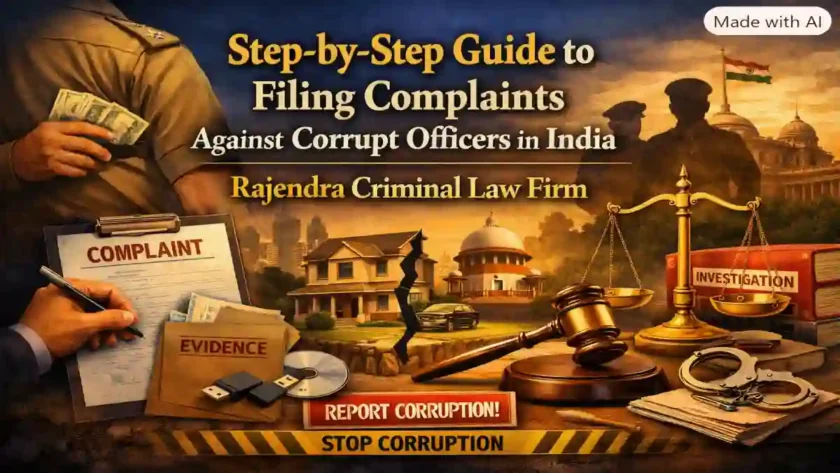
Step-by-Step Guide to Filing Complaints Against Corrupt Officers in India – Rajendra Criminal Law Firm
Authorities Empowered to Investigate Corruption
Different authorities investigate corruption according to jurisdiction, statutory powers, and the nature of allegations. Consequently, complainants should approach the appropriate authority with supporting evidence. State Vigilance and Anti-Corruption Departments investigate corruption involving State Government officials. The Central Bureau of Investigation (CBI) investigates notified matters involving Central Government employees and significant corruption offences. Departmental vigilance authorities examine service misconduct independently of criminal prosecution. Lokayuktas function under applicable State laws wherever established. Courts supervise criminal proceedings according to statutory requirements. Proper documentation, witness details, financial records, electronic communications, and documentary evidence strengthen complaints. Early legal guidance improves procedural compliance while protecting complainants from technical deficiencies during investigation and prosecution.
Identifying Corrupt Conduct and Available Evidence
Common Forms of Corruption
Evidence Required Before Filing a Complaint
Successful corruption complaints depend upon credible and legally admissible evidence. Therefore, complainants should preserve relevant records before approaching investigating authorities. Useful evidence includes audio recordings where legally obtained, official correspondence, bank transaction records, payment receipts, electronic communications, photographs, videos, tender documents, contracts, file notings, government orders, and independent witness details. Digital evidence requires careful preservation to maintain evidentiary value under the Bharatiya Sakshya Adhiniyam, 2023. Moreover, complainants should prepare a chronological summary explaining the alleged misconduct, dates, locations, officials involved, and supporting documents. Nearby Police Stations may receive complaints where cognizable offences arise within their jurisdiction. Rajendra Criminal Law Firm evaluates available evidence, identifies appropriate legal remedies, and prepares comprehensive complaints before competent investigating agencies and criminal courts.
Filing a Corruption Complaint Step-by-Step
Procedure Before Investigation Authorities
Steps for Submitting a Complaint
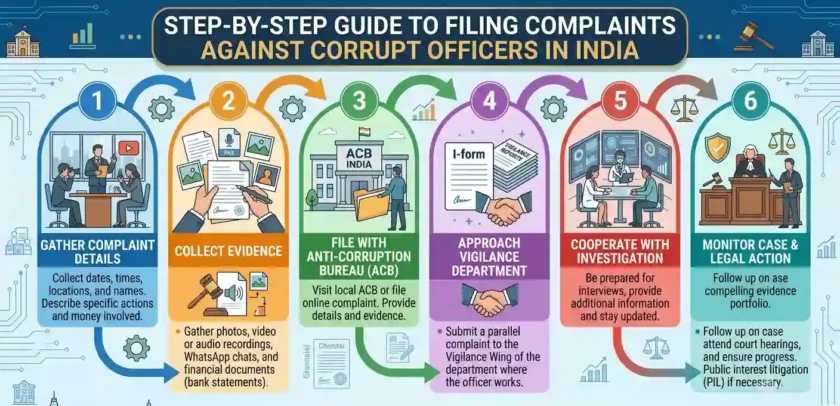
Citizens should follow a structured process while reporting corruption by public officials. Therefore, proper preparation improves acceptance and investigation outcomes. The general complaint process includes:
- Collect details of the alleged corruption incident.
- Preserve relevant documents and electronic evidence.
- Identify the concerned public officer and department.
- Prepare a written complaint with complete facts.
- Submit the complaint before the appropriate authority.
- Obtain acknowledgement or complaint reference details.
- Cooperate with investigation requirements.
- Provide additional evidence when requested.
Additionally, complainants should avoid making unsupported allegations that may weaken credibility. Vigilance authorities examine complaints based on facts, evidence, and legal requirements. Furthermore, legal professionals assist with drafting complaints, representing clients before authorities, and protecting complainants from intimidation or retaliation. Effective legal guidance ensures compliance with procedures under the Prevention of Corruption Act and BNSS while strengthening the prosecution strategy.
Important Government Departments and Forums
Several institutions handle corruption complaints depending upon the accused officer, department, and offence. Consequently, selecting the correct forum prevents unnecessary delays. Important authorities include:
| Authority / Forum | Role in Corruption Matters |
|---|---|
| State Vigilance and Anti-Corruption Department | Investigates State Government corruption |
| Central Bureau of Investigation | Handles notified Central corruption cases |
| Lokayukta | Examines complaints under State laws |
| Departmental Vigilance Wing | Conducts disciplinary inquiries |
| Police Station | Registers criminal complaints |
| Magistrate Court | Reviews criminal proceedings |
| Sessions Court | Handles serious criminal trials |
| High Court | Exercises appellate and constitutional powers |
Moreover, courts examine evidence according to BSA principles. Legal representation before these forums ensures proper pleadings, evidence presentation, and procedural protection throughout the case.
Legal Remedies Against Corrupt Officers
Criminal and Administrative Remedies
Victims of corruption and affected citizens may pursue multiple legal remedies depending upon circumstances. Therefore, selecting an appropriate remedy requires careful legal analysis. Available options include:
- Filing complaints before Vigilance Authorities.
- Requesting investigation under applicable criminal laws.
- Approaching Magistrate Courts through legal procedures.
- Seeking departmental disciplinary action.
- Filing appeals against adverse orders.
- Approaching High Courts through constitutional remedies.
- Seeking protection against harassment.
- Pursuing recovery or compensation claims where legally available.
Furthermore, corruption allegations may involve offences under the Prevention of Corruption Act, BNS, and other applicable statutes. Lawyers analyse facts, evidence, jurisdiction, and procedural requirements before initiating action. Rajendra Criminal Law Firm assists clients with complaint drafting, investigation support, bail matters, trial advocacy, appeals, and strategic litigation before courts and government authorities. Proper legal representation helps maintain fairness while ensuring accountability through lawful processes.
Effective Legal Support for Corruption Complaint Proceedings
Protecting Rights Through Professional Advocacy
Litigation Strategy and Court Representation
Role of Rajendra Criminal Law Firm
Corruption cases require careful handling because they involve public officials, government departments, and complex evidence. Therefore, professional legal support improves the effectiveness of complaint proceedings. Rajendra Criminal Law Firm assists individuals, businesses, whistleblowers, and affected parties through every stage of corruption litigation. The firm reviews complaints, prepares legal notices, analyses documents, coordinates with investigation authorities, and represents clients before criminal courts. Moreover, advocates handle bail applications, trial proceedings, appeals, revisions, and constitutional remedies before appropriate forums. Evidence assessment remains essential because courts rely on legally admissible materials under the Bharatiya Sakshya Adhiniyam, 2023. Legal professionals also ensure compliance with BNSS procedures while protecting complainants and accused persons from unlawful actions. Strategic advocacy promotes accountability while preserving principles of natural justice and fair trial.
Preventive Measures Against Corruption Risks
Individuals and organizations can reduce corruption risks through proper compliance systems and awareness. Furthermore, preventive practices help establish transparency within administrative and commercial activities. Recommended measures include:
- Maintain written official communications.
- Preserve transaction records.
- Follow government procedures.
- Conduct internal compliance audits.
- Report suspicious demands promptly.
- Verify authority before payments.
- Maintain procurement transparency.
- Train employees regarding anti-corruption laws.
- Seek legal advice during disputes.
- Preserve electronic evidence securely.
Additionally, organizations should create reporting mechanisms for unethical conduct. Proper documentation supports future investigations and court proceedings. Consequently, preventive compliance reduces exposure to criminal allegations and administrative penalties. Professional legal consultation also helps businesses understand obligations under applicable laws while managing regulatory risks effectively.
Conclusion: Seeking Justice Against Corruption
Filing complaints against corrupt officers requires accuracy, evidence, and knowledge of legal procedures. Therefore, complainants should approach competent authorities with properly prepared documentation. Rajendra Criminal Law Firm provides legal assistance for corruption complaints, vigilance proceedings, criminal investigations, bail matters, trials, appeals, and constitutional remedies. The firm represents clients before Police Stations, Vigilance Departments, Anti-Corruption Agencies, Magistrate Courts, Sessions Courts, High Courts, and the Supreme Court of India. Furthermore, advocates assist with matters involving bribery, misuse of authority, disproportionate assets, forged government records, and administrative misconduct. Early legal guidance improves procedural compliance while protecting individual rights. Effective legal advocacy ensures corruption allegations receive proper examination through lawful mechanisms and supports transparent governance throughout India.
Frequently Asked Questions
1. Where can I file a complaint against a corrupt government officer?
Complaints may be filed before Vigilance Departments, Anti-Corruption Bureaus, CBI, Lokayukta authorities, or Police Stations depending on jurisdiction.
2. What evidence is required for a corruption complaint?
Documents, communications, transaction records, witness details, and electronic evidence can support allegations when legally collected and preserved.
3. Can I complain anonymously against corruption?
Certain authorities accept anonymous information, but detailed complaints with evidence generally receive stronger investigative consideration.
4. Which laws apply to corruption cases in India?
The Prevention of Corruption Act, BNS, BNSS, and BSA provide important legal frameworks for corruption investigation and prosecution.
5. What remedies are available if authorities ignore my complaint?
Complainants may approach senior authorities, courts, or seek appropriate legal remedies through statutory and constitutional procedures.
6. How can Rajendra Criminal Law Firm help with corruption cases?
The firm assists with complaint drafting, evidence review, investigation support, bail, trial advocacy, appeals, and representation before competent forums.
Read More
- How to Effectively File Complaints Against Government Officers in India
- How to File a Complaint Against Officers in State Social Welfare Departments
- POCSO Defence: What Most Parents Don’t Know Until It’s Too Late
- How to Report Corruption in State Health Department Offices
- Accused in a Cybercrime You Didn’t Commit? 5 Urgent Steps to Take
- Central Vigilance Commission (CVC) – Government of India