
Public grievance portals offer citizens a structured route for reporting administrative failures and officer misconduct. Complaints may involve delay, corruption allegations, refusal of service, harassment, negligence, arbitrary decisions, or procedural violations. Therefore, citizens should identify the responsible department before submitting a grievance. The Centralised Public Grievance Redress and Monitoring System helps citizens approach Central Government departments. State governments maintain separate grievance mechanisms for State subjects. Additionally, departments may provide specialised portals for police, revenue, taxation, municipal, and welfare complaints. A grievance should state facts clearly and avoid unsupported accusations. Relevant documents can establish dates, applications, acknowledgments, communications, and official responses. However, serious criminal allegations may require separate legal proceedings. Rajendra Criminal Law Firm assists citizens with grievance complaints, departmental escalation, police complaints, criminal proceedings, and constitutional remedies.
How to Use Public Grievance Portals to Complain About Officers – Rajendra Criminal Law Firm
Types of Officer Misconduct and Administrative Failures
Government officers can face complaints involving several forms of administrative misconduct. Common grievances include:
- Unreasonable delay in deciding applications.
- Refusal to accept lawful representations.
- Abuse of official authority.
- Demands for unlawful payments.
- Harassment or intimidation.
- Discriminatory administrative treatment.
- Failure to provide statutory services.
- Manipulation or suppression of records.
- Unlawful police action.
- Failure to enforce applicable law.
Moreover, the correct complaint route depends upon the officer’s department and alleged conduct. A service-delivery grievance may require departmental escalation rather than criminal proceedings. Conversely, bribery, threats, assault, fabrication, or destruction of evidence may raise criminal issues. Therefore, citizens should distinguish administrative dissatisfaction from punishable misconduct. The Bharatiya Nyaya Sanhita, 2023 now provides the substantive criminal-law framework. The Bharatiya Nagarik Suraksha Sanhita, 2023 governs criminal procedure. Legal counsel can identify the appropriate remedy before filing multiple complaints.
Choosing the Correct Government Portal
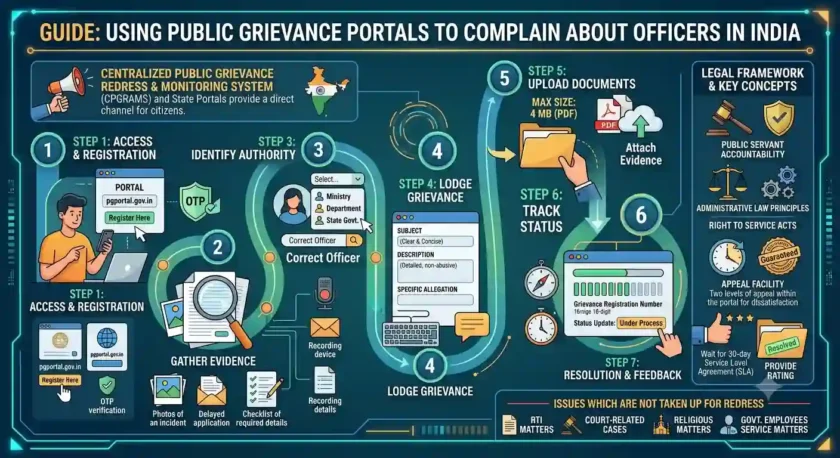
Choosing the correct portal increases the likelihood of meaningful grievance resolution. The Central Government’s CPGRAMS portal accepts public grievances concerning Central Government departments and organisations. State matters generally require the concerned State grievance system. Furthermore, some departments maintain dedicated complaint portals for specialised subjects. Citizens should first identify the department controlling the disputed service. Next, they should identify the officer, office, application number, and relevant jurisdiction. A complaint should explain what happened, when it happened, and what remedy the complainant seeks. Supporting documents should remain legible and properly organised. Additionally, citizens should retain the grievance registration number after submission. That number supports future tracking and escalation. However, a grievance portal does not replace every statutory appeal, criminal complaint, or judicial proceeding. Rajendra Criminal Law Firm can determine whether portal action should accompany another legal remedy.
Filing, Escalation and Legal Remedies
Preparing a Strong Online Grievance
A well-drafted grievance should present facts chronologically and identify a specific administrative failure. Begin with the complainant’s identity and relevant application or service details. Then identify the department, office, and officer concerned. Explain the events using dates and objective facts. Avoid emotional language, personal attacks, and speculative allegations. Next, identify the rule, service obligation, or procedure allegedly violated. Attach applications, receipts, notices, emails, orders, photographs, and other relevant records. Furthermore, specify the remedy requested from the competent authority. A useful request might seek investigation, decision, correction, service delivery, disciplinary review, or written reasons. Citizens should retain the submitted complaint and acknowledgment. Electronic records can later support proceedings under the Bharatiya Sakshya Adhiniyam, 2023. Therefore, careful drafting strengthens both administrative and potential judicial proceedings.
CPGRAMS and Central Government Complaints
CPGRAMS provides an important online mechanism for citizens seeking redress from Central Government authorities. Citizens can register grievances concerning participating Central Government departments and organisations. After registration, the complainant receives a registration reference for tracking. Therefore, applicants should preserve the reference number and submitted documents. The grievance should identify the department and explain the precise administrative failure. Furthermore, citizens should avoid filing repetitive complaints without new facts or grounds. If the response fails to address the grievance, available escalation mechanisms should receive consideration. However, portal procedures cannot override statutory limitation periods or mandatory appellate processes. A person challenging a judicial or quasi-judicial order may require the legally prescribed appeal instead. Likewise, corruption allegations may require specialised authorities. Legal counsel can assess whether CPGRAMS, departmental remedies, statutory appeals, police complaints, or court proceedings should operate together.
State and Local Government Grievances
State and local authorities require complaints through appropriate State or departmental grievance mechanisms. Police, revenue, municipal, transport, registration, welfare, and local administration complaints can follow different procedures. Therefore, citizens should identify whether the disputed officer works under Central, State, or local administration. A complaint should also identify the territorial jurisdiction and relevant office. Subsequently, the authority can route the grievance to the responsible department. Citizens should monitor responses and retain every communication. Furthermore, failure to resolve a grievance may justify departmental escalation or a statutory remedy. Some matters require appeals before designated authorities rather than general grievance portals. Municipal and revenue disputes can also involve specialised tribunals or statutory authorities. Consequently, portal users should avoid treating every administrative dispute as a generic complaint. Rajendra Criminal Law Firm can assess jurisdiction and recommend the appropriate escalation pathway.
Complaints Against Police Officers
Complaints concerning police officers require careful distinction between administrative misconduct and criminal conduct. Citizens may complain about refusal to register information, unlawful detention, harassment, intimidation, abuse, or investigation irregularities. Depending upon the circumstances, departmental authorities, senior police officers, statutory commissions, or courts may provide remedies. The BNSS governs current criminal procedure and includes mechanisms concerning information about cognisable offences. A citizen should preserve complaint copies, acknowledgment records, messages, medical records, and relevant witness details. Furthermore, serious misconduct may justify proceedings before competent judicial authorities. A criminal complaint should clearly state facts supporting the alleged offence. However, disagreement with a lawful investigation does not automatically establish criminal misconduct. Therefore, legal analysis should precede allegations against investigating officers. Rajendra Criminal Law Firm provides assistance with police complaints, escalation representations, criminal proceedings, bail-related issues, and constitutional remedies.
Anti-Corruption and Bribery Complaints
Allegations of bribery require specialised handling because they may involve criminal and disciplinary consequences. Citizens should document the demand, date, location, officer identity, and surrounding circumstances. However, individuals should avoid taking risky independent steps without appropriate legal guidance. Depending upon the public servant and jurisdiction, the State Anti-Corruption Bureau, Central Bureau of Investigation, Lokayukta, or other competent authority may become relevant. The Prevention of Corruption Act, 1988 remains central to public-sector corruption offences. Therefore, a corruption complaint should identify concrete facts rather than broad suspicions. Supporting records can include applications, official communications, transaction details, and lawful electronic evidence. Furthermore, portal complaints may supplement but not necessarily replace specialised anti-corruption procedures. Legal counsel can determine the competent authority and appropriate filing method. Prompt advice also helps protect complainants from procedural mistakes and preserve relevant evidence.
Departmental Action and Disciplinary Proceedings
An officer’s misconduct can also trigger departmental proceedings under applicable service rules. A grievance may lead to administrative examination, preliminary inquiry, vigilance review, or disciplinary action. The exact process depends upon the officer’s service conditions and controlling authority. Therefore, complainants should understand that a grievance response may not disclose confidential disciplinary details. Employees or officers facing allegations also possess procedural rights under applicable service rules. They may require assistance with notices, charges, inquiries, evidence, and disciplinary representations. Furthermore, an administrative complaint does not automatically establish guilt. Authorities must apply applicable procedures before imposing disciplinary consequences. Citizens should therefore focus complaints on verifiable conduct and relevant documents. Meanwhile, accused officers should receive advice before submitting detailed explanations. Rajendra Criminal Law Firm assists complainants and affected persons with departmental representations, vigilance matters, disciplinary proceedings, and related litigation.
Escalation After an Unsatisfactory Response
An inadequate grievance response does not necessarily end the complainant’s available remedies. First, examine whether the authority actually answered each material allegation. Second, identify whether a statutory appeal or review mechanism exists. Third, escalate the grievance to the competent superior authority where permitted. Fourth, consider specialised bodies for corruption, human rights, women, children, or other protected interests. Finally, assess judicial remedies where administrative mechanisms fail. A High Court may exercise constitutional jurisdiction under Articles 226 and 227 in appropriate cases. However, courts may consider alternative statutory remedies before exercising discretionary jurisdiction. Therefore, a writ petition should contain precise facts, legal grounds, supporting documents, and appropriate relief. The Code of Civil Procedure may apply to suitable civil proceedings, but specialised statutory procedures can govern many disputes. Legal counsel can determine the correct escalation sequence and prevent parallel proceedings from creating unnecessary complications.
Evidence and Digital Records
Evidence can significantly influence the outcome of an officer-misconduct complaint. Citizens should preserve original applications, acknowledgment receipts, orders, notices, emails, messages, recordings, photographs, and portal submissions. Electronic records should retain their original context and metadata where available. Furthermore, screenshots should accompany relevant source information whenever possible. The Bharatiya Sakshya Adhiniyam, 2023 governs evidentiary rules for modern legal proceedings. Therefore, digital evidence should receive careful handling before court submission. Citizens should never fabricate, alter, or selectively manipulate records. Such conduct can undermine an otherwise legitimate grievance and create separate legal consequences. Additionally, maintain a chronological evidence index linking each document to the relevant allegation. This method helps authorities understand the complaint quickly. Rajendra Criminal Law Firm can review evidence, prepare representations, identify evidentiary gaps, and formulate litigation strategies based upon documented facts.
Police Stations and Criminal Remedies
Some officer-related grievances require immediate criminal-law assessment rather than ordinary portal escalation. Allegations involving assault, threats, extortion, wrongful confinement, forgery, destruction of evidence, or other offences may require criminal action. The BNS identifies offences and applicable punishments, while the BNSS governs criminal procedure. Therefore, citizens should identify whether the facts disclose a cognisable offence. A complaint may require submission before the appropriate police station or competent senior authority. If police fail to act, further remedies may exist under the BNSS and applicable judicial procedures. However, citizens should avoid filing criminal allegations merely to pressure an officer during an administrative dispute. Courts can scrutinise misuse of criminal process. Consequently, legal advice helps distinguish genuine criminal conduct from ordinary service dissatisfaction. Rajendra Criminal Law Firm can advise on police complaints, magistrate remedies, investigation issues, bail proceedings, and criminal litigation.
Human Rights and Specialised Commissions
Certain complaints may fall within specialised statutory or constitutional bodies. Human-rights violations can involve unlawful detention, custodial violence, discrimination, or abuse by public authorities. The National Human Rights Commission and State Human Rights Commissions may possess relevant jurisdiction depending upon the facts. Similarly, complaints involving women, children, persons with disabilities, or other protected interests may require specialised authorities. Therefore, citizens should identify the subject matter before selecting a forum. A grievance portal may remain useful, but specialised proceedings can offer additional remedies. Furthermore, complainants should check applicable limitation, jurisdiction, and procedural requirements. Supporting records should accompany every complaint where permitted. Legal counsel can determine whether a commission complaint, departmental representation, criminal proceeding, or writ petition offers the strongest remedy. Strategic forum selection can prevent unnecessary duplication and improve the prospects of effective relief.
Remedies Before Courts and Tribunals
Administrative grievances can sometimes progress into formal judicial or quasi-judicial proceedings. Depending upon the subject, forums may include Magistrate Courts, Sessions Courts, High Courts, Central Administrative Tribunal, State Administrative Tribunal, labour forums, consumer commissions, or specialised tribunals. Therefore, the applicable statute should determine the correct forum. A public employee may require service-law remedies through a tribunal or constitutional court. A criminal allegation may require proceedings under the BNSS before criminal courts. Civil disputes may involve civil courts subject to jurisdictional restrictions and statutory remedies. Furthermore, writ jurisdiction can address public-law failures in appropriate cases. The CPC may govern ordinary civil procedure where applicable. Consequently, legal counsel should evaluate maintainability before filing proceedings. Rajendra Criminal Law Firm provides representation before appropriate courts, tribunals, and authorities according to the nature of each dispute.
Legal Notice and Pre-Litigation Strategy
A legal notice can clarify the dispute before formal litigation begins. The notice should identify the authority, relevant officer, disputed action, legal grounds, evidence, and requested remedy. Furthermore, it should provide a reasonable opportunity for corrective action where appropriate. A notice can also establish that the complainant pursued available administrative remedies. However, a legal notice cannot replace mandatory statutory procedures. Some matters require direct complaints before specialised authorities or courts. Therefore, counsel should determine whether issuing notice advances the client’s interests. The notice should avoid exaggerated allegations and unsupported criminal accusations. Instead, it should focus on legally actionable facts and available remedies. A carefully drafted notice can encourage administrative correction and preserve the factual record. Rajendra Criminal Law Firm can prepare legal notices, representations, complaints, petitions, and replies concerning officer misconduct and administrative failures.
Writ Remedies Under the Constitution
High Courts possess constitutional powers that can address unlawful administrative action in appropriate circumstances. Article 226 enables High Courts to issue writs for enforcement of fundamental rights and other legal purposes. Article 227 provides supervisory jurisdiction over subordinate courts and tribunals. Therefore, writ proceedings may address arbitrary administrative action, jurisdictional errors, procedural unfairness, or failure to perform public duties. However, writ jurisdiction remains discretionary. Courts may decline intervention where an adequate alternative statutory remedy exists. Furthermore, disputed facts can influence whether writ proceedings provide an appropriate solution. A successful petition may seek directions, mandamus, certiorari, prohibition, or other suitable relief. Consequently, constitutional litigation requires precise legal grounds and supporting evidence. Rajendra Criminal Law Firm can evaluate writ maintainability, formulate grounds, prepare petitions, and represent clients before constitutional courts.
Common Mistakes to Avoid
Citizens often weaken legitimate grievances through avoidable procedural mistakes. Common errors include filing with the wrong department, making unsupported accusations, omitting dates, and attaching incomplete records. Some complainants also file identical grievances repeatedly without addressing the authority’s response. Others confuse administrative dissatisfaction with criminal offences. Furthermore, citizens sometimes ignore statutory appeals while relying exclusively on grievance portals. Such choices can create limitation problems and weaken available remedies. A complainant should therefore maintain a complete chronological record. The record should include applications, responses, portal numbers, notices, orders, and escalation attempts. Additionally, avoid publishing unverified allegations against officers on social media. Defamatory or contemptuous communications can create separate legal issues. Professional legal advice can prevent these mistakes. Rajendra Criminal Law Firm helps clients develop evidence-based complaints and legally appropriate escalation strategies.
How Rajendra Criminal Law Firm Can Help
Rajendra Criminal Law Firm provides legal support when officer misconduct requires stronger intervention. The firm can assess administrative grievances, police complaints, corruption allegations, criminal offences, departmental misconduct, and constitutional remedies. Legal services may include:
- Public grievance drafting and filing.
- Departmental escalation.
- Police complaint preparation.
- Anti-corruption complaint guidance.
- Legal notices and representations.
- Magistrate and criminal proceedings.
- Bail and investigation assistance.
- High Court writ petitions.
- Tribunal and administrative litigation.
- Evidence and procedural strategy.
Moreover, each complaint receives assessment according to its facts, jurisdiction, evidence, and applicable law. A grievance portal can provide an important first step, but it may not provide the final remedy. Therefore, timely legal assessment remains important where officer conduct causes serious prejudice. The firm assists clients in identifying the correct authority and legally sustainable course of action.
A Practical Complaint Roadmap
A systematic complaint strategy can improve clarity, accountability, and legal protection. Start by recording the officer’s identity, department, office, and jurisdiction. Next, preserve the original application and proof of submission. Then prepare a concise chronology describing every significant event. Identify the exact service failure, misconduct, or unlawful action. Attach relevant documents and state the remedy sought. Submit the grievance through the competent official portal and preserve its acknowledgment. Thereafter, monitor the response and assess whether it resolves the material issue. If necessary, escalate through the department, specialised authority, statutory forum, or court. Serious criminal conduct may require police or judicial intervention under the BNSS. Finally, maintain one complete evidence file containing every submission and response. Professional legal advice can ensure each stage supports the next available remedy.
Frequently Asked Questions
Can I complain about a government officer online?
Yes. CPGRAMS and State grievance portals provide administrative complaint mechanisms. The correct portal depends upon the concerned department, government level, subject matter, and jurisdiction.
Can I complain about police misconduct?
Yes. Citizens can pursue departmental, senior-police, statutory, or judicial remedies. Serious conduct may also require criminal proceedings under the BNSS and BNS.
What evidence should accompany my complaint?
Attach applications, acknowledgments, orders, emails, messages, photographs, notices, and relevant records. Preserve originals and maintain a clear chronological evidence file.
Can a grievance portal replace court proceedings?
Usually, no. Statutory appeals, criminal proceedings, tribunal cases, and writ petitions may require separate filing. Legal advice should determine the appropriate remedy.
What if an officer demands a bribe?
Record relevant facts safely and seek advice promptly. Depending upon jurisdiction, an Anti-Corruption Bureau, CBI, Lokayukta, or other competent authority may have jurisdiction.
Can I approach the High Court against officer misconduct?
Yes, appropriate cases may support writ jurisdiction under Articles 226 or 227. However, courts may consider alternative statutory remedies before exercising discretionary jurisdiction.
Read More
- Step-by-Step Guide to Filing Complaints Against Corrupt Officers in India
- How to Effectively File Complaints Against Government Officers in India
- How to File a Complaint Against Officers in State Social Welfare Departments
- Complaint Process for State Education Department Officials
- How to Report Corruption in State Health Department Offices
- Centralised Public Grievance Redress and Monitoring System (CPGRAMS)