Lodge Complaints About Government Officials – Government official complaints may arise from corruption, bribery, abuse of authority, harassment, discrimination, unlawful demands, negligence, or service-delivery failures. Citizens can complain when officials violate statutory duties or misuse public office. However, the correct forum depends upon the officer, department, conduct, and requested remedy. CPGRAMS accepts grievances concerning public authorities and connects complaints with concerned Central and State departments. Therefore, complainants should identify the official, department, location, date, and precise misconduct. Supporting documents should establish facts without unnecessary allegations. Furthermore, complaints involving criminal conduct may require police action under current criminal laws. The BNS addresses substantive offences, while BNSS governs criminal procedure. The BSA governs relevant evidentiary questions. Consequently, legal advice can help distinguish administrative grievances from criminal offences. Rajendra Criminal Law Firm assists individuals, companies, NGOs, and NRIs with complaint drafting and legal remedies.
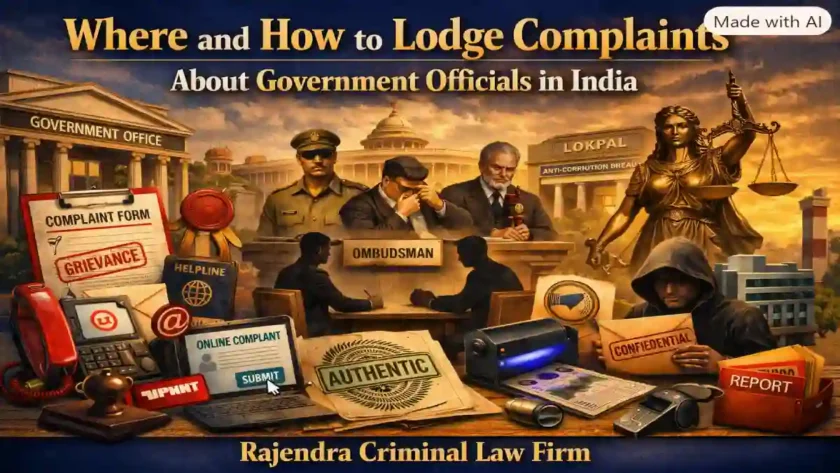
Where and How to Lodge Complaints About Government Officials in India – Rajendra Criminal Law Firm
Choosing the Correct Complaint Authority
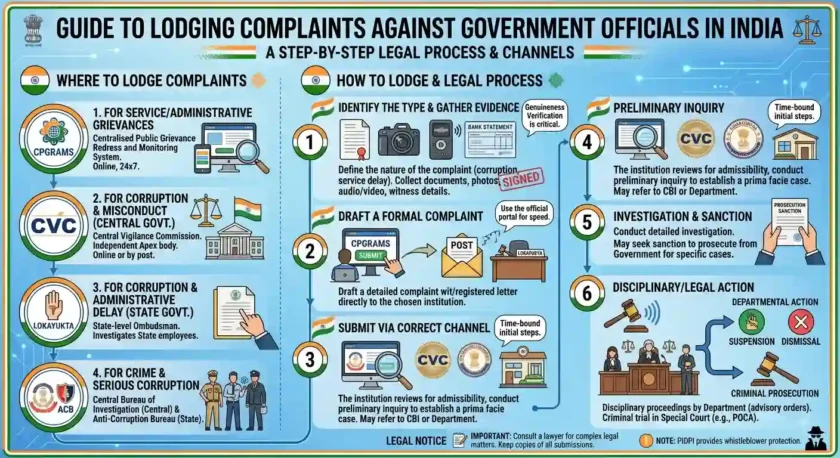
Complaint jurisdiction depends upon whether the official serves Central Government, State Government, local government, or another public institution. CPGRAMS provides a centralised mechanism connected with Government ministries, departments, and States. However, CPGRAMS excludes certain matters, including sub judice cases and RTI matters. Corruption complaints may require specialised vigilance authorities instead. The Central Vigilance Commission handles specified Central Government corruption matters and does not cover State Government employees. Lokpal jurisdiction can also apply to eligible public servants under the Lokpal and Lokayuktas Act. Therefore, complainants should select the forum after analysing the officer’s status. Additionally, departmental disciplinary authorities can investigate service misconduct. Courts may provide judicial remedies when administrative action violates legal rights. Consequently, forum selection should precede complaint filing. Proper jurisdiction can improve efficiency and prevent dismissal for approaching an unsuitable authority.
Preparing a Strong Government Complaint
A government complaint should present facts chronologically and identify a specific grievance. Start by identifying the complainant, official, department, office, and relevant transaction. Next, describe what happened, when it happened, and how the conduct violated a duty. Attach supporting documents, communications, receipts, orders, photographs, recordings, or other lawful evidence. Furthermore, identify witnesses where their evidence genuinely supports the allegations. Avoid emotional language, speculation, personal attacks, or unsupported criminal accusations. A strong complaint should request a precise remedy, such as inquiry, correction, disciplinary action, investigation, or recovery. CPGRAMS provides a registration number that enables grievance tracking and permits appeals after unsatisfactory resolution. Therefore, complainants should preserve acknowledgement details and every subsequent response. Lawyers can also issue representations before escalation to statutory forums. Consequently, careful drafting creates a reliable administrative record. Professional legal assistance becomes especially valuable when allegations involve corruption, coercion, forged records, or repeated official misconduct.
Complaint Procedure, Criminal Remedies and Judicial Relief
Administrative Grievance Mechanisms
Administrative grievance mechanisms provide the first practical route for many complaints against government officials. CPGRAMS operates continuously and accepts public-service grievances concerning Central and State Government organisations. Complainants can track their registration number and use the available appeal mechanism. However, CPGRAMS does not replace statutory proceedings, criminal investigations, or court remedies. Therefore, applicants should determine whether the grievance concerns service delivery or an independent legal violation. Departmental grievance officers can address delays, refusals, administrative errors, and service deficiencies. Furthermore, senior departmental authorities may review subordinate officials’ conduct under applicable service rules. Written representations should identify previous complaints and unresolved issues. Additionally, complainants should avoid filing duplicate complaints across unrelated authorities. Proper escalation can produce faster administrative attention. If the department fails to act, lawyers can examine statutory remedies and judicial review. Consequently, administrative complaint procedures can form the foundation for later proceedings.
Central Vigilance Commission Complaints
Central Vigilance Commission complaints concern specified corruption allegations involving covered Central Government officials and organisations. The CVC states that its jurisdiction does not extend to State Government employees or State Government activities. Therefore, complainants must first determine whether the accused official falls within CVC jurisdiction. Allegations should contain specific facts concerning corruption or misuse of office. Supporting documents should establish the transaction, official involvement, and alleged misconduct. Furthermore, anonymous or vague accusations may face procedural limitations. The CVC’s complaint mechanism operates under its statutory and vigilance framework. Consequently, citizens should avoid sending State-level corruption complaints to the CVC. State vigilance or anti-corruption agencies may provide the appropriate alternative. Lawyers can assess jurisdiction and prepare a focused complaint with supporting evidence. Additionally, complainants should preserve proof of submission and subsequent communications. Properly framed vigilance complaints can support investigation and departmental action. Legal assistance also helps prevent unsupported allegations from weakening legitimate corruption complaints.
Lokpal and Lokayukta Remedies
Lokpal complaints provide a statutory route for eligible corruption allegations involving public servants within the applicable jurisdiction. The Lokpal complaint rules prescribe requirements concerning complaint forms, information, supporting material, and processing. The rules also address circumstances where complaints may face dismissal, including vagueness, frivolous allegations, limitation, or pending proceedings. Therefore, complainants should establish clear allegations supported by relevant evidence. State-level Lokayuktas operate under respective State laws and may cover State public officials. Jurisdiction varies according to statutory provisions and the status of the accused officer. Consequently, lawyers should examine the applicable law before filing. A complaint should identify the official, conduct, dates, documents, witnesses, and requested investigation. Furthermore, complainants should disclose relevant pending proceedings where required. Proper legal drafting can reduce procedural objections. Rajendra Criminal Law Firm assists complainants in evaluating Lokpal, Lokayukta, vigilance, departmental, police, and judicial remedies.
Police Complaints Against Government Officials
Police complaints become relevant when an official’s conduct potentially constitutes a criminal offence. Current criminal law uses the Bharatiya Nyaya Sanhita, 2023 for substantive offences. The Bharatiya Nagarik Suraksha Sanhita, 2023 governs criminal procedure, including investigation and reporting mechanisms. The Bharatiya Sakshya Adhiniyam, 2023 governs evidence questions. Therefore, complainants should describe specific criminal acts rather than merely alleging poor administration. Relevant evidence may include documents, messages, recordings, CCTV footage, receipts, and witness information. Additionally, the appropriate police station depends upon territorial and statutory jurisdiction. If police fail to register or investigate a cognisable offence, further statutory remedies may become available. Lawyers can prepare complaints, representations, and applications before competent authorities. However, criminal proceedings should not become a substitute for ordinary administrative appeals. Consequently, lawyers should separate criminal allegations from service grievances. Proper classification can help direct each issue toward the appropriate legal forum and remedy.
Departmental Disciplinary Proceedings
Departmental proceedings address misconduct by government employees under applicable service rules. Allegations may include dereliction of duty, insubordination, corruption, harassment, abuse of authority, or violation of conduct rules. The competent disciplinary authority determines the applicable procedure according to the employee’s service framework. Therefore, citizens should submit evidence to the authority empowered to investigate or initiate proceedings. A complaint should avoid demanding a predetermined punishment without establishing facts. Furthermore, documents should demonstrate the official’s role and the resulting public harm. Senior officers may conduct preliminary examinations before formal disciplinary action. Additionally, departmental proceedings can operate separately from criminal investigations in appropriate cases. Courts generally examine disciplinary decisions through applicable judicial-review principles. Consequently, complainants should preserve records showing dates, representations, acknowledgements, and departmental responses. Lawyers can assist with drafting representations and monitoring procedural developments. Effective legal support ensures that administrative complaints remain factual, precise, and connected with applicable service rules.
Right to Information and Government Records
RTI applications can help citizens obtain information concerning government decisions, records, files, and official actions. The Right to Information Act, 2005 provides a statutory framework for accessing information from public authorities. However, RTI applications differ from grievance complaints and should not demand action as their primary purpose. CPGRAMS expressly excludes RTI matters from its grievance mechanism. Therefore, applicants should use the RTI framework when seeking information. Requested records may include file notings, orders, correspondence, approvals, inspection reports, and action-taken details, subject to statutory exemptions. Furthermore, information obtained through RTI can support subsequent administrative or judicial proceedings. Lawyers can help formulate precise information requests and identify appropriate appellate remedies. Consequently, RTI can become an important evidence-gathering tool. However, applicants should not misuse RTI to pursue private disputes or unsupported accusations. Properly obtained government records can strengthen complaints and clarify responsibility.
Civil Court and Judicial Review Remedies
Civil courts and constitutional courts may provide remedies when official action infringes legal rights. The Code of Civil Procedure governs ordinary civil proceedings, subject to statutory exclusions and specialised forums. Depending upon circumstances, a claimant may seek declaration, injunction, damages, recovery, or other appropriate relief. High Courts can exercise constitutional judicial-review jurisdiction under Article 226. Therefore, unlawful administrative action may require judicial scrutiny when ordinary remedies prove inadequate. However, courts generally consider alternative statutory remedies and jurisdictional limitations. Furthermore, limitation and maintainability can significantly affect proceedings. Lawyers should identify the precise legal right affected and the authority responsible. Documentary evidence should establish the official action and resulting prejudice. Additionally, courts may require compliance with procedural requirements before granting relief. Consequently, legal consultation should precede filing a writ or civil action. Strategic forum selection can reduce delays and prevent procedural objections. Rajendra Criminal Law Firm can coordinate appropriate criminal, administrative, and judicial remedies.
Complaints Involving Corruption and Bribery
Corruption complaints require specific facts showing an alleged demand, acceptance, misuse of authority, or other prohibited conduct. Mere suspicion may not provide sufficient grounds for effective proceedings. Therefore, complainants should preserve communications, transaction details, witnesses, and other lawful evidence. Depending upon the official’s status, the appropriate authority may include CVC, Lokpal, State vigilance, anti-corruption agencies, or police authorities. The CVC’s jurisdiction specifically covers designated Central Government categories and excludes State Government personnel. Consequently, identifying the employer and controlling authority remains essential. Lawyers can advise complainants on evidence preservation and statutory procedures. Furthermore, complainants should avoid attempting independent sting operations without legal guidance. Such conduct can create evidentiary or personal risks. Appropriate authorities can determine investigation methods according to law. Therefore, a legally structured complaint can protect the complainant while presenting credible allegations. Professional representation also helps address retaliation, confidentiality, and procedural concerns where applicable.
Complaints by Companies, NGOs and NRIs
Companies and NGOs may complain against officials concerning licences, approvals, registrations, inspections, taxation, tenders, regulatory decisions, or service delivery. NRIs may encounter issues involving property records, passports, immigration, consular services, taxation, banking, or government administration. Therefore, legal representatives can submit complaints where direct participation creates practical difficulties. Corporate complaints should identify the authorised representative and attach authority documents. NGO complaints should identify the organisation and responsible office bearers. NRIs should provide appropriate identification and authorisation where representation occurs. Furthermore, each complainant should preserve official acknowledgements and responses. CPGRAMS accepts grievances relating to Central and State Government organisations, subject to its exclusions. However, specialised regulators or courts may provide better remedies for certain disputes. Consequently, legal counsel should determine whether administrative, criminal, regulatory, or judicial action fits the circumstances. Rajendra Criminal Law Firm assists diverse complainants with complaint drafting, evidence review, escalation, and litigation strategy.
Evidence and Digital Records in Complaints
Evidence preservation strengthens complaints against government officials and protects complainants during subsequent proceedings. Useful material can include official letters, emails, electronic messages, receipts, applications, orders, photographs, videos, and certified government records. Furthermore, complainants should preserve original electronic material whenever possible. Screenshots alone may not establish complete context or authenticity. The BSA provides the current statutory framework governing documentary and electronic evidence. Therefore, lawyers should consider evidentiary requirements before submitting digital material. Certified copies can strengthen proof concerning official records. Additionally, a chronological index can help authorities understand complex allegations. Complainants should record dates, officers contacted, responses received, and pending requests. Consequently, evidence should support each material allegation separately. Avoiding exaggerated claims can improve credibility. Lawyers can review documents before filing and identify evidentiary gaps. Proper evidence management also helps during police investigation, departmental inquiry, vigilance proceedings, Lokpal proceedings, or judicial review.
Legal Remedies and Strategic Legal Support
Legal remedies against government officials depend upon the nature of misconduct and the responsible authority. Available routes may include departmental complaints, CPGRAMS, vigilance complaints, Lokpal or Lokayukta proceedings, police complaints, RTI applications, consumer remedies, civil proceedings, and writ petitions. However, every remedy has distinct jurisdiction, procedure, limitation, and evidentiary requirements. Therefore, complainants should avoid filing every possible proceeding simultaneously. A lawyer can first classify the grievance as administrative, civil, criminal, regulatory, or constitutional. Furthermore, counsel can identify the competent authority and prepare supporting documents. CPGRAMS provides tracking and an appeal facility for eligible grievances. Yet CPGRAMS does not adjudicate matters already before courts or certain excluded categories. Consequently, strategic legal advice can prevent forum conflicts and procedural failures. Rajendra Criminal Law Firm offers complaint drafting, legal notices, police representations, vigilance complaints, court petitions, and follow-up support. Early action can preserve evidence and protect legal rights.
Frequently Asked Questions About Complaints Against Officials
Can I complain against a government officer for corruption?
Yes. Depending on jurisdiction, complaints may go to vigilance authorities, Lokpal, Lokayukta, police, or another competent authority.
Can I file a complaint through CPGRAMS?
Yes. CPGRAMS accepts eligible grievances concerning Central and State Government organisations. It provides tracking and an appeal facility.
Can CPGRAMS handle criminal complaints?
CPGRAMS primarily handles public grievances and service-delivery issues. Criminal allegations may require police or another competent statutory authority.
What if police refuse my complaint?
You may have further remedies under BNSS. A lawyer can examine the facts and identify the appropriate statutory or judicial remedy.
Can an NRI complain against an Indian government official?
Yes. NRIs can pursue eligible complaints through authorised representatives, online government mechanisms, regulators, police, or courts.
Can I approach the High Court against official inaction?
A High Court may exercise judicial-review jurisdiction where applicable. However, maintainability and alternative statutory remedies require careful legal assessment.
Read More
- How to Use Public Grievance Portals to Complain About Officers
- Step-by-Step Guide to Filing Complaints Against Corrupt Officers in India
- How to Effectively File Complaints Against Government Officers in India
- How to Report Corruption in State Health Department Offices
- How to File a Complaint Against Officers in State Social Welfare Departments
- CPGRAMS – Centralised Public Grievance Redress and Monitoring System