File Complaints Against Government Officers – Citizens possess legal rights to report misconduct by government officers through statutory complaint mechanisms. Therefore, timely action protects public interest and promotes accountable governance. Rajendra Criminal Law Firm assists individuals, businesses, NGOs, and NRIs facing unlawful administrative actions across India. Complaints may involve corruption, abuse of authority, dereliction of duty, harassment, illegal detention, document manipulation, bribery, discrimination, or misuse of public office. Appropriate legal advice helps complainants select the correct authority before initiating proceedings. Moreover, supporting evidence significantly improves complaint credibility and investigation quality. Several statutory remedies exist before vigilance authorities, Police Stations nearby, departmental authorities, Lokpal, Lokayukta, Human Rights Commissions, and competent courts. Proper documentation strengthens complaints while reducing procedural objections. Early legal consultation often prevents avoidable delays and jurisdictional errors.
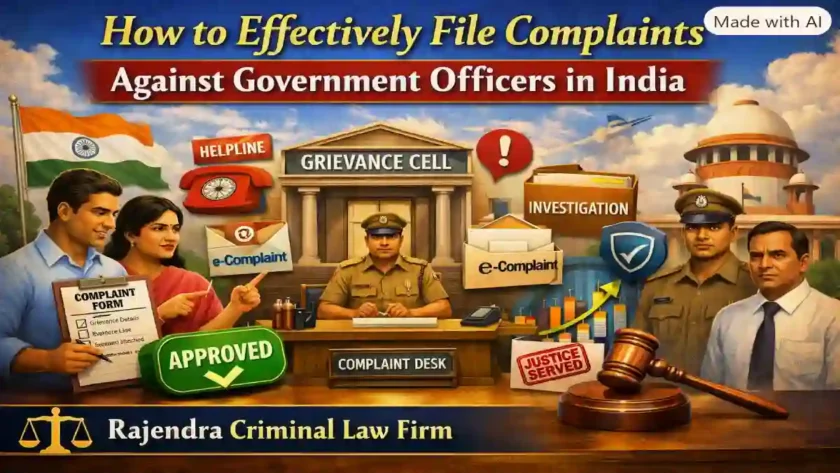
How to Effectively File Complaints Against Government Officers in India – Rajendra Criminal Law Firm
Common Grounds for Filing Complaints
Government officers remain accountable for unlawful conduct performed during official duties or public administration. Accordingly, complainants should identify the precise legal violation before submitting representations. Common grounds include bribery demands, corruption, refusal to perform statutory duties, illegal seizure, abuse of authority, criminal intimidation, wrongful confinement, forged official records, discrimination, negligence, misconduct, and violation of constitutional rights. Service-related misconduct may also justify departmental proceedings under applicable service rules. Furthermore, administrative decisions violating statutory provisions may require judicial review before competent courts. Every allegation should rely upon verifiable evidence rather than assumptions. Accurate factual narration improves investigation quality and legal sustainability. Professional legal guidance strengthens procedural compliance throughout every complaint stage.
Laws Governing Complaints Against Public Servants
Indian law provides several statutory mechanisms for addressing misconduct by government officials. Consequently, complainants should understand applicable legislation before initiating legal proceedings. The Bharatiya Nyaya Sanhita, 2023 governs several criminal offences involving public servants. The Bharatiya Nagarik Suraksha Sanhita, 2023 regulates criminal investigation and procedural safeguards. The Bharatiya Sakshya Adhiniyam, 2023 governs documentary and electronic evidence before courts. The Prevention of Corruption Act, 1988 addresses bribery and criminal misconduct involving public servants. Additionally, the Right to Information Act, 2005 assists citizens in obtaining relevant public records. Constitutional remedies also remain available before High Courts and the Supreme Court whenever fundamental rights require judicial protection.
Selecting the Appropriate Complaint Authority
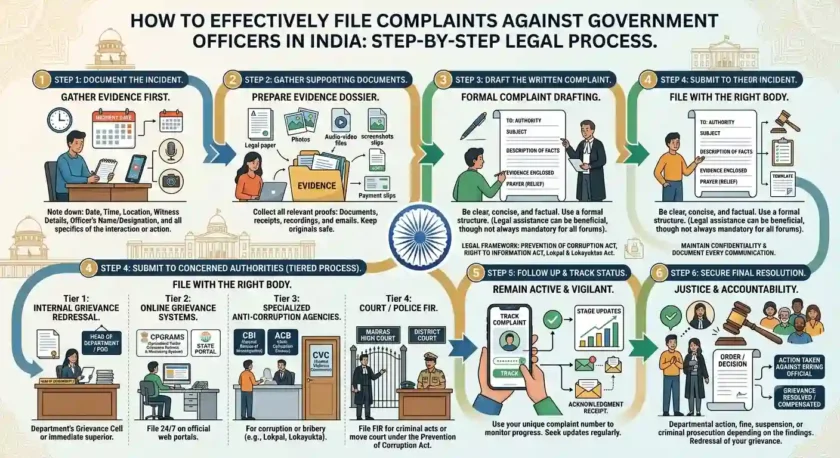
Choosing the correct authority significantly improves complaint efficiency and enforcement prospects. Therefore, legal practitioners evaluate jurisdiction before recommending appropriate proceedings. Departmental complaints generally proceed before supervisory officers or disciplinary authorities. Corruption allegations may require complaints before vigilance departments, the Central Vigilance Commission, Lokpal, or State Lokayuktas according to jurisdiction. Criminal offences should immediately reach the nearby Police Station having territorial jurisdiction. Human rights violations may also require complaints before National or State Human Rights Commissions. Administrative grievances involving service matters sometimes proceed before the Central Administrative Tribunal where legally maintainable. Proper jurisdiction reduces procedural delays and unnecessary litigation expenses. Strategic legal planning supports effective and timely remedies.
| Nature of Complaint | Appropriate Authority | Possible Remedy |
|---|---|---|
| Corruption | CVC/Lokpal/Lokayukta | Investigation |
| Criminal offence | Police Station | FIR and investigation |
| Departmental misconduct | Department Head | Disciplinary action |
| Human rights violation | Human Rights Commission | Recommendations |
| Administrative action | High Court | Writ remedies |
| Service dispute | CAT | Service relief |
Essential Evidence Before Filing Complaints
Strong evidence forms the foundation of every successful complaint against public officials. Additionally, organized records improve credibility before investigating authorities and judicial forums. Complainants should preserve official correspondence, notices, orders, emails, photographs, audio recordings, videos, payment receipts, witness details, and certified electronic records. Electronic evidence should comply with the Bharatiya Sakshya Adhiniyam wherever applicable. Information obtained through RTI applications frequently strengthens factual allegations. Independent witnesses further improve complaint reliability during investigations. Documentary consistency also minimizes contradictory statements before authorities. Early legal review identifies evidentiary gaps before formal filing begins. Comprehensive documentation significantly increases the prospects of effective administrative or judicial action.
Documents Required Before Submission
Proper documentation accelerates complaint processing while supporting legal scrutiny before competent authorities. Hence, complainants should organize essential records before filing.
Important documents include:
- Identity proof.
- Address proof.
- Written complaint.
- Chronology of events.
- Supporting documents.
- Photographs.
- Audio or video recordings.
- RTI replies.
- Witness details.
- Official correspondence.
- Certified electronic records.
- Relevant government orders.
Complete documentation improves procedural compliance while strengthening investigation quality. Experienced legal counsel also verifies supporting materials before submission, reducing avoidable objections and enhancing prospects for effective legal remedies.
Filing Criminal Complaints Before Police Authorities
Criminal misconduct by government officers requires prompt reporting before the competent Police Station. Therefore, complainants should submit clear facts supported by reliable evidence. Allegations involving bribery, criminal intimidation, wrongful confinement, assault, forgery, cheating, criminal breach of trust, or destruction of records may attract provisions under the BNS. The BNSS governs complaint registration, investigation, arrest, and prosecution procedures. Police should examine jurisdiction before commencing investigation. Moreover, complainants should retain acknowledgment copies and supporting documents for future proceedings. Delayed reporting may weaken valuable evidence and witness recollection. Professional legal assistance ensures accurate complaint drafting and procedural compliance. Proper representation also safeguards complainants during investigation and subsequent court proceedings.
Departmental Complaints and Vigilance Proceedings
Departmental action often addresses misconduct that may not immediately require criminal prosecution. Accordingly, complainants should approach competent disciplinary authorities with factual representations. Vigilance departments investigate corruption, abuse of authority, financial irregularities, dereliction of duty, and violations of service conduct rules. Departmental inquiries may proceed independently from criminal investigations where legally permissible. Additionally, complainants should avoid exaggerated allegations unsupported by evidence. Accurate documentation strengthens disciplinary proceedings while improving administrative accountability. Authorities may initiate preliminary inquiries before formal departmental action begins. Legal professionals monitor procedural fairness throughout every inquiry. Effective representation protects complainants while ensuring compliance with applicable service regulations and natural justice principles.
Role of Lokpal, Lokayukta and Vigilance Authorities
Specialized anti-corruption institutions provide additional remedies against misconduct involving public servants. Consequently, complainants should evaluate statutory jurisdiction before approaching these authorities. The Lokpal investigates eligible complaints involving specified public functionaries under the Lokpal and Lokayuktas Act, 2013. State Lokayuktas perform similar functions according to respective State legislation. The Central Vigilance Commission supervises vigilance administration within notified Central Government organizations. Furthermore, departmental vigilance officers investigate internal misconduct under applicable service rules. Proper legal drafting improves complaint clarity and investigative efficiency. Supporting documents remain essential throughout vigilance proceedings. Coordinated legal strategy frequently strengthens outcomes before multiple competent authorities.
Judicial Remedies Before Courts and Tribunals
Certain disputes require judicial intervention when administrative remedies prove ineffective. Therefore, advocates carefully assess available legal options before initiating litigation. High Courts exercise writ jurisdiction against arbitrary administrative actions violating constitutional or statutory rights. Civil Courts determine appropriate civil disputes under the CPC wherever maintainable. Criminal Courts examine offences investigated under the BNS and prosecuted according to the BNSS. The Central Administrative Tribunal decides eligible service disputes involving Central Government employees. Appeals continue before competent appellate forums according to applicable legislation. Strategic litigation planning minimizes procedural delays while protecting valuable legal rights. Experienced advocacy strengthens both interim and final relief applications.
Government Departments and Competent Forums
Different authorities possess jurisdiction over different categories of complaints. Likewise, selecting the proper forum improves investigation and enforcement efficiency.
| Legal Issue | Authority or Forum | Primary Relief |
|---|---|---|
| Corruption | Lokpal/CVC/Lokayukta | Investigation |
| Criminal misconduct | Police Station | FIR and prosecution |
| Service misconduct | Departmental Authority | Disciplinary action |
| Human rights violations | Human Rights Commission | Inquiry |
| Administrative illegality | High Court | Writ relief |
| Service disputes | CAT | Service remedies |
Proper jurisdiction reduces unnecessary procedural challenges while improving legal outcomes. Coordinated representation also supports effective parallel remedies wherever legally permissible.
Legal Remedies Available to Aggrieved Citizens
Indian law provides several remedies against unlawful actions committed by government officers. Accordingly, advocates recommend remedies based upon the facts of every case.
Available remedies include:
- Departmental complaint.
- Vigilance complaint.
- Police complaint.
- FIR registration.
- Writ petition.
- Criminal prosecution.
- Civil suit where maintainable.
- Compensation claims.
- Injunction where applicable.
- RTI application.
- Human Rights Commission complaint.
- Lokpal or Lokayukta complaint.
- Appeal before competent authority.
- Judicial review.
- Execution of court orders.
Appropriate remedy selection strengthens legal protection while ensuring accountability within public administration. Early legal guidance significantly improves procedural compliance and successful case resolution.
Strategic Legal Support for Successful Complaints
Effective complaints require careful planning, accurate drafting, and strong documentary support. Therefore, Rajendra Criminal Law Firm evaluates every case before recommending legal action. Our advocates verify jurisdiction, limitation, available remedies, and evidentiary strength before initiating proceedings. Legal notices, RTI responses, departmental records, and certified electronic evidence frequently strengthen complaints. Moreover, coordinated representation prevents conflicting proceedings before multiple authorities. Clients receive assistance during investigations, departmental inquiries, court hearings, and appellate proceedings. Professional advocacy also protects complainants against procedural irregularities and unlawful retaliation. Early legal intervention improves compliance with statutory requirements while reducing avoidable delays. Strategic case management increases the likelihood of obtaining timely and effective legal relief.
Avoiding Common Mistakes While Filing Complaints
Many complaints fail because of procedural errors rather than legal weakness. Accordingly, complainants should avoid unsupported allegations, incomplete documentation, and incorrect jurisdiction. Every representation should contain a clear chronology, relevant dates, supporting records, and precise relief sought. Anonymous complaints often receive limited consideration unless exceptional circumstances exist. Furthermore, complainants should preserve acknowledgment receipts, postal records, and electronic submissions. Multiple inconsistent complaints before different authorities may weaken credibility. Professional legal review identifies deficiencies before official filing. Careful preparation strengthens investigations while improving judicial and administrative outcomes. Organized documentation also supports appeals whenever authorities reject or delay legitimate complaints.
Why Choose Rajendra Criminal Law Firm
Rajendra Criminal Law Firm provides comprehensive legal representation for complaints involving government officers across India. Furthermore, our legal team advises individuals, companies, NGOs, and NRIs on criminal, vigilance, constitutional, and administrative remedies. We prepare complaints, legal notices, writ petitions, criminal petitions, RTI strategies, and appellate proceedings. Our advocates represent clients before Police Stations, Magistrate Courts, Sessions Courts, High Courts, the Supreme Court, Human Rights Commissions, Lokpal, Lokayuktas, and vigilance authorities. Every matter receives detailed legal analysis before selecting the most effective legal strategy. Practical guidance, ethical representation, and procedural accuracy remain central to our legal services. Early consultation protects rights while strengthening prospects for successful outcomes.
Quick Compliance Checklist
| Requirement | Purpose |
|---|---|
| Identity proof | Verify complainant |
| Written complaint | Present allegations |
| Supporting documents | Establish facts |
| RTI records | Obtain official information |
| Electronic evidence | Support digital claims |
| Witness details | Corroborate allegations |
| Jurisdiction review | Select correct authority |
| Legal consultation | Improve procedural compliance |
Frequently Asked Questions
Q1. Can I file a complaint against any government officer?
Yes. Citizens may complain against public servants for corruption, misconduct, abuse of authority, negligence, or criminal offences before competent authorities.
Q2. Which authority investigates corruption by government officers?
Depending on jurisdiction, complaints may proceed before the Lokpal, Lokayukta, Central Vigilance Commission, departmental vigilance authorities, or Police.
Q3. Can I approach the High Court directly?
Yes. High Courts may exercise writ jurisdiction where administrative actions violate constitutional or statutory rights, subject to legal requirements.
Q4. What evidence strengthens complaints against public servants?
Official documents, RTI replies, photographs, videos, emails, witness statements, and certified electronic records significantly strengthen complaints.
Q5. Can criminal and departmental proceedings continue together?
Yes. Criminal prosecution and departmental inquiries may proceed simultaneously where law permits, depending upon the facts and applicable rules.
Q6. How can Rajendra Criminal Law Firm assist complainants?
Our advocates prepare complaints, collect evidence, advise on jurisdiction, represent clients before authorities, and pursue judicial remedies until resolution.
Conclusion
Citizens possess strong legal remedies against unlawful conduct by government officers under Indian law. Therefore, timely action, proper documentation, and correct jurisdiction remain essential for successful complaints. Statutory remedies before vigilance authorities, Police Stations, Human Rights Commissions, Lokpal, Lokayuktas, tribunals, and constitutional courts ensure accountability within public administration. Rajendra Criminal Law Firm provides strategic legal assistance throughout complaint drafting, investigation, departmental proceedings, criminal litigation, writ petitions, appeals, and enforcement. Whether the issue involves corruption, abuse of authority, negligence, or violation of legal rights, our advocates deliver practical, result-oriented representation while protecting every client’s lawful interests through comprehensive legal support.
Read More
- How to File a Complaint Against Officers in State Social Welfare Departments
- How to Report Corruption in State Health Department Offices
- Complaint Process for State Education Department Officials
- NDPS Bail in Tamil Nadu: How our Senior Advocates Has Fought Complex Cases
- Accused in a Cybercrime You Didn’t Commit? 5 Urgent Steps to Take
- Central Vigilance Commission (CVC)