

Advocacy for Drug Trafficking Charges – Legal framework and prosecution: Drug trafficking allegations primarily arise under the Narcotic Drugs and Psychotropic Substances Act, 1985. The Department of Revenue administers the NDPS framework and publishes current notifications and rules. Trafficking cases can involve possession, transportation, manufacture, sale, purchase, financing, or organised supply networks. Therefore, defence strategy must identify the exact statutory offence and prosecution evidence. Quantity classification often affects punishment and bail prospects. A criminal lawyer should examine seizure records, laboratory reports, witness statements, arrest records, and chain-of-custody documents. Additionally, the defence should verify whether investigating officers followed mandatory statutory safeguards. Courts can scrutinise search, seizure, sampling, documentation, and custody procedures. Hence, an accused should obtain legal representation immediately after arrest or receiving investigation notices. Rajendra Criminal Law Firm assists accused persons with NDPS bail, trial defence, seizure challenges, and constitutional remedies.
Defending Your Rights: Advocacy for Drug Trafficking Charges – Rajendra Criminal Law Firm
Drug Quantity and Criminal Liability
Small, intermediate, and commercial quantities: NDPS liability depends significantly upon the substance and quantity allegedly recovered. The statutory framework distinguishes small and commercial quantities for several offences. Consequently, the prosecution must establish the recovered substance, its identity, and applicable quantity threshold. A defence lawyer should independently examine weighing methods and laboratory analysis. Moreover, mixed substances can require careful interpretation of applicable notifications and statutory definitions. The defence should compare seizure mahazar details with laboratory findings and inventory records. Any unexplained discrepancy can become relevant during bail or trial proceedings. Courts may also consider whether the accused exercised conscious possession over the alleged contraband. Therefore, mere physical proximity does not automatically resolve every factual issue. The defence should examine ownership, control, knowledge, possession, and surrounding circumstances. Drug trafficking lawyers in Chennai can prepare evidence-based arguments around quantity, possession, recovery, and statutory compliance.
Search and Seizure Safeguards
Protecting search and seizure rights: Search procedures require close scrutiny because NDPS prosecutions depend heavily upon recovery evidence. Defence counsel should examine whether officers possessed lawful authority and followed applicable procedural requirements. Section 50 safeguards may become important during personal searches in appropriate circumstances. Additionally, sections concerning searches of premises, recording information, seizure, and reporting require careful examination. The lawyer should compare contemporaneous records with prosecution testimony. Furthermore, independent witnesses, photographs, videos, seals, samples, and inventory documentation can affect evidentiary reliability. Any unexplained break in the chain of custody deserves detailed examination. The defence should also investigate whether officers prepared accurate seizure mahazars and laboratory forwarding documents. Courts assess evidence according to applicable statutory requirements and judicial precedent. Therefore, procedural irregularities can become important grounds for bail, discharge, acquittal, or appellate relief. A Chennai criminal lawyer should review every seizure document before selecting the appropriate remedy.
Conscious Possession and Mens Rea
Challenging conscious possession: NDPS cases often require careful analysis of possession and knowledge surrounding alleged contraband. The prosecution may rely upon physical possession, constructive possession, ownership, control, statements, conduct, or surrounding circumstances. However, the defence can contest whether the accused knowingly possessed the substance. For example, allegations involving vehicles, rented premises, parcels, luggage, or shared accommodation require factual examination. Therefore, counsel should identify who controlled the location or article containing the alleged substance. Witness testimony should also receive scrutiny for contradictions, omissions, and improvements. Furthermore, electronic records may require authentication before courts rely upon them. The Bharatiya Sakshya Adhiniyam, 2023 now governs evidence generally, while NDPS provisions remain crucial. A defence strategy should therefore combine substantive NDPS arguments with evidentiary objections. Properly framed arguments can challenge assumptions about knowledge, ownership, custody, or control. Legal representation should begin before the accused makes statements that may prejudice future proceedings.
Investigation by Police and Agencies
Police stations and enforcement agencies: NDPS investigations can involve state police, specialised narcotics units, the Narcotics Control Bureau, Customs, or other authorised agencies. The Central Bureau of Narcotics also performs investigation and enforcement functions under the NDPS framework. Consequently, the defence must identify the investigating agency and its statutory authority. BNSS procedures now govern general criminal procedure, including arrest safeguards and access to legal representation. Section 38 BNSS recognises an arrested person’s right to meet an advocate during interrogation. Section 47 requires information concerning grounds of arrest and bail rights. Therefore, counsel should monitor arrest documentation, remand applications, case diaries, and investigation timelines. Nearby police stations may receive complaints or conduct preliminary investigative steps. However, an accused should avoid discussing case facts publicly or with unauthorised persons. Immediate legal advice can protect procedural rights while preserving an effective defence strategy.
Arrest, Remand, and Custody Rights
Arrest and remand protection: BNSS contains important safeguards concerning arrest, custody, and production before judicial authorities. Section 57 requires an arrested person to reach the appropriate Magistrate or police station authority. Section 58 addresses detention beyond twenty-four hours without lawful judicial authority. Meanwhile, NDPS cases can create difficult bail conditions because special restrictions may apply. Defence counsel should therefore prepare bail submissions around statutory requirements, evidence gaps, procedural compliance, and individual circumstances. Furthermore, medical examination and custodial treatment can become relevant where allegations involve injury or coercion. Lawyers should obtain remand orders and scrutinise the grounds supporting continued custody. The defence can challenge unlawful detention through appropriate judicial remedies. Depending upon jurisdiction, applications may proceed before Special Courts, High Courts, or other competent forums. Therefore, prompt representation can prevent avoidable procedural prejudice. Families should preserve arrest details, FIR information, seizure documents, and court orders for counsel review.
Bail in NDPS Trafficking Cases
Bail strategy under strict NDPS provisions: Bail requires specialised preparation because NDPS law imposes stringent conditions for several serious offences. Commercial-quantity allegations can create particularly difficult bail proceedings. Therefore, counsel must identify the charged sections, alleged quantity, substance, recovery circumstances, and prosecution evidence. The defence should then address statutory bail restrictions and demonstrate weaknesses within the prosecution case. Contradictions in seizure records, doubtful possession, defective sampling, delayed reporting, or unreliable witnesses may support appropriate submissions. Moreover, prolonged incarceration can become relevant when trials experience substantial delay. Courts assess each application according to statutory requirements and case-specific facts. Hence, generic bail arguments rarely provide sufficient protection in serious narcotics prosecutions. A lawyer should prepare a focused bail memorandum supported by relevant judgments and documentary evidence. If the trial court denies relief, appropriate appellate or constitutional remedies may remain available. Legal support should continue throughout remand, bail, investigation, and trial stages.
BNS and Organised Drug Activity
BNS implications: The Bharatiya Nyaya Sanhita, 2023 introduced organised-crime provisions that can become relevant where allegations involve qualifying continuing unlawful activity. Section 111 expressly includes trafficking in drugs within organised-crime conduct. However, investigators must establish statutory ingredients before applying additional criminal liability. The defence should therefore examine allegations concerning syndicates, continuing unlawful activity, prior charge-sheets, and material benefit. A drug allegation alone does not automatically establish every ingredient of organised crime. Consequently, counsel should separate NDPS allegations from any additional BNS accusations. The prosecution must satisfy the requirements applicable to each charged offence. Furthermore, defence strategy should address jurisdiction, sanction requirements where relevant, evidence collection, and alleged financial benefits. Courts may examine whether the prosecution has properly established the statutory foundation. Therefore, early legal intervention can prevent overcharging and preserve appropriate constitutional and statutory remedies.
BNSS Procedure and Criminal Courts
Forum and jurisdiction: NDPS matters generally proceed before courts exercising statutory jurisdiction over narcotics offences. Special Courts may hear serious NDPS prosecutions according to applicable statutory arrangements. Meanwhile, Magistrates may handle remand and other proceedings within their lawful jurisdiction. High Courts can exercise appellate, revisional, or constitutional jurisdiction where applicable. BNSS now provides the general criminal procedure framework replacing the earlier CrPC framework from its commencement. Accordingly, lawyers should use current statutory provisions when preparing applications and procedural objections. The defence should identify the proper forum before filing bail, quashing, revision, appeal, or constitutional petitions. Jurisdictional errors can create unnecessary delay and procedural complications. Moreover, counsel should track case numbers, custody dates, filing dates, and next hearing dates. Rajendra Criminal Law Firm provides representation before appropriate criminal courts and appellate forums. Strategic forum selection can materially influence the timing and presentation of available remedies.
Electronic and Documentary Evidence
Digital evidence defence: Modern drug investigations may involve mobile phones, CCTV footage, location records, messaging applications, bank records, vehicle trackers, and digital photographs. The Bharatiya Sakshya Adhiniyam, 2023 provides the current general evidentiary framework for electronic and documentary evidence. Therefore, defence counsel should examine how investigators collected, preserved, and presented digital material. Authentication and statutory certification requirements may become important depending upon the evidence and circumstances. Furthermore, metadata, device custody, extraction methods, and forensic reports can affect evidentiary reliability. The defence should compare digital evidence with witness testimony and physical recovery records. Any unexplained alteration, incomplete extraction, or chain-of-custody gap can support a challenge. Lawyers should also identify whether allegedly incriminating messages actually establish trafficking involvement. Mere contact with another accused does not necessarily prove participation in a trafficking offence. Hence, digital evidence requires contextual analysis rather than isolated interpretation.
Financial Investigation and Property Attachment
Financial and property consequences: Serious NDPS investigations can extend beyond alleged contraband and examine assets suspected of representing illegal proceeds. The NDPS framework contains provisions concerning tracing, freezing, seizure, and forfeiture of illegally acquired property. The Department of Revenue identifies seizure, freezing, and forfeiture among key NDPS subjects. Consequently, property owners should obtain immediate advice when authorities issue notices affecting bank accounts, land, vehicles, businesses, or investments. The defence should establish legitimate income sources and documentary ownership histories. Tax returns, bank statements, loan records, sale deeds, and business documents can become significant evidence. Furthermore, third-party property owners should preserve records demonstrating independent ownership or lawful acquisition. Appropriate objections, appeals, or statutory proceedings may challenge unlawful attachment. Therefore, financial defence should run alongside the criminal case rather than waiting until trial completion. Experienced counsel can coordinate NDPS defence with property, taxation, banking, and constitutional remedies.
Evidence, Laboratory Reports, and Chain of Custody
Testing and sample integrity: Laboratory evidence can determine whether seized material falls within an NDPS offence. Consequently, counsel should examine sampling procedures, seals, specimen signatures, forwarding letters, laboratory receipt records, and analytical reports. The defence should compare every document against seizure records and prosecution testimony. Moreover, delays between seizure, sampling, dispatch, receipt, and examination deserve careful scrutiny. Any unexplained discrepancy can affect the reliability of prosecution evidence. Lawyers should also examine whether the laboratory identified the substance correctly and reported relevant quantities accurately. Where appropriate, expert evidence can assist courts in understanding technical issues. Additionally, defence counsel should challenge unsupported assumptions regarding purity, composition, or possession. Courts evaluate evidence according to statutory requirements and established judicial principles. Therefore, a thorough chain-of-custody review can identify weaknesses that ordinary case reading may overlook. Rajendra Criminal Law Firm can conduct document-by-document scrutiny before trial or during bail proceedings.
Trial Defence and Cross-Examination
Building a trial defence: Effective NDPS trial defence requires disciplined cross-examination and careful evidence management. Counsel should test prosecution witnesses regarding search authority, recovery circumstances, sealing, sampling, custody, documentation, and identification. Additionally, cross-examination should expose contradictions between statements, mahazars, case diaries, and courtroom testimony. Independent witnesses may provide important evidence concerning the alleged recovery. Police witnesses also require careful questioning about timing, communication, movement, and procedural compliance. Furthermore, forensic witnesses should explain laboratory methodology and sample handling. The defence should avoid unnecessary admissions and focus questioning on legally relevant weaknesses. Documentary evidence can support contradictions and establish alternative explanations. A coherent defence theory should remain consistent throughout the trial. Therefore, experienced advocacy requires preparation long before final arguments. If prosecution evidence fails to establish statutory ingredients beyond reasonable doubt, the defence can seek acquittal according to law.
Constitutional and Procedural Remedies
Judicial remedies: Accused persons can consider several remedies depending upon the procedural stage and factual circumstances. These may include bail, discharge, revision, appeal, quashing, constitutional petitions, evidentiary objections, and challenges to unlawful detention. However, each remedy requires statutory and jurisdictional analysis. High Courts possess important powers under the constitutional framework and applicable procedural law. The Supreme Court may exercise appellate or special jurisdiction according to constitutional and statutory provisions. Therefore, counsel should select remedies based on the precise grievance rather than filing repetitive applications. Procedural violations should be documented through certified orders and contemporaneous records. Furthermore, prolonged custody may require a separate assessment of trial progress and constitutional protections. A lawyer should also consider whether parallel property proceedings require independent challenges. Effective legal support therefore combines criminal litigation, constitutional advocacy, and evidence analysis. Timely action can preserve remedies that become harder to pursue after important procedural stages.
Rights of Foreign Nationals and NRIs
NRI and foreign-national defence: Drug trafficking allegations can create additional complications for NRIs and foreign nationals. Immigration status, passport issues, international travel, extradition concerns, and consular communication may require coordinated legal advice. Therefore, overseas families should appoint reliable Indian counsel quickly after learning about an arrest. Lawyers can monitor remand hearings, bail proceedings, investigation developments, and court dates. Additionally, counsel can explain powers of attorney and document requirements for family members abroad. Foreign nationals may require communication with their diplomatic mission while continuing independent legal representation. However, consular assistance does not replace criminal defence before Indian courts. Evidence concerning travel, employment, financial transactions, and communications may require international coordination. The defence should preserve original documents and avoid altering electronic records. Moreover, an accused should comply with court directions concerning appearance, surrender, bail, and travel. Experienced Chennai advocates can coordinate local representation with overseas families and authorised representatives.
Free Legal Aid and Defence Support
Access to legal assistance: Financial limitations should not prevent an eligible accused from seeking criminal legal representation. NALSA states that free legal services can cover criminal proceedings before courts, tribunals, and authorities. Tamil Nadu State Legal Services Authority also provides legal-aid eligibility information and services. Therefore, persons in custody or otherwise eligible should ask the appropriate Legal Services Authority about representation. Additionally, accused persons can seek private NDPS lawyers when specialised advocacy suits their circumstances. Legal support may include bail preparation, document review, trial representation, appeals, and procedural applications. Families should provide lawyers with FIRs, arrest memos, remand orders, seizure records, and medical documents. Furthermore, they should disclose all relevant facts honestly to counsel. A complete factual record helps lawyers identify risks and realistic remedies. Early legal assistance can protect rights during investigation and reduce avoidable procedural mistakes.
Practical Steps After an Arrest
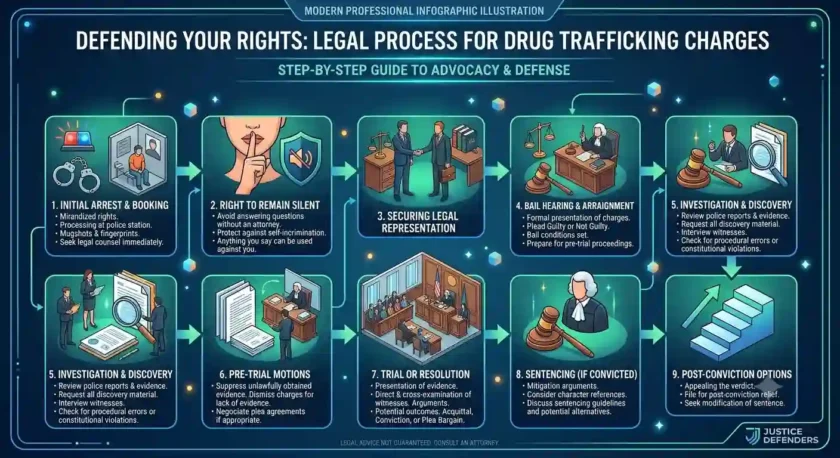
Immediate defence checklist: Families should respond calmly when police or narcotics agencies arrest someone for an alleged drug offence. First, record the arresting agency, police station, case number, sections, and court details. Next, contact a qualified NDPS criminal lawyer without unnecessary delay. Then preserve seizure documents, remand orders, medical records, and relevant communications. Avoid discussing substantive facts with strangers or posting case details online. Additionally, do not destroy, modify, or conceal electronic or documentary evidence. Lawyers should promptly assess search procedures, quantity, possession, laboratory evidence, and custody records. The defence should also identify possible witnesses and legitimate explanations for disputed circumstances. Furthermore, counsel should monitor every remand and bail hearing. BNSS recognises important rights concerning arrest information, legal consultation, and judicial production. Proper preparation strengthens bail applications and later trial strategy. Rajendra Criminal Law Firm offers strategic NDPS criminal defence and representation across appropriate courts and forums.
Why Choose Rajendra Criminal Law Firm
Specialised advocacy for NDPS allegations: Drug trafficking prosecutions require focused knowledge of NDPS provisions, criminal procedure, evidence law, and constitutional remedies. Rajendra Criminal Law Firm approaches each matter through detailed factual and documentary analysis. The defence team can examine arrest legality, search procedures, seizure records, quantity classification, laboratory evidence, and alleged possession. Furthermore, counsel can prepare bail applications and challenge procedural defects before competent courts. Trial representation includes cross-examination, evidentiary objections, legal submissions, and final arguments. The firm can also address property attachment issues and coordinate appropriate appellate remedies. For NRIs, overseas families, and business owners, coordinated communication can simplify case management. Additionally, lawyers can identify whether BNS or other penal provisions create additional allegations. Every case requires an individual strategy because evidence and statutory ingredients differ. Therefore, prompt consultation remains essential after an arrest, seizure, summons, or trafficking allegation. Strong advocacy protects lawful rights while pursuing every legally available remedy.
Current Government Sources for NDPS Defence
Official legal resources: The Department of Revenue provides the central NDPS Act, rules, notifications, policy information, and narcotics-related guidance. India Code provides authoritative statutory texts for BNSS and BNS. NALSA and Tamil Nadu State Legal Services Authority provide information concerning legal-aid services. Useful official resources include:
- India Code
- Department of Revenue – NDPS
- Narcotics Control Bureau
- NALSA
- Tamil Nadu State Legal Services Authority
These sources help lawyers and accused persons verify current legislation, notifications, and legal-aid procedures.
Legal Remedies and Defence Strategy
Available remedies: NDPS defence can involve several remedies depending upon the allegations and procedural stage. Common remedies include:
- Regular or statutory bail applications.
- Anticipatory relief where legally maintainable.
- Discharge or appropriate preliminary objections.
- High Court petitions against legally unsustainable proceedings.
- Trial-based acquittal arguments.
- Appeals against conviction or adverse orders.
- Revision or constitutional remedies where appropriate.
- Challenges concerning unlawful seizure, custody, or evidence.
- Property attachment and forfeiture challenges.
- Legal-aid representation through competent authorities.
However, NDPS cases demand specialised statutory analysis before choosing any remedy. The applicable quantity, offence, evidence, court, and investigation stage remain critical. Therefore, accused persons should obtain individual legal advice before taking procedural action. No general article can guarantee bail, acquittal, quashing, or dismissal. Prompt professional advocacy remains the safest approach after a drug trafficking allegation.
Frequently Asked Questions
1. What happens after a drug trafficking arrest?
Police or another authorised agency may register proceedings and produce the accused before the competent court. Immediate legal representation can protect procedural rights.
2. Can I obtain bail in a commercial quantity NDPS case?
Bail can remain difficult because special statutory restrictions may apply. Counsel must address the exact offence, quantity, evidence, and statutory bail conditions.
3. Can an NDPS seizure be challenged?
Yes. Defence counsel can examine search authority, statutory compliance, seizure documentation, sampling, sealing, laboratory procedures, and chain-of-custody evidence.
4. Does possession automatically prove drug trafficking?
No. The prosecution must establish the statutory ingredients of the charged offence. The defence can challenge knowledge, control, possession, and surrounding circumstances.
5. Can an NRI defend an NDPS case from abroad?
An NRI can appoint Indian legal counsel and coordinate through authorised representatives. However, court directions concerning appearance or surrender must receive careful attention.
6. Where can I seek free legal assistance?
Eligible persons can approach NALSA or the Tamil Nadu State Legal Services Authority. Legal-aid services can include representation in criminal proceedings.
Read More
- Protecting Second Amendment Rights: Legal Aid for Unauthorized Firearms Possession
- Filing Complaints Against Bureaucratic Misconduct in India: Central & State Tips
- Where and How to Lodge Complaints About Government Officials in India
- Step-by-Step Guide to Filing Complaints Against Corrupt Officers in India
- How to Use Public Grievance Portals to Complain About Officers
- Narcotics Control Bureau (NCB), Government of India