
In India, the concept of maintenance is often misunderstood. Many people assume that only a financially dependent spouse can claim maintenance. However, the reality is more nuanced. Over time, the courts—especially the Supreme Court—have clarified that even an earning spouse may be entitled to maintenance under certain circumstances. This has led to important discussions about fairness, dignity, and financial balance within marriage and after separation.
Maintenance to Earning Spouse – Supreme Court Guidelines Explained : Rajendra Criminal Law Firm
What is Maintenance in Law?
To begin with, maintenance refers to financial support provided by one spouse to the other. It is meant to ensure that a person can live with dignity and meet basic needs such as food, shelter, clothing, and medical expenses.
Maintenance can be claimed under different laws, including:
- Section 125 of the Criminal Procedure Code (CrPC)
- Hindu Marriage Act, 1955
- Protection of Women from Domestic Violence Act, 2005
Although these laws differ slightly, the basic idea remains the same: no spouse should suffer financially after separation or divorce.
Can an Earning Spouse Claim Maintenance?
Now, this is where things become interesting. A common belief is that if a spouse is earning, they are not eligible for maintenance. However, this is not entirely correct.
The Supreme Court has clearly stated that merely earning does not automatically disqualify a spouse from receiving maintenance. Instead, courts must look deeper into the financial situation.
For example, an earning spouse may still be entitled to maintenance if:
- Their income is insufficient to maintain a similar standard of living
- There is a significant income gap between the spouses
- They have additional responsibilities, such as childcare
- Their employment is unstable or temporary
Therefore, the key factor is not whether the spouse earns, but whether they can sustain themselves comfortably.
Supreme Court’s Key Principles on Maintenance
Over the years, the Supreme Court has laid down several important guidelines. Let us understand them one by one.
1. Right to Live with Dignity
First and foremost, the Court has emphasized that maintenance is not charity—it is a right. The spouse claiming maintenance should be able to live with dignity, similar to the standard enjoyed during the marriage.
Thus, even if a spouse earns a small amount, it may not be enough to maintain that standard. In such cases, maintenance can still be granted.
2. Mere Earning is Not Enough
Secondly, the Court has repeatedly clarified that just because a spouse is working does not mean they are financially independent.
For instance, if a wife earns ₹10,000 per month while the husband earns ₹1,00,000, there is a clear imbalance. In such situations, the Court may direct the husband to provide additional financial support.
Therefore, courts focus on adequacy of income, not just the existence of income.
3. Comparative Financial Status Matters
Another important guideline is the comparison of financial positions.
Courts examine:
- Income of both spouses
- Lifestyle during marriage
- Assets and liabilities
- Future financial prospects
As a result, if one spouse is significantly better off, the other may receive maintenance to bridge the gap.
4. Qualification vs. Actual Income
Often, one spouse may argue that the other is well-qualified and capable of earning more. However, the Supreme Court has clarified that qualification alone is not enough.
Instead, the Court considers:
- Whether the person is actually employed
- Whether suitable job opportunities are available
- Whether they had to leave work due to marriage or childcare
So, even a highly qualified spouse may still receive maintenance if they are not earning sufficiently.
5. Temporary vs. Permanent Employment
In many cases, the earning spouse may have only a temporary or unstable job. The Supreme Court has recognized that such income cannot be treated as reliable.
For example:
- Contract-based jobs
- Freelancing work
- Part-time employment
In such situations, courts may still grant maintenance to ensure financial security.
6. Childcare Responsibilities
Another crucial factor is childcare. If one spouse is responsible for taking care of children, their ability to earn may be limited.
The Supreme Court has acknowledged that:
- Raising children is a full-time responsibility
- It directly affects earning capacity
Therefore, even if a spouse earns a small income while managing children, they may still be entitled to maintenance.
7. No Fixed Formula for Maintenance
Interestingly, the Supreme Court has not fixed a strict formula for calculating maintenance. Instead, courts are given flexibility to decide based on facts of each case.
However, certain general considerations include:
- Monthly income of both parties
- Reasonable expenses
- Number of dependents
- Standard of living
This flexible approach ensures fairness in different situations.
Landmark Guidelines for Transparency
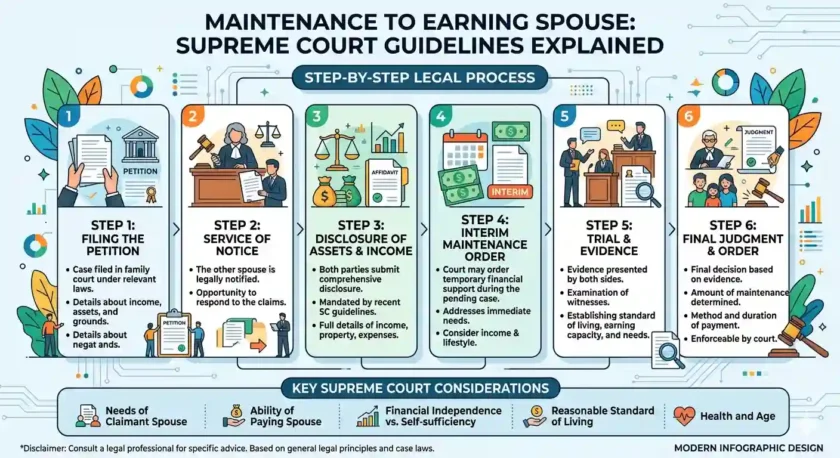
In a significant step, the Supreme Court also introduced guidelines to ensure transparency in maintenance cases.
Both parties are required to disclose:
- Income details
- Assets and investments
- Liabilities and expenses
This helps the court make a fair and informed decision. Moreover, it prevents concealment of income, which is a common issue in such cases.
Maintenance for Husband – Is It Possible?
Although maintenance is usually associated with wives, the law is gender-neutral in certain situations.
Yes, an earning husband can also claim maintenance if:
- He is unable to earn due to illness or disability
- His income is significantly lower than his wife’s
- He is financially dependent
However, such cases are less common and depend heavily on specific facts.
Interim Maintenance vs. Final Maintenance
It is also important to understand the difference between interim and final maintenance.
Interim Maintenance
This is temporary financial support given during the pendency of the case. It ensures that the spouse can manage expenses while the case is ongoing.
Final Maintenance
This is decided at the end of the case and may continue for a longer period or as a lump sum.
In both cases, the earning status of the spouse is considered, but it is not the only factor.
Misuse and False Claims – Court’s Approach
While maintenance is a right, the Supreme Court has also taken note of misuse in some cases.
To address this, courts:
- Carefully examine financial documents
- Verify income claims
- Consider conduct of parties
If a spouse deliberately hides income or files false claims, the court may reject or reduce maintenance.
Thus, honesty and transparency are extremely important.
Practical Examples
To better understand, let us look at a few real-life scenarios:
Example 1
A wife earns ₹15,000 per month, while the husband earns ₹1,20,000. She struggles to meet expenses.
➡️ The court may grant maintenance.
Example 2
A husband claims maintenance but is fully capable of earning and chooses not to work.
➡️ The court may reject the claim.
Example 3
A wife works part-time and takes care of two children. Her income is irregular.
➡️ The court is likely to grant maintenance.
These examples show that each case depends on facts rather than rigid rules.
Importance of Legal Guidance
Maintenance cases can be complex. Many factors must be properly presented before the court. Therefore, it is crucial to seek professional legal assistance.
An experienced lawyer can:
- Prepare accurate financial disclosures
- Present strong arguments
- Protect your rights
- Ensure fair calculation of maintenance
At Rajendra Criminal Law Firm, we assist clients in navigating these sensitive matters with clarity and confidence.
Frequently Asked Questions
Yes, a working spouse can still claim maintenance. The Supreme Court has clearly stated that earning alone does not mean financial independence. If the income is not sufficient to maintain a similar standard of living as during the marriage, the court may grant maintenance. Therefore, the adequacy of income matters more than the mere fact of employment.
Courts compare the financial status of both spouses. They consider income, lifestyle, expenses, assets, and liabilities. If there is a significant difference in earnings, the higher-earning spouse may be directed to provide maintenance. The goal is to ensure fairness and prevent financial hardship for the lower-earning spouse.
No, qualification alone does not disqualify a person from receiving maintenance. The Supreme Court has clarified that actual income and employment status are more important than educational qualifications. If the spouse is not earning enough despite being qualified, they may still be entitled to maintenance.
Not necessarily. If the earning spouse’s income is too low to meet basic needs or maintain a reasonable lifestyle, the court may still award maintenance. The courts focus on whether the income is sufficient for a dignified life, not just whether the spouse is earning.
Childcare responsibilities are a major factor. If one spouse is taking care of children, their ability to earn may be limited. Courts recognize this and may grant maintenance even if the spouse has some income, ensuring both the parent and children are financially supported.
Conclusion
To sum up, the Supreme Court has made it clear that maintenance is not denied simply because a spouse is earning. Instead, the focus is on financial fairness, dignity, and the ability to maintain a reasonable standard of living.
The key takeaway is simple: earning does not always mean financial independence. Courts look at the complete picture, including income adequacy, responsibilities, and lifestyle. As a result, maintenance laws in India aim to strike a balance between both spouses, ensuring that neither party suffers undue hardship.
Read More
- Excessive Maintenance Orders: Appellate Remedies Under BNSS
- Interim Maintenance Challenge in High Court – Legal Remedies After BNSS
- Appeal Against Maintenance Order: BNSS vs Old CrPC Explained (BNSS Chapter on Maintenance vs Section 125 CrPC)
- Understanding the NDPS Act: Defence Strategies for Drug Cases
- The Criminal Court Process in India: From FIR to Judgment
- Ministry of Law and Justice (India)