
Parallel Maintenance Proceedings – Maintenance is a vital legal remedy that protects spouses, children, and parents who depend on financial support. However, over time, many cases have shown that parties sometimes file multiple maintenance proceedings in different courts under different laws. This creates confusion, delays justice, and may even lead to unfair advantages. To address this issue, the Bharatiya Nagarik Suraksha Sanhita (BNSS) introduces clearer safeguards to prevent abuse of legal process.
In this article, Rajendra Criminal Law Firm explains how parallel maintenance proceedings arise, why they can be problematic, and how BNSS aims to streamline the system while ensuring fairness.
Parallel Maintenance Proceedings – How BNSS Prevents Abuse of Process – Rajendra Criminal Law Firm
What Are Parallel Maintenance Proceedings?
Simply put, parallel maintenance proceedings occur when a person files multiple claims for maintenance under different legal provisions at the same time. For example, a spouse may file:
- A maintenance case under criminal law provisions
- A domestic violence complaint seeking monetary relief
- A family court petition for maintenance
While each law serves a specific purpose, filing multiple cases for the same relief can create overlapping claims.
Therefore, although the intention may sometimes be genuine, in many situations it leads to duplication and misuse of legal remedies.
Why Do Parallel Proceedings Happen?
There are several reasons why individuals initiate multiple maintenance cases:
1. Lack of Awareness
Many litigants are unaware that similar relief can be granted under one proceeding itself. As a result, they approach different courts for the same purpose.
2. Strategic Legal Advantage
In some cases, parties deliberately file multiple proceedings to pressure the opposite party or to increase the chances of getting higher maintenance.
3. Delays in One Forum
If one court takes time, litigants may file another case elsewhere to speed up relief.
4. Legal Advice Variations
Different lawyers may suggest filing under multiple laws to strengthen the case, even when it is not necessary.
Problems Caused by Parallel Maintenance Proceedings
Although the law allows access to justice, misuse can lead to serious complications.
1. Conflicting Orders
Different courts may pass different maintenance amounts, which creates confusion and enforcement issues.
2. Double Recovery
There is a risk that a person may receive maintenance more than what is reasonable or justified.
3. Judicial Burden
Multiple cases increase the workload on courts, leading to delays in genuine cases.
4. Harassment of the Respondent
Facing multiple cases in different courts can be mentally and financially exhausting for the respondent.
5. Lack of Uniformity
Different courts may apply different standards, leading to inconsistent outcomes.
Introduction to BNSS and Its Role
The Bharatiya Nagarik Suraksha Sanhita (BNSS) replaces older procedural criminal laws with a more modern and streamlined framework. Importantly, it focuses on efficiency, fairness, and prevention of misuse.
When it comes to maintenance proceedings, BNSS introduces procedural clarity and encourages coordination between courts.
Key Ways BNSS Prevents Abuse of Process
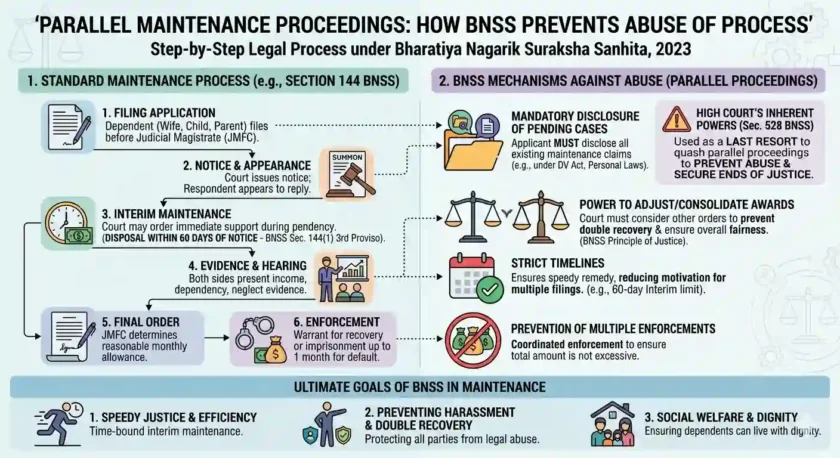
1. Emphasis on Disclosure of Existing Proceedings
First and foremost, BNSS encourages full disclosure. Parties are expected to inform the court about any ongoing or previous maintenance cases.
This ensures transparency. As a result, courts can take informed decisions and avoid duplication.
2. Judicial Coordination
BNSS promotes better coordination between courts. When multiple proceedings are identified, courts can:
- Consider previous orders
- Adjust maintenance amounts accordingly
- Avoid passing contradictory decisions
Therefore, the system becomes more consistent and fair.
3. Adjustment and Set-Off Principles
One of the most practical safeguards is the concept of adjustment. If maintenance has already been granted in one case, another court can:
- Reduce the amount
- Set off the earlier awarded sum
This prevents double recovery and ensures balanced relief.
4. Prevention of Forum Shopping
Forum shopping refers to choosing courts strategically to get a favorable order. BNSS discourages this practice by:
- Encouraging jurisdictional discipline
- Promoting judicial scrutiny of multiple filings
Consequently, litigants cannot misuse different forums for unfair advantage.
5. Faster Disposal of Cases
BNSS aims to reduce delays through improved procedures. When cases are resolved faster, the need to file multiple proceedings naturally decreases.
Thus, efficiency itself becomes a tool to prevent abuse.
6. Strengthening Judicial Discretion
Judges under BNSS have greater clarity and authority to:
- Examine the intent behind multiple filings
- Identify misuse of process
- Pass appropriate orders to prevent injustice
This strengthens the overall legal framework.
Practical Example
Consider a situation where a wife files:
- A maintenance petition in a magistrate court
- A domestic violence case seeking monetary relief
- A family court petition for alimony
Without proper safeguards, she might receive separate maintenance orders from each court.
However, under BNSS principles:
- She must disclose all cases
- Courts will consider existing orders
- The total maintenance will be adjusted
As a result, fairness is maintained, and duplication is avoided.
Role of Lawyers in Preventing Misuse
Legal professionals play a crucial role in ensuring that the system is not abused.
1. Providing Correct Advice
Lawyers must guide clients on the most appropriate legal remedy instead of encouraging multiple filings.
2. Ensuring Transparency
They should ensure that all ongoing proceedings are disclosed to the court.
3. Promoting Ethical Practice
Responsible advocacy helps maintain the integrity of the legal system.
At Rajendra Criminal Law Firm, we focus on strategic, ethical, and effective legal solutions rather than unnecessary litigation.
Rights of the Respondent
It is equally important to understand that the respondent (usually the person paying maintenance) has legal protections.
Under BNSS, the respondent can:
- Inform the court about multiple proceedings
- Request adjustment of maintenance amounts
- Challenge overlapping or excessive claims
Therefore, the law balances the rights of both parties.
Balancing Protection and Prevention
While preventing abuse is important, the law must also protect genuine claimants. BNSS strikes this balance by:
- Allowing access to multiple remedies when necessary
- Preventing duplication through judicial checks
- Ensuring fair and reasonable maintenance
Thus, it does not deny rights but regulates their use.
Challenges in Implementation
Despite its advantages, certain challenges remain:
1. Lack of Awareness
Many litigants and even some practitioners may not fully understand BNSS provisions initially.
2. Coordination Between Courts
Effective communication between courts is essential but may take time to streamline.
3. Varying Interpretations
Different courts may interpret provisions differently until consistent precedents develop.
However, over time, these challenges are expected to reduce.
Importance of Documentation
Proper documentation plays a key role in preventing abuse.
Parties should maintain:
- Copies of all maintenance orders
- Details of ongoing cases
- Financial records
This helps courts make accurate and fair decisions.
Tips for Litigants
To avoid complications, litigants should follow these simple guidelines:
- Always disclose existing cases
- Avoid filing multiple cases without proper legal advice
- Focus on genuine claims rather than strategic pressure
- Maintain honesty and transparency
These steps not only help the court but also strengthen your case.
Future Outlook
BNSS represents a progressive step towards modernizing the legal system. With time, it is expected to:
- Reduce unnecessary litigation
- Improve consistency in maintenance orders
- Strengthen trust in the justice system
Most importantly, it ensures that legal remedies are used for protection, not for harassment.
Frequently Asked Questions
Parallel maintenance proceedings arise when a party files multiple claims for maintenance under different laws simultaneously. They become problematic because they can lead to conflicting court orders, duplication of relief, and unnecessary harassment of the respondent.
BNSS promotes transparency by requiring parties to disclose existing proceedings. It also allows courts to consider earlier orders and adjust maintenance amounts accordingly, ensuring fairness and preventing duplication.
Yes, the law permits filing under different statutes because each serves a unique purpose. However, courts will examine whether the relief overlaps and may limit or adjust the final maintenance granted to avoid unjust enrichment.
The respondent can inform the court about pending or decided cases, seek adjustment of maintenance amounts, and challenge excessive or overlapping claims. This ensures protection against unfair financial burden.
Not entirely, but it significantly reduces misuse by strengthening judicial oversight, encouraging honest disclosure, and promoting coordination between courts. Ultimately, it balances the rights of genuine claimants with safeguards against abuse of process. In practice, courts also rely on principles of equity and good faith while evaluating claims. They examine income, needs, and existing liabilities before deciding the final amount. Therefore, parties are encouraged to act responsibly and avoid unnecessary litigation, as misuse may weaken their credibility before the court and affect the outcome of the case as well for all parties involved in proceedings.
Conclusion
Parallel maintenance proceedings have long been a challenge in the legal system. While multiple remedies exist to protect vulnerable individuals, misuse of these remedies can lead to unfair outcomes.
The Bharatiya Nagarik Suraksha Sanhita (BNSS) addresses this issue through transparency, judicial coordination, and procedural safeguards. By encouraging disclosure, preventing double recovery, and promoting efficiency, BNSS ensures that justice remains fair and balanced.
At Rajendra Criminal Law Firm, we believe that the true purpose of law is to deliver justice without unnecessary complexity. With the right legal guidance and responsible use of remedies, maintenance proceedings can serve their intended purpose—providing timely and fair support to those in need.
Read More
- Maintenance to Earning Spouse – Supreme Court Guidelines Explained
- Excessive Maintenance Orders: Appellate Remedies Under BNSS
- Interim Maintenance Challenge in High Court – Legal Remedies After BNSS
- Appeal Against Maintenance Order: BNSS vs Old CrPC Explained (BNSS Chapter on Maintenance vs Section 125 CrPC)
- Understanding the NDPS Act: Defence Strategies for Drug Cases
- Ministry of Home Affairs (MHA)