
Enforcement of Maintenance Orders – The Bharatiya Nagarik Suraksha Sanhita, 2023 (BNSS) fundamentally transforms maintenance order enforcement across India. Therefore, every maintenance claimant and their legal counsel must understand these critical legislative changes immediately. Rajendra Criminal Law Firm provides expert, current, and aggressive legal representation for maintenance enforcement matters. Our dedicated advocates help wives, children, and parents secure every rupee of legally entitled maintenance without compromise.
Understanding the Legal Shift: BNSS Versus CrPC in Maintenance Law
Historical Background: Maintenance Under CrPC and Its Key Limitations
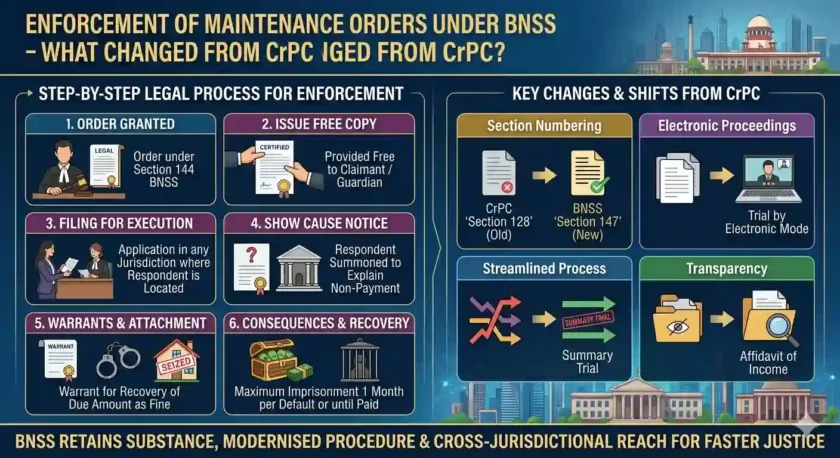
The Code of Criminal Procedure, 1973 (CrPC) governed maintenance proceedings in India for over five decades. Therefore, understanding CrPC’s framework helps appreciate the significance of BNSS improvements comprehensively. Section 125 CrPC entitled wives, children, and parents to claim maintenance from neglectful persons. Furthermore, Section 128 CrPC provided enforcement mechanisms through warrant and distress proceedings against defaulters. Consequently, enforcement remained slow, procedurally cumbersome, and frequently ineffective for desperate claimants. Additionally, CrPC lacked specific timelines for maintenance proceedings, causing systemic and prolonged delays. Key structural limitations of the CrPC maintenance framework included:
- No mandatory timeline for disposal of maintenance applications under Section 125
- Absence of interim maintenance enforcement mechanisms with teeth
- Limited territorial jurisdiction causing procedural hardship on claimants
- Vague enforcement provisions leading to inconsistent judicial application
- No express provision for attachment of salary or bank accounts for recovery
- Inadequate penalty structure for wilful defaulters failing to pay maintenance
- No specific provision addressing maintenance for divorced women comprehensively
Moreover, courts frequently took years to finalize maintenance quantum, leaving families in severe financial distress. Therefore, the law reform through BNSS addressed these persistent structural gaps directly and decisively. Rajendra Criminal Law Firm handled countless CrPC maintenance cases and deeply understands legacy challenges. Consequently, our team is uniquely positioned to navigate the transition from CrPC to BNSS with precision.
Key Legislative Changes: How BNSS Transforms Maintenance Order Enforcement
The BNSS, 2023 introduces transformative changes that fundamentally strengthen maintenance enforcement mechanisms. Therefore, claimants and advocates must understand every new provision to maximize legal outcomes. The following comparative table highlights critical differences between CrPC and BNSS maintenance frameworks:
| Aspect | CrPC, 1973 | BNSS, 2023 |
|---|---|---|
| Disposal Timeline | No prescribed timeline | 60-day mandatory disposal period |
| Interim Maintenance | Section 125(2) – limited clarity | Section 144(2) – within 60 days |
| Territorial Jurisdiction | Place of residence of husband | Place of residence of wife or claimant |
| Enforcement Mechanism | Warrant, distress proceedings | Salary attachment, bank account freeze |
| Technology Integration | None prescribed | E-filing, virtual hearings enabled |
| Penalty for Default | One-month imprisonment | Enhanced penalties and civil attachment |
| Trial Period Maintenance | Not explicitly addressed | Section 144 – explicitly provided |
Additionally, BNSS Section 144 replaces CrPC Section 125 with significantly enhanced procedural protections. Consequently, claimants benefit from faster adjudication, broader jurisdiction, and stronger enforcement under the new law. Furthermore, the shift to claimant-friendly jurisdiction represents a fundamental philosophical shift in legislative approach. Therefore, Rajendra Criminal Law Firm immediately adapts every maintenance strategy to these powerful BNSS provisions.
Jurisdiction, Forums, and Courts for Maintenance Enforcement Under BNSS
BNSS fundamentally reshapes territorial jurisdiction rules for maintenance proceedings across India. Therefore, understanding the applicable forum for each type of maintenance claim is strategically critical. Under BNSS Section 144, the Executive Magistrate or Judicial Magistrate First Class adjudicates maintenance claims. Furthermore, the claimant may now file the application where she or the dependent child actually resides. Consequently, wives and children no longer need to travel to the defaulter’s location to file claims. Additionally, Family Courts in urban areas exercise concurrent jurisdiction over maintenance-related matters comprehensively. Key competent forums for maintenance enforcement under BNSS include:
- Judicial Magistrate First Class (JMFC) – Primary maintenance adjudication forum
- Executive Magistrate – Urgent maintenance and enforcement orders
- Family Court – Matrimonial maintenance claims in designated Family Court cities
- Sessions Court – Appeals from Magistrate maintenance orders under BNSS
- High Court of Madras – Revision petitions and constitutional challenges
- Supreme Court – Final appeals in significant maintenance jurisprudence cases
- District Legal Services Authority (DLSA) – Free legal aid and mediation services
Moreover, BNSS enables virtual hearings for maintenance matters, reducing physical court attendance burden on claimants. Therefore, women in remote locations or facing safety concerns can attend hearings from secure locations. Rajendra Criminal Law Firm files maintenance applications before every applicable forum across Tamil Nadu. Consequently, our clients access justice through the most convenient, efficient, and strategically optimal legal forum available.
Comprehensive Legal Services by Rajendra Criminal Law Firm for Maintenance Enforcement
Filing Maintenance Applications Under BNSS Section 144: Complete Legal Support
Filing a maintenance application under BNSS Section 144 requires meticulous documentation and strategic preparation. Therefore, Rajendra Criminal Law Firm provides complete end-to-end support from petition drafting to final order enforcement. BNSS Section 144(1) entitles wives, legitimate and illegitimate children, and parents to claim maintenance. Furthermore, the application must establish the respondent’s sufficient means and neglect or refusal to maintain. Consequently, collecting and presenting compelling financial and circumstantial evidence is critically important from the outset. Additionally, the BNSS mandates disposal of maintenance applications within sixty days of filing. Our maintenance application services under BNSS include:
- Drafting comprehensive maintenance petition under BNSS Section 144
- Collecting proof of marriage, birth certificates, and financial dependency evidence
- Establishing respondent’s income through salary slips, ITR, and bank statements
- Filing interim maintenance application for immediate financial relief
- Attending all court hearings and cross-examinations on behalf of claimants
- Monitoring the sixty-day disposal timeline and filing urgency applications if delayed
- Appealing inadequate maintenance orders before Sessions Court promptly
Moreover, BNSS Section 144(2) specifically mandates interim maintenance orders within sixty days. Therefore, claimants facing immediate financial hardship receive faster judicial relief under the new law. Rajendra Criminal Law Firm ensures every BNSS procedural timeline is strictly monitored and enforced. Consequently, our clients benefit from faster maintenance orders and immediate financial support throughout proceedings.
Enforcement of Maintenance Orders: Salary Attachment, Bank Freeze, and Warrant
BNSS introduces significantly stronger enforcement mechanisms for maintenance order defaulters than CrPC provided. Therefore, claimants now possess more powerful legal tools to compel payment from recalcitrant respondents. BNSS Section 148 provides for distress and attachment proceedings against maintenance defaulters comprehensively. Furthermore, courts may now order direct salary attachment from the defaulter’s employer under BNSS provisions. Consequently, employers receive court directions to deduct maintenance from monthly salary and remit directly. Additionally, bank account attachment orders freeze defaulter accounts until overdue maintenance arrears are fully paid. Our enforcement services for maintenance order defaults include:
- Filing enforcement applications under BNSS Section 148 for immediate default action
- Obtaining salary attachment orders directed to the defaulter’s employer
- Securing bank account attachment orders through the Magistrate’s court
- Filing warrant applications for arrest of persistent maintenance defaulters
- Initiating distress proceedings against movable and immovable defaulter property
- Filing contempt applications before Family Courts for wilful order violations
Moreover, BNSS enhances penalties for maintenance defaulters, including civil imprisonment provisions. Therefore, persistent defaulters face the real prospect of imprisonment for non-payment of court-ordered maintenance. Rajendra Criminal Law Firm aggressively pursues every available enforcement remedy on behalf of maintenance claimants. Consequently, defaulters quickly discover that non-compliance with BNSS maintenance orders carries severe and unavoidable consequences.
Interim Maintenance Under BNSS: Securing Immediate Financial Relief for Dependants
Interim maintenance relief is often the most urgent and critical need for maintenance claimants. Therefore, BNSS Section 144(2) expressly mandates interim maintenance orders within sixty days of application filing. This represents a dramatic improvement over CrPC, which lacked a specific interim maintenance timeline. Furthermore, interim maintenance covers essential living expenses, children’s education fees, and medical costs. Consequently, claimants receive financial support during the pendency of the main maintenance proceedings. Additionally, courts calculate interim maintenance based on the respondent’s disclosed income and the applicant’s established needs. Our interim maintenance services include:
- Filing urgent interim maintenance applications alongside the main petition
- Presenting evidence of respondent’s income and claimant’s immediate financial needs
- Arguing for quantum of interim maintenance reflecting actual living standards
- Enforcing interim maintenance orders immediately upon court issuance
- Modifying interim maintenance orders upon material change in circumstances
- Recovering arrears of unpaid interim maintenance through enforcement proceedings
Moreover, courts grant interim maintenance retroactively from the date of application in appropriate cases. Therefore, claimants who file promptly recover arrears of interim maintenance from the application date. Rajendra Criminal Law Firm prioritizes securing interim maintenance relief for every client immediately. Consequently, our clients maintain financial stability and dignity throughout the maintenance litigation process.
Criminal Remedies Under BNS for Maintenance Non-Payment and Domestic Violence
Maintenance default often occurs alongside domestic violence, harassment, and cruelty by the respondent. Therefore, the Bharatiya Nyaya Sanhita, 2023 (BNS) provides powerful criminal remedies complementing BNSS maintenance proceedings. BNS Section 85 addresses cruelty by husband or relatives, including economic cruelty through maintenance deprivation. Furthermore, BNS Section 84 criminalizes domestic violence causing grave injury to women and children. Consequently, maintenance defaulters who simultaneously perpetrate domestic violence face serious criminal prosecution. Additionally, the Protection of Women from Domestic Violence Act, 2005 (PWDVA) provides monetary relief as a parallel remedy. Key criminal and civil remedies available alongside BNSS maintenance proceedings include:
- BNS Section 85 – FIR for matrimonial cruelty including economic abuse
- BNS Section 84 – Criminal complaint for domestic violence with grave injury
- PWDVA Section 20 – Monetary relief including maintenance from Magistrate
- PWDVA Section 19 – Residence orders protecting the claimant’s housing rights
- PWDVA Section 23 – Interim protection orders granted on urgent application
- BNS Section 74 – Complaint for criminal intimidation by maintenance defaulters
Moreover, filing a BNS Section 85 complaint accelerates maintenance compliance by creating serious criminal pressure. Therefore, Rajendra Criminal Law Firm strategically combines BNSS maintenance applications with BNS criminal complaints. Our advocates appear before Magistrates and Family Courts simultaneously for comprehensive client protection. Consequently, multi-forum legal action creates maximum legal pressure compelling maintenance defaulters to comply immediately.
Maintenance for Divorced Women, Children, and Parents Under BNSS Provisions
BNSS Section 144 significantly expands the categories of persons entitled to claim maintenance comprehensively. Therefore, divorced women, children including those born outside marriage, and parents all receive specific protections. A divorced wife may continue claiming maintenance until she remarries or obtains adequate means of support. Furthermore, children’s maintenance claims extend until they attain majority or complete higher education as applicable. Consequently, parents unable to maintain themselves may claim against adult children under BNSS Section 144. Additionally, BNSS aligns with personal law provisions under the Hindu Adoption and Maintenance Act and Muslim Women Act. Maintenance entitlements under BNSS by category include:
- Wives – Including legally married and women in live-in relationships (judicially recognized)
- Divorced Women – Until remarriage, subject to personal law provisions
- Minor Children – Legitimate, illegitimate, and adopted children equally
- Major Children with Disability – Continuing maintenance for disabled adult children
- Aged Parents – Father and mother unable to maintain themselves independently
- Children Pursuing Higher Education – Judicially extended maintenance in appropriate cases
Moreover, courts now consider inflation-adjusted cost of living when calculating maintenance quantum. Therefore, maintenance amounts reflect realistic current living standards rather than outdated financial benchmarks. Rajendra Criminal Law Firm advises every category of claimant on their full entitlements under BNSS. Consequently, no eligible maintenance claimant is left without expert legal support and maximum financial protection.
Role of Bharatiya Sakshya Adhiniyam in Maintenance Proceedings Evidence
The Bharatiya Sakshya Adhiniyam, 2023 (BSA) governs admissibility of evidence in maintenance proceedings. Therefore, maintenance claimants must understand how digital and electronic evidence is treated under the new law. BSA Section 57 makes electronic records including bank statements, salary slips, and digital communications fully admissible. Furthermore, Section 63 BSA requires a certificate authenticating electronic evidence for court admissibility purposes. Consequently, respondents can no longer conceal income by suppressing physical documents alone. Additionally, BSA Section 32 enables expert opinion evidence on respondent income assessment and lifestyle analysis. Key evidence types admissible in maintenance proceedings under BSA include:
- Digital bank account statements showing salary credits and lifestyle expenses
- Income Tax Returns (ITR) and Form 16 establishing respondent’s actual income
- Social media evidence of respondent’s high-value spending and lifestyle
- WhatsApp messages admitting financial capacity or threatening non-payment
- Email communications between parties regarding maintenance and financial support
- Property documents and vehicle registration records evidencing respondent wealth
Moreover, BSA Section 16 makes previous statements admitting financial capacity relevant in maintenance courts. Therefore, screenshots, recorded conversations, and social media admissions become powerful evidence tools. Rajendra Criminal Law Firm builds comprehensive BSA-compliant evidence portfolios for every maintenance client. Consequently, strong digital evidence under BSA significantly improves both quantum and enforcement of maintenance orders.
FIR Filing and Police Station Complaints for Maintenance Default and Harassment
Maintenance default combined with harassment or economic abuse warrants immediate police complaints. Therefore, understanding which police stations handle maintenance-related criminal complaints in Chennai is essential. BNSS Section 173 enables Zero FIR registration at any police station regardless of territorial jurisdiction. Furthermore, All Women Police Stations (AWPS) specifically handle domestic violence and matrimonial cruelty complaints. Consequently, women facing maintenance default alongside harassment receive specialized police support at AWPS. Additionally, Economic Offences Wing complaints are appropriate where respondents conceal assets or income fraudulently. Key police stations for Chennai-area maintenance-related complaints include:
- All Women Police Stations (AWPS) – T. Nagar, Adyar, Anna Nagar, Mylapore, Tambaram
- Domestic Violence Units – All Police Commissionerates in Tamil Nadu
- Economic Offences Wing (EOW) – Commissioner’s Office, Chennai
- Local Police Stations – Nungambakkam, Egmore, Velachery, Perambur, Porur
- Central Crime Branch (CCB) – Vepery, Chennai
Moreover, Protection Officers under PWDVA are located at every District Social Welfare Office across Tamil Nadu. Therefore, claimants can simultaneously approach Protection Officers and police stations for comprehensive protection. Rajendra Criminal Law Firm accompanies clients to police stations and prepares detailed complaint letters. Consequently, well-documented police complaints strengthen parallel maintenance proceedings and accelerate final legal relief.
Modification and Revision of Maintenance Orders Under BNSS Provisions
Maintenance orders require modification when circumstances of either party undergo material change. Therefore, BNSS Section 147 empowers courts to alter or modify maintenance orders on application by either party. Claimants may seek upward revision when respondent’s income increases, inflation rises, or needs change. Furthermore, respondents may apply for downward revision upon genuine income reduction or changed circumstances. Consequently, maintenance orders remain fair and relevant to actual financial realities of both parties. Additionally, courts apply the principle of changed circumstances derived from settled judicial precedents in revision proceedings. Our maintenance modification legal services include:
- Filing modification applications under BNSS Section 147 on behalf of claimants
- Establishing material change in circumstances through documentary evidence
- Arguing enhanced maintenance based on respondent’s improved financial position
- Opposing respondent’s downward revision applications on behalf of claimants
- Seeking retrospective enhancement from the date of changed circumstances
- Appealing modification orders before Sessions Court or High Court as warranted
Moreover, cost of living increases and children’s growing educational expenses constitute valid modification grounds. Therefore, claimants should periodically review maintenance adequacy and apply for revision proactively. Rajendra Criminal Law Firm monitors every client’s maintenance order for revision opportunities continuously. Consequently, claimants always receive maintenance amounts that genuinely reflect their current financial needs.
Appeals and Revision Petitions Against Inadequate Maintenance Orders
Unsatisfactory maintenance orders from Magistrate courts must be challenged through timely appellate proceedings. Therefore, Rajendra Criminal Law Firm provides aggressive appellate representation before Sessions Courts and High Courts. BNSS Section 149 provides appeal rights against maintenance orders to the Sessions Court. Furthermore, the High Court exercises revision jurisdiction under BNSS Section 438 over Sessions Court maintenance orders. Consequently, maintenance claimants can pursue relief through two additional levels of judicial hierarchy above the Magistrate. Additionally, the High Court of Madras has consistently upheld women’s and children’s rights to adequate maintenance. Our appellate services for maintenance matters include:
- Filing criminal appeals before Sessions Court against inadequate Magistrate maintenance orders
- Filing revision petitions before the High Court of Madras under BNSS Section 438
- Arguing appeals emphasizing respondent’s concealed income and inflated deductions
- Seeking stay of operation of lower court orders pending appeal hearings
- Pursuing Supreme Court appeals in landmark maintenance jurisprudence matters
Moreover, High Court revision petitions effectively challenge both quantum inadequacy and procedural irregularities. Therefore, our advocates meticulously identify every legal ground for revision in inadequate maintenance orders. Rajendra Criminal Law Firm has extensive appellate experience before the High Court of Madras. Consequently, our clients consistently receive enhanced maintenance amounts through persistent and skillful appellate advocacy.
Government Departments and Support Authorities for Maintenance Claimants
Multiple government departments and legal services authorities support maintenance claimants across Tamil Nadu. Therefore, knowing the correct support authority enables claimants to access free or subsidized legal assistance. The Tamil Nadu State Legal Services Authority (TNSLSA) provides free legal aid to eligible maintenance claimants. Furthermore, District Legal Services Authorities (DLSA) operate in every district headquarters across Tamil Nadu. Consequently, economically disadvantaged women and children access quality legal representation at no personal cost. Additionally, One Stop Centres (Sakhi Centres) under the Ministry of Women and Child Development assist abuse survivors. Key government support departments for maintenance claimants include:
| Authority | Function | Location |
|---|---|---|
| TNSLSA | Free legal aid, DLSA coordination | High Court Campus, Chennai |
| DLSA Chennai | Free lawyers, mediation services | City Civil Court Complex, Chennai |
| One Stop Centre (Sakhi) | Shelter, legal, medical support | Multiple districts, Tamil Nadu |
| Dept. of Social Defence, TN | Women welfare, rehabilitation | Teynampet, Chennai |
| National Commission for Women | Grievance redressal for women | New Delhi / Online portal |
| Family Court, Chennai | Matrimonial maintenance adjudication | Krishnaswamy Avenue, Mylapore |
| Protection Officer, Chennai | PWDVA implementation | District Social Welfare Office |
Moreover, the National Commission for Women (NCW) operates an online grievance portal for maintenance-related complaints. Therefore, claimants facing systemic denial of maintenance access NCW intervention for institutional pressure. Rajendra Criminal Law Firm assists clients in accessing every available government support mechanism simultaneously. Consequently, maintenance claimants receive comprehensive legal, financial, and institutional support throughout their legal journey.
Mediation and Alternative Dispute Resolution for Maintenance Disputes Under BNSS
The Mediation Act, 2023 provides structured mediation mechanisms for resolving maintenance disputes constructively. Therefore, court-referred mediation offers maintenance claimants a faster and less adversarial resolution pathway. BNSS expressly contemplates settlement and conciliation proceedings in maintenance matters between parties. Furthermore, Tamil Nadu Mediation and Conciliation Centre at the High Court of Madras facilitates professional mediation services. Consequently, parties reaching mediated settlements avoid prolonged litigation and achieve customized payment arrangements. Additionally, Family Courts routinely refer maintenance disputes to empaneled mediators before proceeding to contested hearings. Our ADR services for maintenance dispute resolution include:
- Representing claimants in court-referred mediation before Family Court mediators
- Participating in DLSA Lok Adalat proceedings for maintenance arrears settlement
- Negotiating structured maintenance payment agreements protecting claimant interests
- Drafting enforceable mediated settlement agreements on behalf of clients
- Enforcing mediated settlements as court decrees under Mediation Act Section 27
Moreover, Lok Adalat awards under the Legal Services Authorities Act are final, binding, and non-appealable. Therefore, maintenance claimants who settle through Lok Adalat receive immediate enforcement without further delays. Rajendra Criminal Law Firm recommends mediation when it serves the client’s genuine best interests. Consequently, many maintenance disputes resolve faster through mediation, preserving family relationships and financial stability.
Technology Integration in BNSS Maintenance Proceedings: E-Filing and Virtual Hearings
BNSS explicitly integrates technology into criminal court proceedings, including maintenance matters. Therefore, e-filing of maintenance applications significantly reduces geographical barriers for remote claimants. Virtual hearings under BNSS enable participation in maintenance proceedings from any secure location. Furthermore, the Supreme Court’s e-Courts Mission Mode Project facilitates digital case tracking for all BNSS maintenance cases. Consequently, claimants monitor their maintenance case status online without physically visiting court premises. Additionally, electronic service of notices under BNSS reduces delays caused by non-receipt of physical summons. Key technology features benefiting maintenance claimants under BNSS include:
- E-filing of maintenance applications through district court e-seva portals
- Virtual hearing attendance for claimants in remote or unsafe locations
- Electronic notice service to respondents through WhatsApp and SMS channels
- Online case status tracking through eCourts Services portal and mobile app
- Digital payment tracking for maintenance compliance verification by courts
- Video-recorded statements reducing repeated court attendance for witnesses
Moreover, electronic service of summons under BNSS prevents deliberate non-receipt by evasive respondents. Therefore, respondents who previously evaded service now face swift electronic notice without geographical escape. Rajendra Criminal Law Firm utilizes every BNSS technology provision to accelerate client maintenance proceedings. Consequently, technological integration under BNSS delivers significantly faster maintenance orders and enforcement outcomes for claimants.
Comparing BNSS Maintenance Enforcement With Hindu Marriage Act and Personal Laws
BNSS maintenance proceedings exist alongside personal law maintenance remedies under civil jurisdiction. Therefore, maintenance claimants often benefit from pursuing remedies under both BNSS and personal law simultaneously. The Hindu Marriage Act, 1955 under Section 24 provides interim maintenance during matrimonial proceedings. Furthermore, Section 25 HMA grants permanent alimony following divorce, judicial separation, or annulment proceedings. Consequently, BNSS maintenance and HMA alimony claims can proceed in parallel, addressing different financial needs. Additionally, Muslim Women (Protection of Rights on Divorce) Act, 1986 and Muslim Women Act, 2019 govern Muslim maintenance. Our comparative personal law maintenance advisory services include:
- BNSS Section 144 maintenance for immediate financial needs during matrimonial proceedings
- HMA Section 24 interim maintenance in divorce or judicial separation proceedings
- HMA Section 25 permanent alimony application following divorce decree issuance
- Muslim Women Act, 2019 – Mehr and maintenance claims during iddat period
- Christian and Parsi personal law maintenance claims in respective courts
- Special Marriage Act Section 36 maintenance for inter-faith and civil marriage couples
Moreover, courts often coordinate BNSS maintenance and civil matrimonial proceedings to avoid duplicate payment orders. Therefore, strategic legal advice on which forum provides maximum and fastest relief is critically important. Rajendra Criminal Law Firm provides comprehensive advisory spanning BNSS and all applicable personal laws. Consequently, every maintenance claimant receives optimally structured multi-forum legal strategy for maximum financial protection.
Why Rajendra Criminal Law Firm Is Your Best Choice for Maintenance Enforcement Under BNSS
Rajendra Criminal Law Firm offers specialized, aggressive, and compassionate legal representation for all maintenance matters. Therefore, claimants seeking to enforce maintenance orders under BNSS benefit from our deep legislative and procedural expertise. Our advocates have mastered every provision of BNSS, BNS, BSA, PWDVA, and personal law affecting maintenance. Consequently, we design comprehensive multi-statute strategies that maximize financial protection for every client. Furthermore, we maintain active representation before Magistrate courts, Family Courts, Sessions Courts, and the High Court of Madras. Therefore, every appeal, revision, and enforcement proceeding receives expert representation from our dedicated maintenance law team. Our distinctive strengths for BNSS maintenance enforcement clients include:
- Expert knowledge of BNSS, BNS, BSA, PWDVA, HMA, and all personal law maintenance provisions
- Active representation at Magistrate Courts, Family Court Chennai, Sessions Court, High Court
- Specialized in income concealment detection and financial investigation for maintenance cases
- Dedicated women and child claimant support with sensitivity and confidentiality
- Proven track record in salary attachment, bank freeze, and warrant enforcement proceedings
- Legal aid coordination with DLSA Chennai and TNSLSA for eligible clients
- Free initial consultation for all maintenance claimants and their families
- Regular case progress updates with transparent, client-aligned communication
Moreover, Rajendra Criminal Law Firm conducts regular maintenance law awareness workshops for women in Chennai. Therefore, vulnerable women and children access current BNSS knowledge and understand their full legal rights. Our unwavering commitment to maintenance justice drives every strategy and every court appearance. Ultimately, Rajendra Criminal Law Firm remains Tamil Nadu’s most trusted and effective legal partner for BNSS maintenance enforcement.
Frequently Asked Questions: BNSS Maintenance Enforcement in India
FAQ 1: What is the key difference between CrPC Section 125 and BNSS Section 144 on maintenance?
BNSS Section 144 mandates 60-day disposal and grants claimant-side jurisdiction. CrPC Section 125 had no timeline and required filing at the respondent’s residence location.
FAQ 2: Where can a wife file a maintenance application under BNSS in Chennai?
Under BNSS, she can file where she resides. The JMFC Court or Family Court, Chennai, Mylapore, handles maintenance applications conveniently near the claimant’s location.
FAQ 3: How quickly can interim maintenance be obtained under BNSS provisions?
BNSS Section 144(2) mandates interim maintenance within 60 days. Courts act faster in urgent cases. Immediate filing and complete documentation accelerate interim maintenance relief significantly.
FAQ 4: Can a maintenance defaulter be arrested under BNSS for non-payment?
Yes. BNSS Section 148 enables warrant issuance for persistent defaulters. Courts may also order civil imprisonment for wilful non-payment after exhausting attachment remedies.
FAQ 5: Is WhatsApp evidence admissible in BNSS maintenance proceedings?
Yes. Under BSA Section 57, WhatsApp messages are electronic records and admissible. A Section 63 BSA certificate authenticates digital evidence before maintenance courts effectively.
FAQ 6: Can bank accounts be frozen for maintenance default under BNSS?
Yes. Courts issue bank account attachment orders for maintenance defaulters under BNSS enforcement provisions. Salary attachment orders can also direct employers to remit maintenance directly to claimants.
FAQ 7: Where can maintenance claimants file a Zero FIR for maintenance-related harassment?
BNSS Section 173 allows Zero FIR at any police station. All Women Police Stations in T. Nagar, Adyar, and Anna Nagar handle matrimonial and maintenance harassment complaints.
FAQ 8: Can parents claim maintenance from adult children under BNSS provisions?
Yes. BNSS Section 144 entitles aged parents unable to maintain themselves to claim from adult children. Applications are filed before the nearest JMFC court with supporting evidence.
FAQ 9: Can maintenance orders be revised when the respondent’s income increases later?
Yes. BNSS Section 147 allows modification on material change in circumstances. Claimants apply for upward revision with income evidence like updated ITR and salary slips.
FAQ 10: Is free legal aid available for maintenance claimants under BNSS in Tamil Nadu?
Yes. TNSLSA and DLSA Chennai provide free legal aid to eligible maintenance claimants. One Stop Centres (Sakhi) also offer free legal support to women facing domestic abuse.
Read More
- Parallel Maintenance Proceedings – How BNSS Prevents Abuse of Process
- Maintenance to Earning Spouse – Supreme Court Guidelines Explained
- Excessive Maintenance Orders: Appellate Remedies Under BNSS
- Interim Maintenance Challenge in High Court – Legal Remedies After BNSS
- Appeal Against Maintenance Order: BNSS vs Old CrPC Explained (BNSS Chapter on Maintenance vs Section 125 CrPC)
- Ministry of Home Affairs