
Rajendra Criminal Law Firm guides clients across Chennai and Tamil Nadu through complex maintenance enforcement proceedings. Arrears of maintenance represent unpaid court-ordered financial support under Indian family and criminal law. Consequently, understanding execution, appeal, and stay mechanisms becomes essential for every aggrieved spouse, child, or dependent. This article covers jurisdiction, forums, applicable laws, and practical remedies under the Bharatiya Nagarik Suraksha Sanhita 2023 (BNSS), Bharatiya Nyaya Sanhita 2023 (BNS), Code of Civil Procedure 1908 (CPC), and Bharatiya Sakshya Adhiniyam 2023 (BSA).
Arrears of Maintenance: Execution, Appeal, and Stay Explained – Rajendra Criminal Law Firm
Legal Framework Governing Maintenance Arrears in India
Statutory Provisions Under BNSS, BNS, and CPC
Maintenance law in India draws authority from several overlapping statutes. Primarily, Section 144 BNSS replaces the former Section 125 CrPC and mandates monthly allowances for wives, children, and parents. Furthermore, civil courts enforce maintenance decrees under Order XXI CPC. The BNS 2023 criminalises wilful default under relevant provisions. Additionally, the Hindu Adoptions and Maintenance Act 1956, Muslim Women (Protection of Rights on Divorce) Act 1986, and Special Marriage Act 1954 supplement enforcement rights. Tribunals such as the Family Court under the Family Courts Act 1984 hear maintenance disputes. District Courts, High Courts, and the Supreme Court constitute the appellate hierarchy. Consequently, multiple legal avenues exist for recovering maintenance arrears efficiently across Tamil Nadu.
Key Definitions and Terminology You Must Know
Understanding legal terminology prevents procedural mistakes in enforcement. Arrears means overdue maintenance amounts unpaid beyond the due date ordered by court. Execution refers to the court mechanism enforcing a maintenance decree or order. Stay suspends enforcement proceedings temporarily pending appeal. Notably, mesne profits differ from maintenance and arise separately in civil suits. The term judgment debtor refers to the defaulting maintenance payer. The decree holder is the beneficiary entitled to receive maintenance. Therefore, correctly identifying parties and orders avoids filing procedural errors. Under BSA 2023, documentary evidence including bank statements and salary slips proves payment or default conclusively before courts. Jurisdiction rests with courts in the district where the respondent resides or where the marriage was solemnised.
Jurisdiction of Courts and Tribunals Across Tamil Nadu
Choosing the correct forum directly determines speed and success of enforcement. Family Courts in Chennai, Coimbatore, Madurai, Tiruchirappalli, and Salem have exclusive jurisdiction over matrimonial maintenance matters. Additionally, Judicial Magistrate Courts handle BNSS Section 144 proceedings across all districts. The Madras High Court exercises appellate and revisional jurisdiction over all lower court maintenance orders. Moreover, District Courts entertain civil maintenance execution petitions under CPC. The District Legal Services Authority (DLSA) provides free legal aid to indigent maintenance claimants under the Legal Services Authorities Act 1987. Lok Adalats resolve maintenance disputes through settlement. Police stations in Chennai including Egmore, Anna Nagar, Tambaram, Velachery, and Adyar receive complaints about maintenance default as a cognisable offence under applicable BNSS provisions.
Execution of Maintenance Orders: Procedure and Remedies
Filing an Execution Petition for Maintenance Arrears
Filing an execution petition initiates formal recovery of unpaid maintenance amounts. Consequently, the decree holder must submit a written petition before the court that originally passed the maintenance order. The petition must clearly specify the total arrears amount, the period of default, and the relief sought. Attach certified copies of the maintenance order and proof of non-payment. Under Order XXI Rule 11 CPC, the execution application must state the nature of decree and the manner of execution sought. The court then issues a notice to the judgment debtor before proceeding further. Family Courts in Chennai require additional affidavits confirming the default. Therefore, engaging an experienced advocate from Rajendra Criminal Law Firm ensures correct documentation and prompt filing without procedural delays affecting your recovery rights.
Modes of Execution Available to Maintenance Claimants
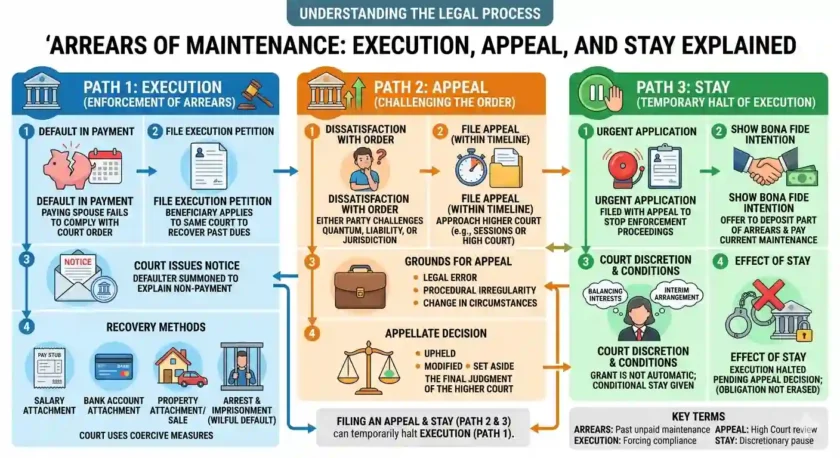
Courts offer multiple execution modes to effectively recover maintenance arrears from defaulters. Claimants may choose the most suitable method based on the debtor’s financial assets. Furthermore, combining modes simultaneously accelerates recovery. Available execution modes include:
- Attachment of salary or wages — Court orders the employer to deduct maintenance directly.
- Attachment of bank accounts — Court freezes and transfers funds from the defaulter’s accounts.
- Attachment and sale of movable property — Vehicles, jewellery, and goods are seized and auctioned.
- Attachment of immovable property — Land or house is attached and sold through court auction.
- Civil imprisonment — Defaulter faces jail under Order XXI Rule 37 CPC for wilful non-payment.
- Arrest warrant — Magistrates issue warrants under BNSS Section 144(3) for non-compliance.
- Garnishee order — Third-party holding debtor’s money pays the court directly.
Rajendra Criminal Law Firm advises claimants to attach salary accounts first for fastest results in Chennai courts.
Role of Police Stations in Enforcing Maintenance Orders
Police play a vital supporting role when courts issue warrants for maintenance defaulters. Consequently, the decree holder should approach the nearest police station with a certified copy of the warrant. Notable police stations handling such matters in Chennai include Egmore Police Station, Mylapore Police Station, Kodambakkam Police Station, Perambur Police Station, and Guindy Police Station. The All Women Police Stations (AWPS) across Tamil Nadu specifically assist women claimants in maintenance enforcement. Officers must execute court warrants promptly under their duty obligations. Moreover, filing an FIR for cruelty under BNS Section 85 strengthens the maintenance case by demonstrating wilful harassment. Therefore, coordinating civil execution proceedings with police action creates maximum pressure on defaulting respondents and compels faster compliance with court maintenance orders.
Attachment of Property: Step-by-Step Execution Process
Attaching a defaulter’s property follows a structured court-supervised procedure. The following numbered steps outline the complete process clearly:
- File execution petition before the competent Family Court or Magistrate Court.
- Court issues notice to the judgment debtor allowing time to comply voluntarily.
- Upon non-compliance, court issues an attachment order identifying specific assets.
- Court bailiff serves the attachment order on the debtor and relevant third parties.
- Bank or employer receives a garnishee notice requiring them to freeze funds immediately.
- Attached property is inventoried and placed under court supervision pending sale.
- Court schedules public auction with proper notice under CPC Order XXI Rules 64–94.
- Auction proceeds are deposited in court and disbursed to the decree holder.
- Any surplus after satisfying arrears is returned to the judgment debtor promptly.
- Execution proceedings are formally closed upon full satisfaction of arrears.
Imprisonment of Defaulter as a Last Resort Remedy
Civil imprisonment remains a powerful deterrent against wilful maintenance default. Notably, courts invoke this remedy only when the defaulter has sufficient means but refuses to pay. Under Order XXI Rule 37 CPC, the court issues a show-cause notice before ordering imprisonment. If the debtor fails to appear or offer a satisfactory reason, the court may commit them to civil prison. The maximum period of civil imprisonment for maintenance default is three months under applicable CPC provisions. Moreover, under BNSS Section 144(3), a Magistrate may sentence the defaulter to imprisonment for one month per month of arrears. Consequently, persistent defaulters face compounding penalties. Rajendra Criminal Law Firm recommends pursuing imprisonment simultaneously with property attachment for maximum enforcement effectiveness in Chennai Family Courts and Magistrate Courts across Tamil Nadu districts.
Comparison of Execution Forums: Civil vs Criminal Proceedings
Claimants must strategically choose between civil and criminal enforcement channels. Therefore, understanding each forum’s advantages and limitations is critical before filing. The table below compares both tracks for maintenance arrears recovery:
| Factor | Civil Court (CPC / Family Court) | Criminal Court (BNSS Section 144) |
|---|---|---|
| Applicable Law | CPC Order XXI, Family Courts Act 1984 | BNSS Section 144, BNS relevant provisions |
| Relief Granted | Property attachment, garnishee, sale | Arrest warrant, fine, imprisonment up to 1 month |
| Speed of Process | Moderate — property sale takes time | Faster — warrant issued promptly |
| Standard of Proof | Preponderance of evidence (BSA 2023) | Beyond reasonable doubt for criminal conviction |
| Court | Family Court / District Court | Judicial Magistrate / JMFC |
| Appeal Forum | High Court (Civil Division) | Sessions Court then High Court |
| Cost | Court fees + advocate fees apply | Minimal fees; DLSA provides free aid |
| Outcome | Recovery of arrears in money | Compliance through fear of imprisonment |
Attachment of Salary Accounts Through Employer Garnishee Orders
Salary attachment represents the fastest and most efficient execution method for salaried maintenance defaulters. Courts issue garnishee orders directly to the employer or salary disbursing authority. Consequently, the employer deducts maintenance amounts from the debtor’s monthly salary before disbursement. Under Order XXI Rule 46 CPC, salary attachment is governed by specific limits protecting the debtor’s subsistence income. Notably, only one-third of net salary is attachable at one time under the law. Government employees’ salaries are attached through the Drawing and Disbursing Officer (DDO) or treasury department. Therefore, Rajendra Criminal Law Firm files garnishee applications within one week of execution petition admission. This method avoids property sale delays and provides immediate monthly recovery directly from the respondent’s income stream.
Attachment of Bank Fixed Deposits and Savings Accounts
Bank account attachment offers direct access to liquid assets held by the maintenance defaulter. Accordingly, the court issues a garnishee notice to the specific bank branch identified by the decree holder. Banks must freeze and transmit the specified amount to the court registry upon receipt of the order. The Reserve Bank of India (RBI) guidelines require banks to comply with court attachment orders immediately. Moreover, Fixed Deposits, Recurring Deposits, and Savings Accounts are all attachable under CPC provisions. Claimants should provide accurate bank details including IFSC code and account number in the execution petition. Therefore, comprehensive financial investigation before filing strengthens enforcement. Rajendra Criminal Law Firm uses BSA 2023 evidence provisions to compel production of bank statements proving available funds in the defaulter’s accounts across Tamil Nadu.
Lok Adalat and Mediation as Alternative Execution Channels
Lok Adalats provide a speedy, cost-free alternative for resolving maintenance arrears disputes amicably. Consequently, parties avoid lengthy litigation and reach binding settlements in a single sitting. The National Legal Services Authority (NALSA) and Tamil Nadu State Legal Services Authority (TNSLSA) organise regular Lok Adalats specifically addressing family and maintenance matters. Awards passed by Lok Adalats are deemed decrees of civil courts and are immediately executable. Furthermore, awards cannot be challenged in any court, providing finality to settlements. Mediation centres attached to Madras High Court and District Courts facilitate structured negotiations. Therefore, Rajendra Criminal Law Firm advises attempting mediation first when partial payment offers are available. Successful mediation reduces costs, preserves relationships, and ensures faster actual recovery compared to prolonged attachment and auction proceedings in Tamil Nadu courts.
Role of District Legal Services Authority in Free Legal Aid
The District Legal Services Authority (DLSA) provides free legal representation to eligible maintenance claimants across all Tamil Nadu districts. Consequently, financially weak spouses, children, and parents can enforce maintenance orders without bearing advocate fees. Eligibility includes persons with annual income below Rs. 3 lakhs and women in all categories under NALSA schemes. DLSA panel advocates file execution petitions, attend hearings, and pursue arrears recovery professionally. Moreover, DLSAs in Chennai, Coimbatore, Madurai, Salem, and Vellore districts have dedicated family law panels. Free legal aid certificates are issued within 15 days of application. Therefore, claimants should approach the nearest DLSA office along with maintenance order copies and identity proof. Rajendra Criminal Law Firm collaborates with DLSA panels to assist clients who cannot afford private legal representation in maintenance enforcement proceedings.
Enforcement Through Revenue Departments and Sub-Registrar Offices
Immovable property attachment requires coordination between courts and revenue department officials. Accordingly, courts issue attachment orders to the District Collector, Tahsildar, and Sub-Registrar offices in the relevant taluk. The Sub-Registrar notes the attachment in property encumbrance records, preventing future transfer or sale by the defaulter. Revenue officials conduct physical demarcation of attached agricultural lands when applicable. Furthermore, the Revenue Divisional Officer (RDO) oversees auction proceedings for attached agricultural properties in rural Tamil Nadu. CMDA (Chennai Metropolitan Development Authority) records are checked for urban property ownership verification. Therefore, Rajendra Criminal Law Firm routinely searches encumbrance certificates before requesting property attachment in maintenance execution proceedings. This prevents wasted effort on already mortgaged or encumbered properties that cannot satisfy the arrears amount efficiently.
Appeal Against Maintenance Orders: Grounds and Procedure
Both claimants and respondents possess the right to appeal maintenance orders through higher courts. Consequently, understanding appeal grounds and timelines prevents dismissal on technical grounds. Appeals from Family Court orders lie before the Madras High Court under Section 19 of the Family Courts Act 1984. Appeals against Magistrate maintenance orders under BNSS Section 144 lie before the Sessions Court within 30 days of the order. The following grounds justify filing an appeal against a maintenance order:
- Perverse findings of fact — Trial court misread or ignored crucial evidence.
- Jurisdictional error — Court lacked jurisdiction to pass the maintenance order.
- Excessive or insufficient quantum — Maintenance amount is disproportionate to income and needs.
- Non-consideration of material evidence — Important documents or testimony ignored.
- Violation of natural justice — Party was not heard before the order was passed.
- Legal error — Wrong provision applied, or applicable statute misinterpreted.
- Change in circumstances — Significant income or custody change since original order.
Additionally, revision petitions under Section 442 BNSS lie before the Sessions Court against Magistrate orders.
Filing an Appeal: Documents Required and Timeline
Timely appeal filing preserves the right to challenge an unfavourable maintenance order. Therefore, strict attention to limitation periods is mandatory. The following documents are required when filing a maintenance appeal before the Madras High Court or Sessions Court:
| Document | Purpose | Copies Required |
|---|---|---|
| Certified copy of impugned order | Primary basis of appeal | 3 sets |
| Memorandum of appeal with grounds | Specifies legal and factual errors | 3 sets |
| Vakalatnama (Power of Attorney) | Authorises advocate to appear | 1 original |
| Index of documents filed below | Provides trial court record reference | 3 sets |
| Affidavit supporting appeal | Verifies facts stated in grounds | 1 original + 2 copies |
| Court fee receipt | Payment of prescribed appellate fees | Original |
| Condonation of delay petition (if late) | Seeks excuse for filing beyond limitation | 3 sets |
Stay of Execution Pending Appeal: Law and Practice
A stay suspends execution of the maintenance order while the appeal is heard and decided. Importantly, stay is not automatically granted merely by filing an appeal. The appellant must make a separate application demonstrating prima facie merit in the appeal. Under Order XLI Rule 5 CPC, courts may grant conditional or unconditional stay of execution proceedings. Notably, BNSS Section 442 empowers the Sessions Court to suspend operation of Magistrate maintenance orders pending revision. Courts consider irreparable injury, balance of convenience, and prima facie case before granting stay. Furthermore, courts frequently impose conditions requiring deposit of arrears or future maintenance as a stay condition. Consequently, defaulters seeking stay must often deposit substantial amounts in court. Rajendra Criminal Law Firm advises clients on realistic stay prospects before investing in expensive appellate proceedings against maintenance orders.
Conditions Courts Impose While Granting Stay of Maintenance
Courts impose protective conditions while granting stay to safeguard the maintenance claimant’s interests. Therefore, appellants must be prepared to comply with these conditions immediately upon stay grant. Common conditions imposed by Tamil Nadu courts include:
- Deposit of entire arrears in court or DLSA account within a fixed timeframe.
- Payment of interim maintenance at a reduced or full rate during appeal pendency.
- Furnishing surety bonds guaranteeing compliance if appeal fails ultimately.
- Surrendering passport to prevent the appellant from evading future compliance.
- Filing quarterly compliance affidavits confirming continued payment of interim amounts.
- Notifying the court of any change in income, employment, or residence immediately.
- Depositing lump sum equivalent to six months’ maintenance as security for the claimant.
Accordingly, courts balance the appellant’s right to appeal with the claimant’s right to maintenance during the appeal period.
Interim Maintenance During Appeal and Execution Stay Period
Claimants retain the right to receive interim maintenance even when stay is granted. Consequently, courts ensure financial protection continues during the appellate process. Under BNSS Section 144, the court can award interim maintenance independently of the main stay application. Moreover, the Protection of Women from Domestic Violence Act 2005 allows parallel maintenance claims even during BNSS appeal proceedings. Interim maintenance applications must be filed promptly with income proof and expenditure affidavits. Family Courts in Chennai typically decide interim maintenance applications within 60 days. Furthermore, failure to pay court-ordered interim maintenance constitutes contempt and disentitles the defaulter from stay benefits. Therefore, Rajendra Criminal Law Firm simultaneously pursues interim maintenance enforcement while the main appeal proceeds through the Madras High Court’s family division bench.
Modification and Revision of Maintenance Orders
Maintenance orders remain subject to modification upon proof of changed circumstances. Consequently, both claimants and respondents may seek revision when income or needs change substantially. Under BNSS Section 144(7), courts may cancel or alter maintenance orders on proof of changed circumstances. Grounds for modification include:
- Increase in respondent’s income — Pay raise, business growth, or property acquisition justifies upward revision.
- Inflation and cost of living increase — Courts regularly enhance maintenance to match economic realities.
- Change in claimant’s financial status — Claimant’s remarriage or employment may reduce entitlement.
- Children’s educational expenses increase — Higher education costs justify enhanced child maintenance orders.
- Medical expenses of older parents — Rising healthcare costs support modification of parental maintenance.
- Respondent’s insolvency or severe income reduction — Proven financial hardship may justify downward revision.
Moreover, the Madras High Court has consistently held that maintenance must keep pace with inflation and rising living standards across Tamil Nadu.
Contempt of Court for Wilful Maintenance Default
Wilful default of court-ordered maintenance constitutes contempt of court punishable by fine and imprisonment. Consequently, contempt proceedings create powerful enforcement pressure on habitual defaulters. Under the Contempt of Courts Act 1971, civil contempt covers wilful disobedience of any court order including maintenance orders. The Madras High Court has sentenced maintenance defaulters to imprisonment in landmark cases. Moreover, BNS Section 238 penalises absconders who evade court process. Filing contempt petitions simultaneously with execution proceedings multiplies enforcement effectiveness significantly. The Supreme Court of India in multiple judgments has directed strict enforcement of maintenance orders protecting vulnerable dependents. Therefore, Rajendra Criminal Law Firm regularly combines contempt proceedings with civil execution petitions for maximum enforcement impact in Chennai Family Courts and the Madras High Court jurisdiction.
Online Portals and Digital Tools for Maintenance Enforcement
Digital platforms significantly simplify monitoring and enforcement of maintenance orders in Tamil Nadu. Therefore, claimants and advocates should leverage available technology effectively. Useful online resources include:
- eCourts Services Portal (ecourts.gov.in) — Track case status, orders, and hearing dates online.
- FASTER System (Fax and Secure Transmission of Electronic Records) — Rapid transmission of court orders to police and banks.
- NALSA e-Legal Services — Apply for free legal aid online through NALSA portal.
- TNCSC and Revenue Department portals — Verify property records and encumbrance certificates digitally.
- MCA21 (Ministry of Corporate Affairs) — Trace company directorship and shares of defaulting business owners.
- CERSAI Portal — Verify mortgages and charges on properties owned by the maintenance defaulter.
- EPFO portal (epfindia.gov.in) — Trace employment and EPF contributions to confirm income levels.
Accordingly, using digital tools strengthens evidence gathering and accelerates execution proceedings before all Tamil Nadu courts.
Government Departments Assisting Maintenance Enforcement in Tamil Nadu
Several government departments actively support maintenance enforcement beyond courts and police. Consequently, claimants should strategically engage these departments for comprehensive enforcement. The Tamil Nadu Women and Child Development Department provides welfare schemes supporting maintenance claimants. The One Stop Centre (Sakhi Centre) scheme under the Ministry of Women and Child Development offers integrated support including legal aid, police assistance, and medical help. District Collectors intervene in cases involving government employees defaulting on maintenance. Moreover, the Income Tax Department can provide income information through court-ordered disclosure. The Provident Fund Commissioner can facilitate attachment of EPF balances upon court orders. Therefore, Rajendra Criminal Law Firm coordinates with multiple departments simultaneously to create a comprehensive enforcement strategy ensuring maximum recovery of maintenance arrears for deserving claimants across Tamil Nadu.
Frequently Asked Questions: Maintenance Arrears, Execution, and Appeal
FAQs on Maintenance Enforcement Under Indian Law
1. What is the limitation period for recovering maintenance arrears?
Under Article 181 of the Limitation Act 1963, maintenance arrears can be recovered within 3 years of each payment becoming due. File promptly to avoid losing your right.
2. Can a wife claim maintenance arrears after divorce is granted?
Yes. A divorced wife can claim arrears of maintenance accrued before divorce. She may also claim permanent alimony separately under applicable personal law provisions.
3. Which court handles maintenance execution in Chennai?
Family Courts in Chennai and Judicial Magistrate Courts handle maintenance execution. The court that passed the original order typically executes it under CPC and BNSS provisions.
4. Does filing an appeal automatically stay maintenance execution?
No. Filing an appeal does NOT automatically stay execution. A separate stay application must be filed and granted by the appellate court before execution stops legally.
5. Can parents claim maintenance arrears from adult children?
Yes. Under BNSS Section 144 and the Maintenance and Welfare of Parents and Older People Act 2007, parents can recover arrears from adult children through execution proceedings.
6. What is the maximum imprisonment for maintenance default under BNSS?
Under BNSS Section 144(3), a defaulter faces up to one month’s imprisonment per month of default. Courts may impose this upon proof of wilful non-payment despite having means.
7. Can a Lok Adalat award be challenged in High Court?
No. Lok Adalat awards are final and binding under Section 21 of the Legal Services Authorities Act 1987. They cannot be challenged before any court, making settlement permanent.
8. How is a maintenance order enforced against NRI defaulters?
Courts attach Indian properties and bank accounts of NRI defaulters. Additionally, courts may issue Look Out Circulars preventing departure from India under BNSS provisions.
9. Is free legal aid available for maintenance execution cases?
Yes. DLSA provides free legal aid for eligible claimants with income below Rs. 3 lakhs annually. Women claimants receive free aid regardless of income under NALSA guidelines.
10. Can maintenance arrears be waived by mutual agreement of parties?
Yes. Parties may waive or settle arrears by mutual consent through a recorded settlement before court or Lok Adalat. Such agreements bind both parties permanently and finally.
Read More
- Enforcement of Maintenance Orders Under BNSS – What Changed From CrPC?
- Parallel Maintenance Proceedings – How BNSS Prevents Abuse of Process
- Maintenance to Earning Spouse – Supreme Court Guidelines Explained
- Excessive Maintenance Orders: Appellate Remedies Under BNSS
- Interim Maintenance Challenge in High Court – Legal Remedies After BNSS
- National Judicial Data Grid (NJDG)