

White-collar crime may not involve violence, but it can cause serious damage to businesses, individuals, and even the economy of a country. In India, such crimes have increased with the growth of digital transactions, corporate activities, and global trade. Therefore, understanding the legal framework, possible defences, and penalties is essential for individuals, companies, NGOs, and NRIs alike.
At Rajendra Criminal Law Firm, we regularly assist clients in navigating complex white-collar crime matters. In this article, we explain the topic in simple words, while also covering the legal depth required for proper understanding.
White-Collar Crime in India: Laws, Defences, and Penalties – By Rajendra Criminal Law Firm
What is White-Collar Crime?
White-collar crime refers to non-violent, financially motivated offences committed by individuals, professionals, or businesses. Typically, these crimes involve deception, breach of trust, or misuse of authority.
For example, fraud, insider trading, money laundering, tax evasion, and cybercrime all fall under this category. Unlike traditional crimes, white-collar offences are often committed in offices, boardrooms, or online platforms.
Moreover, these crimes are usually complex. As a result, they require detailed investigation and strong legal strategy.
Common Types of White-Collar Crimes in India
To understand the subject better, let us look at some common forms:
1. Fraud and Cheating
This includes misrepresentation of facts to gain financial advantage. For instance, fake investment schemes or forged documents fall under this category.
2. Money Laundering
Here, illegal money is converted into legitimate funds. This often involves multiple transactions and shell companies.
3. Corporate Fraud
Companies may manipulate financial statements or hide losses to mislead investors and regulators.
4. Cybercrime
With increasing digitalization, offences like hacking, identity theft, and online scams have become more common.
5. Tax Evasion
This involves deliberately avoiding payment of taxes through illegal means.
6. Insider Trading
Using confidential company information to trade shares unfairly is also a serious offence.
Laws Governing White-Collar Crime in India
India has a strong legal framework to deal with white-collar crimes. Various laws apply depending on the nature of the offence. Let us explore the key ones.
Indian Penal Code (IPC), 1860
The IPC covers offences like cheating, criminal breach of trust, forgery, and fraud. It forms the base for many white-collar crime cases.
Prevention of Money Laundering Act (PMLA), 2002
This law targets the process of laundering illegal money. It allows authorities to attach and confiscate properties derived from criminal activities.
Companies Act, 2013
This Act deals with corporate governance and fraud committed by company officials. It imposes strict duties on directors and auditors.
Information Technology Act, 2000
This law addresses cyber offences, including hacking, data theft, and online fraud.
Income Tax Act, 1961
Tax evasion and undisclosed income are dealt with under this Act.
SEBI Act, 1992
This Act regulates the securities market and addresses insider trading and market manipulation.
Authorities Involved in Investigation
White-collar crimes often involve multiple agencies. Therefore, different authorities may investigate and prosecute cases.
- Enforcement Directorate (ED) handles money laundering cases.
- Central Bureau of Investigation (CBI) investigates major financial frauds.
- Serious Fraud Investigation Office (SFIO) deals with corporate fraud.
- Income Tax Department handles tax-related offences.
- Cyber Crime Cells investigate digital offences.
Because of overlapping jurisdictions, coordination between agencies becomes crucial.
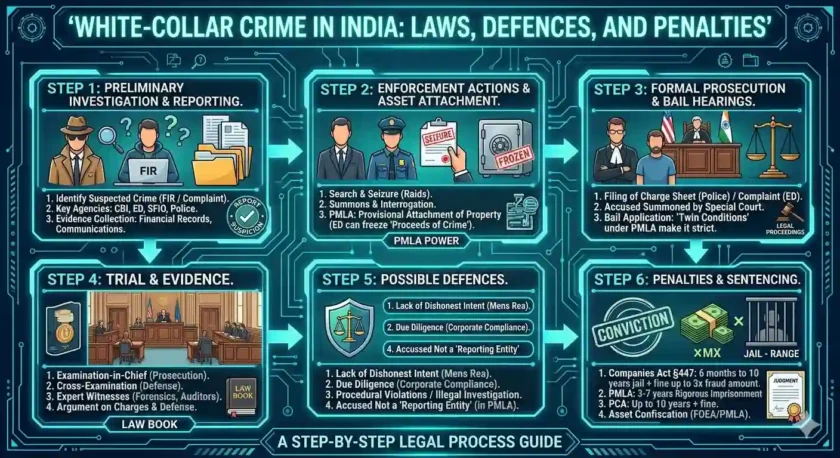
Legal Process in White-Collar Crime Cases
The legal process usually follows several steps:
1. Complaint or Detection
The case begins with a complaint or detection by authorities.
2. Investigation
Authorities collect evidence, record statements, and analyze financial data.
3. Arrest or Summons
Depending on the seriousness, the accused may be arrested or summoned.
4. Filing of Charges
A chargesheet or complaint is filed before the court.
5. Trial
The court examines evidence and hears both sides.
6. Judgment
Finally, the court decides whether the accused is guilty or not.
Since these cases involve technical evidence, trials may take time.
Defences Available in White-Collar Crime Cases
Even though the laws are strict, the accused has the right to defend themselves. A strong defence can make a significant difference.
1. Lack of Intent
Many white-collar crimes require proof of intention. If the accused can show that there was no dishonest intent, the case may weaken.
2. Absence of Evidence
If the prosecution fails to provide sufficient evidence, the accused can benefit.
3. Procedural Errors
If authorities do not follow proper legal procedures, the defence can challenge the case.
4. Mistaken Identity
In complex financial transactions, sometimes the wrong person is accused.
5. Reliance on Professional Advice
In some cases, individuals act based on advice from accountants or lawyers. This can be used as a defence.
6. Duress or Coercion
If the accused acted under pressure or threat, it may reduce liability.
At Rajendra Criminal Law Firm, we carefully analyze each case to build a tailored defence strategy.
Penalties for White-Collar Crimes
Penalties vary depending on the nature and severity of the offence. However, they are often strict to deter such crimes.
1. Imprisonment
Many offences carry jail terms ranging from a few years to life imprisonment.
2. Fines
Heavy monetary penalties are imposed, sometimes running into crores.
3. Confiscation of Property
Illegal assets may be seized by authorities.
4. Disqualification
Company directors may be disqualified from holding positions.
5. Denylisting
Businesses may be barred from government contracts.
6. Reputational Damage
Apart from legal penalties, reputation loss can be severe and long-lasting.
Challenges in White-Collar Crime Cases
Despite strong laws, certain challenges remain:
- Complexity of financial transactions
- Cross-border elements involving NRIs
- Lack of awareness among victims
- Delay in judicial processes
- Difficulty in gathering digital evidence
Therefore, timely legal advice becomes extremely important.
Role of Legal Experts
Handling white-collar crime cases requires specialized knowledge. Lawyers must understand finance, technology, and regulatory frameworks.
At Rajendra Criminal Law Firm, we focus on:
- Providing early legal advice
- Representing clients before investigative agencies
- Drafting responses and legal documents
- Handling bail and trial proceedings
- Protecting clients’ rights at every stage
Because each case is unique, we adopt a practical and strategic approach.
Preventive Measures
Prevention is always better than cure. Individuals and organizations can take steps to avoid legal trouble.
- Maintain proper records and documentation
- Follow compliance and regulatory requirements
- Conduct internal audits regularly
- Use secure digital systems
- Seek legal advice before major decisions
By doing so, risks can be minimized significantly.
Importance for NRIs, Companies, and NGOs
White-collar crime laws affect not just individuals but also organizations and NRIs.
- Companies must ensure corporate governance and compliance.
- NGOs must follow strict rules for foreign funding and transparency.
- NRIs must comply with Indian laws in cross-border transactions.
Failure to do so can lead to serious consequences.
Frequently Asked Questions
White-collar crime in India refers to non-violent offences committed for financial gain through deceit, breach of trust, or misuse of position. Common examples include fraud, money laundering, tax evasion, insider trading, and cybercrimes. These offences are usually committed by professionals, businesspersons, or organizations, and often involve complex financial transactions and documentation.
Several laws regulate white-collar crimes depending on the nature of the offence. The Indian Penal Code, 1860 covers cheating and fraud. The Prevention of Money Laundering Act, 2002 deals with laundering of illegal funds. The Companies Act, 2013 addresses corporate fraud, while the Information Technology Act, 2000 governs cyber offences. Additionally, SEBI and Income Tax laws apply in specific cases.
Accused persons can raise several legal defences. These include lack of criminal intent, insufficient evidence, procedural lapses by authorities, or acting in good faith based on professional advice. In some situations, coercion or mistaken identity may also be argued. A well-prepared defence strategy depends on the facts, documents, and nature of allegations involved.
Penalties vary depending on the seriousness of the offence. They may include imprisonment, heavy fines, confiscation of assets, and disqualification from holding key positions in companies. In severe cases, authorities may also attach properties and initiate recovery proceedings. Apart from legal punishment, reputational damage can significantly affect individuals and businesses.
Prevention involves strong compliance and internal controls. Maintaining transparent records, conducting regular audits, and following legal and regulatory requirements are essential steps. Organizations should implement data security measures and train employees on ethical practices. Seeking timely legal advice before major financial decisions can also help reduce exposure to legal risks.
Conclusion
In conclusion, white-collar crime in India is a serious and evolving area of law. While the legal framework is robust, navigating it requires careful understanding and expert guidance.
On one hand, the government continues to strengthen laws and enforcement. On the other hand, individuals and businesses must stay informed and cautious.
At Rajendra Criminal Law Firm, we are committed to helping our clients face these challenges confidently. Whether it is prevention, defence, or representation, our goal is to provide clear, practical, and effective legal solutions.
Read More
- Arrears of Maintenance: Execution, Appeal, and Stay Explained
- Enforcement of Maintenance Orders Under BNSS – What Changed From CrPC?
- Parallel Maintenance Proceedings – How BNSS Prevents Abuse of Process
- Maintenance to Earning Spouse – Supreme Court Guidelines Explained
- Excessive Maintenance Orders: Appellate Remedies Under BNSS
- Enforcement Directorate