
Guide to Domestic Violence Cases – Domestic violence devastates families and leaves victims helpless without proper legal guidance. Understanding your rights under IPC Section 498A and related laws is therefore essential in 2026. Rajendra Criminal Law Firm provides expert criminal law support for domestic violence victims across all courts, police stations, and tribunals in India.
A Guide to Domestic Violence Cases under IPC 498A: Rights, Remedies & Legal Support 2026
Understanding IPC 498A and Domestic Violence Laws in India 2026
Section 498A of the Indian Penal Code, 1860 specifically protects married women from cruelty. Consequently, this provision criminalises mental, physical, and economic abuse by husbands and in-laws. The Bharatiya Nyaya Sanhita, 2023 (BNS) replaces IPC and retains this protection under Section 85 and Section 86. Additionally, the Protection of Women from Domestic Violence Act, 2005 (PWDVA) provides comprehensive civil remedies. The Bharatiya Nagarik Suraksha Sanhita, 2023 (BNSS) governs all procedural aspects of domestic violence criminal cases. Furthermore, the Bharatiya Sakshya Adhiniyam, 2023 (BSA) governs admissibility of evidence in these cases. Cruelty under Section 85 BNS includes both physical harm and mental harassment of the wife. Dowry demands made by husbands or relatives also attract criminal prosecution under these provisions. Therefore, victims must understand all applicable laws before approaching the police or courts. Rajendra Criminal Law Firm offers immediate legal consultation for domestic violence victims across India.
What Constitutes Cruelty Under BNS Section 85 and Former IPC 498A
Cruelty has a broad legal meaning under both IPC 498A and its replacement BNS Section 85. Accordingly, courts interpret cruelty to include multiple forms of harmful conduct against married women. The following acts constitute legally recognised cruelty under Indian law:
- Physical Violence: Beating, slapping, kicking, or any bodily injury caused to the wife.
- Mental Harassment: Taunting, humiliating, threatening, or emotionally abusing the wife regularly.
- Dowry Demands: Unlawful demands for cash, property, or valuables from the wife’s family.
- Economic Abuse: Denying financial support, controlling money, or sabotaging employment opportunities.
- Sexual Abuse: Forcing unwanted sexual acts on the wife within the marriage relationship.
- Verbal Abuse: Repeated insults, threats, and degrading language causing mental suffering.
- Social Isolation: Preventing the wife from meeting family, friends, or seeking outside help.
Furthermore, a single grave act of cruelty suffices to attract criminal liability under BNS Section 85. Courts have consistently held that cruelty need not be continuous to constitute an offence. Therefore, victims must document every incident carefully with dates, witnesses, and medical records. Rajendra Criminal Law Firm guides victims in evidence collection and complaint filing immediately.
Key Governing Laws for Domestic Violence Cases in India 2026
Multiple statutes collectively address domestic violence and cruelty against women in India. Importantly, understanding all applicable laws maximises legal protection and remedies available to victims. The following table summarises all governing laws applicable in 2026:
| Statute | Key Provision | Relevance to Victim |
|---|---|---|
| BNS, 2023 | Sections 85–86 | Cruelty by husband/relatives |
| PWDVA, 2005 | Sections 12, 18–23 | Protection, residence & maintenance |
| Dowry Prohibition Act, 1961 | Sections 3, 4, 6 | Dowry demand & giving |
| BNSS, 2023 | Sections 35, 173, 179 | Arrest, FIR & trial procedure |
| BSA, 2023 | Sections 62–90 | Evidence admissibility |
| Hindu Marriage Act, 1955 | Section 13 | Divorce grounds including cruelty |
| CrPC / BNSS | Section 125 / Section 144 | Maintenance & protection orders |
Therefore, a domestic violence case simultaneously invokes criminal, civil, and family law provisions. Victims benefit most when all applicable laws are strategically deployed together. Rajendra Criminal Law Firm provides integrated legal representation covering all applicable statutes comprehensively.
Punishment for Domestic Violence and Cruelty Under BNS 2023
The BNS, 2023 prescribes specific punishment for cruelty against married women under Section 85. Accordingly, conviction under this provision carries imprisonment up to three years and a fine. The offence is cognisable, non-bailable, and non-compoundable under the First Schedule of BNSS, 2023. Consequently, police must register an FIR immediately without requiring a magistrate’s order. The accused cannot be released on bail as a matter of right without court scrutiny. Furthermore, courts cannot permit private compromise or withdrawal of this case once filed. Dowry death under Section 80 BNS (formerly Section 304B IPC) attracts minimum seven years imprisonment. Additionally, Section 86 BNS addresses dowry-related cruelty with enhanced punishment provisions. Abetment of suicide by a married woman attracts Section 108 BNS prosecution as well. Therefore, accused persons face serious criminal consequences upon conviction under these provisions. Rajendra Criminal Law Firm defends both victims and accused persons with equal legal expertise.
Complete Legal Remedies for Domestic Violence Victims in India 2026
Domestic violence victims in India have access to both criminal and civil legal remedies. Notably, pursuing multiple remedies simultaneously maximises protection and financial security for victims. The PWDVA, 2005 provides civil remedies including protection orders, residence orders, and maintenance. Additionally, criminal remedies under BNS and BNSS deliver punishment to abusers through court prosecution. Maintenance under Section 144 BNSS (formerly Section 125 CrPC) provides immediate financial relief. Furthermore, divorce on grounds of cruelty under the Hindu Marriage Act, 1955 provides permanent legal separation. Custody of children is addressed through the Guardians and Wards Act, 1890 and family courts. Additionally, the National Commission for Women (NCW) provides legal aid and support to victims. Free legal aid under the Legal Services Authorities Act, 1987 is available at DLSA offices. Therefore, victims must not delay seeking legal protection as early action prevents escalating abuse. Rajendra Criminal Law Firm handles every domestic violence remedy with urgency and sensitivity.
Filing an FIR Under BNS Section 85: Police Station Procedure 2026
Filing an FIR is the first and most critical step in a domestic violence criminal case. Consequently, victims must approach the nearest police station to register their complaint immediately. Under BNSS, 2023, police are legally obligated to register FIRs in cognisable offences without delay. The following police stations and units handle domestic violence complaints across India:
- All Women Police Stations (AWPS): Dedicated stations staffed by women officers across India.
- Local Jurisdictional Police Stations: Handle FIRs based on where the offence occurred.
- Crime Against Women (CAW) Cells: Specialised units in metro cities like Delhi and Mumbai.
- One Stop Centres (Sakhi Centres): Government-run centres providing police, legal, and medical aid.
Importantly, a victim can also file a Zero FIR at any police station, regardless of jurisdiction. The FIR is subsequently transferred to the jurisdictional police station for investigation. Furthermore, e-FIR facilities are available in states including Tamil Nadu, Maharashtra, and Delhi. The investigating officer must complete investigation within 60 days under BNSS timelines. Additionally, a Judicial Magistrate can order FIR registration if police refuse under Section 175(3) BNSS. Therefore, no victim should tolerate police reluctance in registering domestic violence complaints today. Rajendra Criminal Law Firm accompanies victims to police stations and ensures proper FIR registration.
Protection Orders Under PWDVA 2005: Emergency and Regular Relief
Protection orders under PWDVA, 2005 immediately restrain the abuser from committing further violence. Accordingly, Section 18 of PWDVA empowers Magistrates to pass protection orders urgently. Emergency protection orders can be granted ex parte even without hearing the respondent. Furthermore, violation of a protection order is itself a criminal offence punishable under Section 31 PWDVA. The following types of orders are available under PWDVA, 2005:
- Protection Order (Section 18): Restrains abuser from committing any act of domestic violence.
- Residence Order (Section 19): Protects victim’s right to shared household occupation.
- Monetary Relief Order (Section 20): Awards compensation for losses including medical expenses.
- Custody Order (Section 21): Grants interim custody of children to the aggrieved woman.
- Compensation Order (Section 22): Awards damages for injuries and emotional distress suffered.
Additionally, the Magistrate must dispose of a PWDVA application within 60 days of first hearing. Protection Officers appointed under PWDVA assist victims in filing applications and accessing services. Furthermore, Service Providers registered under PWDVA provide shelter, counselling, and legal assistance. Notably, the Supreme Court in Hiral P. Harsora v. Kusum Narottamdas Harsora expanded PWDVA applicability. Rajendra Criminal Law Firm files urgent PWDVA applications before Magistrates for immediate victim protection.
Maintenance Rights of Domestic Violence Victims: Section 144 BNSS
Maintenance provides essential financial support to domestic violence victims during legal proceedings. Consequently, Section 144 of BNSS, 2023 (formerly Section 125 CrPC) guarantees maintenance rights. Courts can grant interim maintenance within the first few hearings of the maintenance application. Furthermore, maintenance under PWDVA Section 20 can be sought separately and simultaneously. The following maintenance remedies are available to domestic violence victims in India:
- Interim Maintenance: Immediate financial support during pending court proceedings.
- Permanent Maintenance: Monthly support ordered at final disposal of the maintenance application.
- PWDVA Monetary Relief: Covers rent, medical costs, loss of earnings, and property damage.
- HMA Section 24 Alimony: Pendente lite maintenance during divorce proceedings in family court.
Importantly, courts now apply gender-sensitive principles when determining maintenance quantum. The Supreme Court in Rajnesh v. Neha issued guidelines standardising maintenance across all courts. Additionally, defaulting on maintenance orders can result in attachment of the husband’s salary or property. Therefore, maintenance orders provide vital financial independence to victims during lengthy legal proceedings. Rajendra Criminal Law Firm aggressively pursues maintenance claims in all courts across India.
Dowry Harassment and BNS Section 86: Legal Action Against In-Laws
Dowry harassment is one of the most prevalent forms of domestic violence across India today. Accordingly, the Dowry Prohibition Act, 1961 and BNS Section 86 jointly address this serious offence. Section 3 of the Dowry Prohibition Act criminalises giving or taking dowry with up to five years imprisonment. Furthermore, Section 4 punishes dowry demands with a minimum imprisonment of six months. The accused in dowry harassment cases typically include the following persons:
- The husband who makes or supports unlawful dowry demands.
- The mother-in-law who actively participates in harassment campaigns.
- The father-in-law who demands or receives dowry from the bride’s family.
- Brothers-in-law and sisters-in-law who assist in harassment acts.
- Any relative of the husband who participates in cruelty or demands.
Notably, Dowry Prohibition Officers (DPOs) are appointed in every state to monitor and investigate dowry cases. Additionally, the National Commission for Women (NCW) accepts dowry harassment complaints online for immediate action. The Mahila Thana or Women’s Police Cells in Tamil Nadu handle dowry complaints sensitively. Therefore, victims must record every dowry demand through messages, audio recordings, or witness testimony. Rajendra Criminal Law Firm builds strong dowry harassment prosecutions with compelling evidence strategies.
Bail in IPC 498A / BNS 85 Cases: Court Procedures and Accused Rights
Bail in domestic violence cases involves complex legal considerations for both victims and accused. Consequently, understanding bail provisions helps victims oppose premature releases effectively in court. BNS Section 85 is a non-bailable offence, requiring accused persons to apply before a Magistrate. Furthermore, courts consider the severity of violence, flight risk, and victim safety before granting bail. The following courts handle bail applications in domestic violence criminal cases:
- Judicial Magistrate Courts: First point for bail applications after arrest under BNSS.
- Sessions Courts: Handle bail where Magistrate refuses or for more serious connected offences.
- High Courts: Entertain bail applications under Section 483 BNSS for High Court bail.
- Supreme Court: Grants special leave and bail in exceptional cases of national importance.
Importantly, the Supreme Court in Arnesh Kumar v. State of Bihar directed police not to arrest mechanically in 498A cases. Therefore, arrests must follow a Magistrate-approved checklist before detaining any accused person. Additionally, anticipatory bail under Section 482 BNSS protects persons fearing false or retaliatory cases. Rajendra Criminal Law Firm appears before all courts for bail, anticipatory bail, and bail cancellation applications.
Role of Family Courts in Domestic Violence Related Disputes 2026
Family Courts play a central role in resolving domestic violence-linked matrimonial disputes in India. Accordingly, the Family Courts Act, 1984 established specialised family courts across all states. These courts handle divorce, maintenance, custody, and matrimonial property disputes arising from domestic violence. Importantly, family courts adopt a conciliation-first approach before proceeding to contested litigation. The following matters are adjudicated by Family Courts in domestic violence contexts:
- Divorce petitions on grounds of cruelty under Hindu Marriage Act, Section 13(1)(ia).
- Custody and visitation rights of children born in the abusive marriage.
- Restitution of conjugal rights applications filed by either spouse.
- Matrimonial property disputes including stridhan recovery claims.
- Permanent alimony and maintenance under HMA Section 25.
Furthermore, Family Courts can simultaneously hear PWDVA maintenance applications for victim convenience. Stridhan recovery — recovering wife’s personal gold, gifts, and property — is also handled by Family Courts. Additionally, courts now increasingly accept digital evidence under BSA, 2023 in matrimonial disputes. Notably, legal aid lawyers are available at Family Court Legal Services Committees for free representation. Therefore, domestic violence victims should approach Family Courts immediately alongside criminal proceedings. Rajendra Criminal Law Firm provides complete family court representation for all domestic violence-linked matrimonial matters.
Protection Officers and Service Providers Under PWDVA 2005
Protection Officers are designated government officials who bridge victims and the legal system effectively. Consequently, their role is critical in ensuring victims access all available remedies without delay. The following table summarises the roles of key PWDVA functionaries in 2026:
| Functionary | Role | Where to Find |
|---|---|---|
| Protection Officer (PO) | Assists in filing DIR, applications, and safety plans | District Collectorate / DM Office |
| Service Provider (SP) | Provides shelter, medical, and legal support | NGOs and government centres |
| Magistrate (JMFC) | Passes protection, residence, and custody orders | Judicial Magistrate Court |
| Police Officer | Registers FIR and escorts victim to safety | Nearest Police Station / AWPS |
| Medical Officer | Provides medical examination and MLC report | Government Hospital / PHC |
Additionally, Protection Officers prepare the Domestic Incident Report (DIR), which is filed before the Magistrate. Furthermore, Service Providers registered under Section 10 PWDVA run shelter homes and counselling centres. The One Stop Centre Scheme (Sakhi) under the Ministry of Women and Child Development assists victims. Therefore, Protection Officers are the first point of contact for victims seeking PWDVA remedies today. Rajendra Criminal Law Firm coordinates with Protection Officers to ensure seamless victim support throughout proceedings.
Tribunals and Forums Handling Domestic Violence-Related Complaints 2026
Domestic violence victims can approach multiple forums and tribunals for comprehensive legal relief. Accordingly, choosing the correct forum ensures faster and more effective legal outcomes for victims. The following forums specifically handle domestic violence and related complaints in India:
- Judicial Magistrate First Class (JMFC): Primary court for PWDVA applications and BNS 85 trials.
- Sessions Court: Handles serious domestic violence cases and bail matters.
- Family Court: Adjudicates divorce, custody, and maintenance arising from domestic violence.
- National Commission for Women (NCW): Accepts complaints and facilitates legal action.
- State Women’s Commissions: Investigate and refer complaints to appropriate authorities.
- Human Rights Courts: High Courts designated under Protection of Human Rights Act, 1993.
- Legal Services Authority (DLSA/SLSA): Provides free legal aid and Lok Adalat settlement.
Furthermore, the Tamil Nadu State Commission for Women actively intervenes in domestic violence cases in Chennai. Additionally, Mahila Courts in several states provide dedicated women-centric justice delivery. Notably, Lok Adalats under the Legal Services Authorities Act, 1987 facilitate amicable settlements in eligible matters. Therefore, victims benefit from pursuing simultaneous remedies across multiple forums strategically. Rajendra Criminal Law Firm represents clients before all forums, commissions, and courts effectively.
Digital Evidence in Domestic Violence Cases: BSA 2023 Provisions
Digital evidence now plays a decisive role in domestic violence criminal and civil proceedings. Consequently, the Bharatiya Sakshya Adhiniyam, 2023 (BSA) comprehensively governs electronic evidence admissibility. Screenshots, WhatsApp messages, call recordings, and emails are now commonly accepted as evidence. Importantly, Section 63 of BSA, 2023 governs secondary evidence including electronic documents in all courts. The following types of digital evidence strengthen domestic violence cases significantly:
- WhatsApp messages and voice notes showing threats, demands, or abusive language.
- Call recordings capturing verbal abuse, dowry demands, or threats from accused persons.
- CCTV footage from home or building premises showing physical violence incidents.
- Photographs of injuries, broken property, or damaged household items.
- Medical records, hospital bills, and MLC reports documenting physical injuries sustained.
- Bank statements showing economic abuse or sudden financial withdrawal patterns.
- Emails and social media posts containing threats or defamatory content against the victim.
Furthermore, Section 61 of BSA requires an Electronic Evidence Certificate for admissibility in courts. Therefore, victims must carefully preserve all digital communications without deletion or alteration. Additionally, forensic experts can extract deleted messages and data under court orders if required. Rajendra Criminal Law Firm assists clients in collecting, preserving, and presenting digital evidence effectively.
Free Legal Aid for Domestic Violence Victims: Government Schemes 2026
Free legal aid ensures that economic hardship does not prevent domestic violence victims from accessing justice. Accordingly, the Legal Services Authorities Act, 1987 mandates free legal aid for all women in India. Every District Legal Services Authority (DLSA) provides free lawyers for domestic violence cases. Furthermore, the following government schemes specifically support domestic violence victims in 2026:
- One Stop Centre Scheme (Sakhi): Provides police, legal, medical, and shelter under one roof.
- Swadhar Greh: Ministry of WCD scheme providing shelter to women in difficult circumstances.
- Ujjwala Scheme: Supports rescue, rehabilitation, and legal aid for violence victims.
- NALSA Legal Aid: National Legal Services Authority provides free representation at all courts.
- 181 Abhayam Helpline: Women’s helpline for emergency assistance and legal guidance.
Additionally, the National Commission for Women (NCW) provides a legal resource centre and online complaint portal. State Legal Services Authorities in Tamil Nadu, Maharashtra, and Delhi run dedicated women’s legal aid cells. Furthermore, Lok Adalats provide amicable resolution and monetary compensation without prolonged litigation. Notably, all legal aid services are completely free for women irrespective of income level. Therefore, no domestic violence victim in India needs to face abuse without access to legal protection. Rajendra Criminal Law Firm coordinates with DLSA and other legal aid bodies for comprehensive victim support.
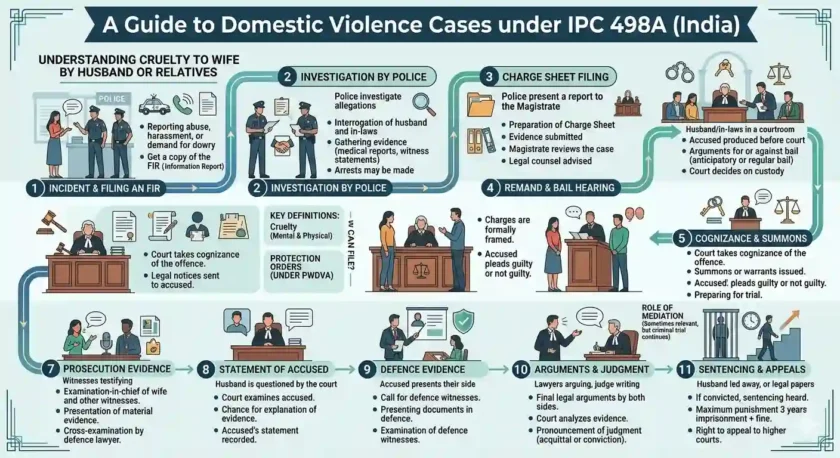
Step-by-Step Process to File a Domestic Violence Case in India 2026
Filing a domestic violence case requires following a clear, structured process for maximum legal impact. Consequently, understanding each procedural step prevents delays and strengthens the victim’s legal position significantly. The step-by-step process for filing a domestic violence case in India is as follows:
- Seek Safety First: Move to a safe location such as a Sakhi Centre or trusted family home.
- Medical Examination: Get examined at a government hospital to obtain a Medico-Legal Certificate (MLC).
- Contact Protection Officer: File a Domestic Incident Report (DIR) through the Protection Officer.
- Register FIR: File a police complaint at the nearest police station or All Women Police Station.
- Engage a Lawyer: Consult a criminal lawyer experienced in domestic violence cases immediately.
- File PWDVA Application: Approach the Judicial Magistrate for protection and residence orders.
- File Maintenance Application: Apply for maintenance under Section 144 BNSS before the Magistrate.
- Approach Family Court: File for divorce, custody, and stridhan recovery in Family Court.
- Collect Evidence: Preserve messages, photographs, medical records, and witness statements.
- Attend All Hearings: Appear before courts regularly and update your lawyer on all developments.
Therefore, following this structured process ensures comprehensive legal protection for domestic violence victims. Rajendra Criminal Law Firm provides step-by-step support from the first complaint to final court decree.
Misuse of IPC 498A / BNS 85: Legal Defence for Falsely Accused Persons
Courts have acknowledged that BNS Section 85 complaints are sometimes filed with malicious intent. Consequently, falsely accused persons require skilled criminal defence to protect their legal rights. The Supreme Court in Social Action Forum v. Union of India issued guidelines preventing automatic arrests. Furthermore, the Arnesh Kumar judgment mandates a checklist-based approach before every arrest in these cases. The following legal defences are available to persons falsely accused under BNS Section 85:
- Anticipatory Bail (Section 482 BNSS): Protects accused from arrest during investigation stage.
- Quashing of FIR (Section 528 BNSS): High Court can quash malicious and false FIRs.
- Counter-Complaint: File complaint for malicious prosecution and defamation against complainant.
- Alibi Evidence: Establish the accused was not present during the alleged incident.
- Witness Evidence: Present credible witnesses to disprove the allegations made against the accused.
Additionally, the Family Welfare Committees formed under Supreme Court directives scrutinise complaints before arrest. Therefore, false cases are increasingly being identified and dismissed at early stages of proceedings. Notably, filing a false FIR can itself attract prosecution under Section 211 BNS (false charge offence). Rajendra Criminal Law Firm provides vigorous criminal defence for persons falsely accused under BNS Section 85.
Government Departments and Helplines for Domestic Violence Support 2026
Multiple government departments and helplines provide immediate support for domestic violence victims. Accordingly, victims must be aware of all available government resources for timely assistance. The following table lists key government departments, helplines, and their roles in 2026:
| Department / Helpline | Contact | Services Provided |
|---|---|---|
| National Commission for Women (NCW) | 7827170170 | Legal support, complaint redressal |
| Women Helpline (Abhayam) | 181 | Emergency assistance and counselling |
| Police Emergency | 112 | Immediate police intervention and rescue |
| One Stop Centre (Sakhi) | 181 | Legal, medical, shelter, police support |
| NALSA Legal Aid | 15100 | Free legal representation across India |
| Ministry of WCD (iSakhi) | Online Portal | Online complaint registration and tracking |
| Childline (Child Custody) | 1098 | Child safety in domestic violence homes |
Furthermore, Tamil Nadu has dedicated Mahila Thanas and Women’s Help Desks at all police stations. Additionally, the Tamil Nadu State Commission for Women accepts complaints through its official web portal. Notably, the Cyber Crime Portal (cybercrime.gov.in) handles online harassment linked to domestic violence. Therefore, victims in every state have access to immediate government support around the clock. Rajendra Criminal Law Firm coordinates with all these agencies to maximise protection and legal outcomes for clients.
Frequently Asked Questions: Domestic Violence Cases and IPC 498A / BNS 85 India 2026
Expert Answers by Rajendra Criminal Law Firm
1. What is the difference between IPC 498A and BNS Section 85?
BNS Section 85 replaces IPC 498A from July 2024 with identical cruelty provisions. Punishment remains 3 years imprisonment plus fine. BNS applies to all new FIRs registered after July 1, 2024 across India.
2. Can a wife file a domestic violence case even after separation?
Yes. PWDVA applies even after separation. Victims can seek protection, maintenance, and residence orders. The Supreme Court confirmed this right in multiple judgments protecting women post-separation.
3. Is a domestic violence case bailable or non-bailable in India?
BNS Section 85 is a non-bailable cognisable offence. Accused must apply for bail before a Magistrate. Courts consider victim safety before granting bail in all domestic violence criminal cases.
4. Can in-laws be arrested under BNS 85 for domestic violence?
Yes. BNS Section 85 covers husband and his relatives who subject the wife to cruelty. Mother-in-law, father-in-law, and siblings can be named as accused if they participated in harassment.
5. How long does a domestic violence case take to resolve in India?
PWDVA cases are directed to conclude within 60 days. Criminal trials vary from 1–5 years based on complexity. Interim orders for protection and maintenance are typically granted within weeks of filing.
6. Can digital evidence like WhatsApp messages be used in a 498A case?
Yes. BSA 2023 allows WhatsApp messages, call recordings, and emails as electronic evidence. Courts require a Section 61 Electronic Evidence Certificate for formal admissibility in criminal proceedings.
7. What is a Domestic Incident Report (DIR) and who files it?
A DIR is a formal record of domestic violence filed by the Protection Officer. It is submitted before the Magistrate and forms the basis for PWDVA protection order applications by the victim.
8. Is free legal aid available for domestic violence victims in India?
Yes. DLSA and NALSA provide free legal aid to all women in domestic violence cases. Contact your District Legal Services Authority or call NALSA helpline 15100 for immediate free legal assistance.
9. Can a husband get anticipatory bail in a domestic violence case?
Yes. Accused persons can apply for anticipatory bail under Section 482 BNSS. Courts evaluate the nature of allegations before granting protection from arrest in domestic violence FIR cases.
10. How can Rajendra Criminal Law Firm help in my domestic violence case?
Rajendra Criminal Law Firm handles FIR filing, PWDVA applications, bail, maintenance, divorce, and custody. We represent both victims and accused across all courts, police stations, and forums in India.
Read More
- White-Collar Crime in India: Laws, Defences, and Penalties
- Arrears of Maintenance: Execution, Appeal, and Stay Explained
- Enforcement of Maintenance Orders Under BNSS – What Changed From CrPC?
- Parallel Maintenance Proceedings – How BNSS Prevents Abuse of Process
- Maintenance to Earning Spouse – Supreme Court Guidelines Explained
- Ministry of Home Affairs (MHA) – Judicial Division