
Quashing of FIR in Chennai – Filing a First Information Report (FIR) triggers serious legal consequences for the accused. Fortunately, the High Court holds inherent powers to quash such FIRs. Section 482 of the Code of Criminal Procedure (CrPC) codifies these inherent powers. Furthermore, the Bharatiya Nagarik Suraksha Sanhita (BNSS), 2023 — the successor to CrPC — preserves these powers under Section 528. Courts exercise these powers to prevent abuse of the process of law. Additionally, they intervene to secure the ends of justice. Consequently, an accused person in Chennai may approach the Madras High Court directly. The petition must demonstrate one of the recognised grounds for quashing. Notably, even the Supreme Court has upheld this power repeatedly. Therefore, understanding this remedy is critical for every accused person. Rajendra Criminal Law Firm guides clients through every step of this complex process. Early legal intervention significantly improves the chances of a successful quashing petition.
Quashing of FIR in Chennai: A Complete Guide to Section 482 CrPC – Rajendra Criminal Law Firm
Key Legal Framework: CrPC, BNSS, BNS, and BSA Governing FIR Quashing
The legal framework governing FIR quashing in India has evolved significantly in recent years. The Bharatiya Nyaya Sanhita (BNS), 2023 replaced the Indian Penal Code (IPC), 1860 effective July 1, 2024. Similarly, the Bharatiya Sakshya Adhiniyam (BSA), 2023 replaced the Indian Evidence Act, 1872. The BNSS, 2023 replaced the CrPC, 1973 on the same date. Therefore, FIRs registered after July 1, 2024 cite BNS sections instead of IPC sections. Courts now interpret quashing petitions under the BNSS framework. However, FIRs registered before July 1, 2024 still reference CrPC and IPC provisions. Thus, both legal regimes remain practically relevant today. Practitioners must carefully identify the applicable statute in every case. Furthermore, the Madras High Court at Chennai is the sole forum for quashing FIRs in Tamil Nadu. Rajendra Criminal Law Firm stays updated on all legislative changes. Consequently, clients always receive accurate and current legal advice.
Jurisdiction of the Madras High Court Over FIR Quashing Petitions in Tamil Nadu
The Madras High Court at Chennai exercises exclusive jurisdiction over FIR quashing in Tamil Nadu. Under Article 227 of the Constitution and Section 482 CrPC (Section 528 BNSS), this power is well-established. A Criminal Original Petition (Crl.O.P.) is filed before the relevant bench. Moreover, the petitioner must demonstrate that the FIR is frivolous, malicious, or legally unsustainable. The jurisdiction covers all districts of Tamil Nadu, including Chennai, Coimbatore, Madurai, and Salem. However, Madurai Bench handles matters arising from southern districts. Therefore, identifying the correct bench is the first practical step. Additionally, the court may grant an interim stay of investigation pending final orders. Consequently, the accused secures immediate relief from arrest during pendency. The Tamil Nadu Police Act and BNSS provisions both apply to Chennai Police Stations. Rajendra Criminal Law Firm files petitions before the appropriate bench. Furthermore, timely filing prevents unnecessary harassment and custodial risk for clients.
Types of FIRs That Are Commonly Quashed by the Madras High Court
Not every FIR qualifies for quashing; however, certain categories enjoy higher success rates. Courts consistently quash FIRs in the following situations:
- FIRs arising from purely civil disputes disguised as criminal complaints
- FIRs filed with mala fide intent to harass the accused
- FIRs where the offence disclosed is non-cognizable without Magistrate’s order
- FIRs involving compoundable offences after genuine compromise between parties
- FIRs where no prima facie case is made out against the accused
- FIRs barred by limitation or double jeopardy principles
- FIRs violating fundamental rights guaranteed under Articles 14, 19, and 21
Additionally, the Supreme Court in State of Haryana v. Bhajan Lal (1992) laid down seven binding categories. These categories are still followed by the Madras High Court consistently. Rajendra Criminal Law Firm assesses every FIR against these established categories. Consequently, clients receive a realistic evaluation before filing any petition.
Role of Chennai Police Stations in FIR Registration and Investigation
Chennai Police Stations across multiple zones register and investigate FIRs every day. Understanding the police structure helps accused persons and their lawyers respond effectively. The following major police stations in Chennai handle criminal complaints:
| Zone | Police Station | Jurisdiction Area |
|---|---|---|
| North Zone | Washermanpet PS | North Chennai Industrial Belt |
| Central Zone | Egmore PS | Central Chennai Courts Area |
| South Zone | Adyar PS | South Chennai Residential Areas |
| West Zone | Ashok Nagar PS | West Chennai Commercial Zones |
| Cybercrime | CCPS, Vepery | All Online Fraud Cases |
Therefore, identifying the registering police station is essential for filing a quashing petition. Moreover, investigation bias or procedural lapses at specific stations strengthen quashing grounds. Rajendra Criminal Law Firm regularly appears across all Chennai Police Station jurisdictions. Consequently, clients benefit from deep local knowledge and established court relationships.
Step-by-Step Process for Filing an FIR Quashing Petition in Chennai
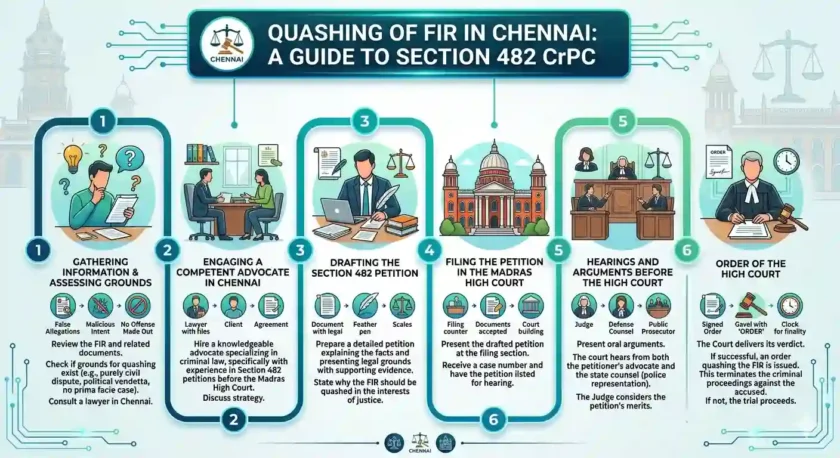
Filing an FIR quashing petition requires careful preparation and strategic legal thinking. Initially, the lawyer must obtain a certified copy of the FIR from the concerned police station. Subsequently, the chargesheet or case diary is reviewed to identify legal infirmities. The petition is then drafted citing specific grounds recognised by the Supreme Court and Madras High Court. Thereafter, the Crl.O.P. is filed before the Madras High Court Registry in Chennai. The court then examines the petition for prima facie merits before issuing notice. Additionally, the State (represented by the Public Prosecutor) and the defacto complainant receive notice. Both parties present their arguments before the bench. Furthermore, the petitioner may seek interim relief staying the investigation or arrest. The court ultimately passes orders either quashing or dismissing the petition. Consequently, every stage demands precise legal drafting and confident court advocacy. Rajendra Criminal Law Firm handles all procedural stages from start to finish.
Documents Required for a Successful FIR Quashing Petition Before the Madras High Court
Proper documentation is the foundation of every successful FIR quashing petition. Therefore, collecting and organising records early is critically important. The following documents are mandatorily required for filing:
- Certified copy of the FIR from the concerned police station
- Copy of the complaint submitted by the defacto complainant
- Vakalatnama authorising the advocate to appear
- Affidavit sworn by the petitioner stating facts clearly
- Copies of prior court orders, if any, passed in the matter
- Settlement deed or compromise agreement in compoundable offence cases
- Medical records or expert reports if the FIR involves bodily harm allegations
- Bank statements or financial documents in cheque bounce or fraud FIRs
- Correspondence records proving civil nature of the underlying dispute
- Previous bail orders or anticipatory bail orders, if obtained earlier
Furthermore, incomplete documentation leads to unnecessary delays and adjournments. Rajendra Criminal Law Firm verifies every document before filing. Consequently, petitions are always complete and legally sound on the day of filing.
Grounds Most Accepted by the Madras High Court for Quashing FIRs in Chennai Cases
The Madras High Court evaluates quashing petitions based on well-settled judicial grounds. Firstly, the court examines whether the allegations, taken at face value, disclose any cognizable offence. Secondly, it analyses whether the FIR is an abuse of the criminal justice system. Thirdly, continuing prosecution would amount to oppression and prejudice to the accused. Moreover, the following specific grounds are consistently accepted:
- The dispute is purely civil in nature involving contractual obligations
- The FIR was registered beyond the statutory limitation period
- The offence alleged is not made out from the complaint’s averments
- There is a genuine settlement in matrimonial or personal dispute cases
- The accused has been falsely implicated due to personal enmity
- The investigation is arbitrary and violates procedural mandates under BNSS
Additionally, constitutional violations under Articles 14 and 21 independently justify quashing. Therefore, every ground must be argued with supporting case law. Rajendra Criminal Law Firm drafts comprehensive petitions citing precedents from the Madras High Court and Supreme Court. Clients thus receive the strongest possible legal arguments in their favour.
Interim Stay of Investigation: Protecting the Accused During Pendency of Quashing Petition
Securing an interim stay of investigation is often as important as the final quashing order itself. Accordingly, lawyers apply for interim relief simultaneously with the main quashing petition. The Madras High Court may grant a stay of all further proceedings in the lower courts. Furthermore, the investigating officer is restrained from arresting the petitioner during pendency. This relief is especially critical in non-bailable offence cases under BNS, 2023. Equally important, the stay protects the petitioner’s employment and reputation. Courts typically grant interim stay when a prima facie case for quashing is made out. Additionally, the petitioner must show irreparable harm if stay is not granted. Consequently, the burden of proof at the interim stage is relatively lower than at the final stage. Police stations in Chennai are legally bound to comply with such stay orders immediately. Therefore, securing interim relief is the first tactical objective in every quashing matter. Rajendra Criminal Law Firm prioritises urgent interim relief applications for all clients.
Comparison of FIR Quashing Under Old CrPC and New BNSS 2023 Provisions
Understanding the differences between CrPC and BNSS helps lawyers choose the right arguments. Therefore, the following comparison table clarifies the key distinctions:
| Parameter | CrPC 1973 | BNSS 2023 |
|---|---|---|
| Inherent Powers Section | Section 482 | Section 528 |
| Bail Provisions | Sections 436–439 | Sections 478–483 |
| Trial Timeline | No mandatory limit | Maximum 3-year timeline |
| Zero FIR | Not explicitly codified | Expressly recognised |
| Victim Rights | Limited provisions | Expanded victim participation |
| Electronic Evidence | Limited reference | Expressly governed by BSA 2023 |
Consequently, lawyers must correctly identify which law applies before drafting the petition. Additionally, transitional provisions in BNSS must be carefully examined in cases straddling July 2024. Rajendra Criminal Law Firm provides precise analysis of applicable law in every case. Therefore, clients are never disadvantaged by legislative transitions.
FIR Quashing in Matrimonial Disputes and Domestic Violence Cases Under BNS 2023
Matrimonial disputes account for a large proportion of FIR quashing petitions filed in Chennai. FIRs under BNS Section 85 (cruelty by husband), Section 86 (dowry death), and Protection of Women from Domestic Violence Act are commonly challenged. Courts adopt a liberal approach when genuine reconciliation has occurred between spouses. Furthermore, the Supreme Court in Rajesh Sharma v. State of U.P. (2017) issued guidelines on this very issue. Moreover, Family Courts in Chennai at Allikulam and Saidapet play a supporting role in such matters. Settlement agreements recorded before the Family Court strengthen the quashing petition significantly. Additionally, the National Commission for Women may be involved in sensitising such cases. However, courts do not quash FIRs in cases of serious violence even after compromise. Therefore, legal strategy must be customised to the specific facts of each matrimonial dispute. Rajendra Criminal Law Firm handles matrimonial FIR quashing with sensitivity and expertise.
Quashing of Cybercrime FIRs in Chennai Under BNS and IT Act Provisions
Cybercrime FIRs are increasingly registered at Chennai’s Cybercrime Police Station in Vepery. Offences under BNS Sections 316 (cheating), 318 (fraud), and the IT Act, 2000 are commonly involved. Additionally, online defamation, morphed images, and social media harassment cases frequently arise. The Cybercrime Appellate Tribunal provides a quasi-judicial forum for related grievances. Moreover, the Adjudicating Officer under the IT Act has jurisdiction over data breach matters. Consequently, lawyers must distinguish between criminal cybercrime complaints and civil IT grievances. FIRs registered without proper technical investigation are particularly vulnerable to quashing. Furthermore, the BSA, 2023 governs admissibility of electronic evidence in such proceedings. Courts examine whether digital forensics were properly conducted before filing the FIR. Therefore, technical evidence analysis is essential before approaching the High Court. Rajendra Criminal Law Firm collaborates with digital forensics experts to strengthen quashing petitions. Clients accused of online offences thus receive both legal and technical support.
Quashing of Economic Offence FIRs Including Cheque Bounce and Bank Fraud Cases
Economic offence FIRs in Chennai often involve cheque dishonour, bank fraud, or Ponzi schemes. FIRs under BNS Section 316 (cheating), 317 (cheating by impersonation), and 318 (fraud) are common. Additionally, cases under the Prevention of Money Laundering Act (PMLA) and FEMA arise frequently. The Enforcement Directorate (ED) and CBI investigate serious economic offences at a national level. Moreover, the Economic Offences Wing (EOW) of Chennai Police handles local financial crimes. These FIRs carry serious reputational and financial consequences for businesspersons. Therefore, securing a quashing order in economic offence cases is enormously valuable. Courts analyse whether the complaint discloses criminal intent beyond mere breach of contract. Additionally, civil recovery proceedings running simultaneously weaken the criminal complaint. Consequently, courts frequently quash FIRs where criminal proceedings are used as recovery tools. Rajendra Criminal Law Firm has extensive experience in economic offence FIR quashing. Clients regain business and financial stability through successful quashing outcomes.
Role of the Consumer Forum, Labour Tribunal, and Other Forums Alongside FIR Quashing
FIR quashing does not operate in isolation from other legal forums in Chennai. Parallel proceedings before the District Consumer Disputes Redressal Commission (DCDRC) at Chennai often coexist. Labour Tribunals, the Industrial Tribunal, and Workmen’s Compensation Commissioner handle employment-related disputes. Moreover, the Debt Recovery Tribunal (DRT) at Chennai deals with banking fraud and loan default cases. The Tamil Nadu Human Rights Commission (TNHRC) receives complaints of police abuse and illegal arrests. Additionally, the National Company Law Tribunal (NCLT) Chennai Bench handles corporate fraud matters. Therefore, a comprehensive legal strategy involves coordinating FIR quashing with parallel forum proceedings. Lawyers must advise clients on which forum provides the most effective and immediate relief. Furthermore, outcomes in one forum can influence proceedings in another forum significantly. Rajendra Criminal Law Firm offers multi-forum legal strategy combining criminal defence with civil and regulatory proceedings. Consequently, clients receive holistic legal protection across all relevant forums simultaneously.
Legal Remedies Available Before and After FIR Registration in Chennai
Accused persons in Chennai have multiple legal remedies available at different stages of criminal proceedings. Before FIR registration, a person may approach a Magistrate under Section 156(3) BNSS for investigation directions. After FIR registration, the following remedies are available in a prioritised sequence:
- Anticipatory Bail under Section 482 BNSS before Sessions Court or High Court
- Regular Bail under Section 483 BNSS after arrest
- Quashing Petition under Section 528 BNSS before Madras High Court
- Discharge Application before the trial court after chargesheet filing
- Revision Petition before Sessions Court against lower court orders
- Writ Petition under Article 226 before Madras High Court for constitutional violations
- Special Leave Petition (SLP) before the Supreme Court as a last resort
Therefore, choosing the right remedy at the right stage is crucial for the accused. Furthermore, pursuing the wrong remedy wastes time and increases legal costs unnecessarily. Rajendra Criminal Law Firm maps the optimal legal pathway for every client’s unique situation. Consequently, no opportunity for relief is ever missed or delayed through poor strategic planning.
Government Departments and Institutions Involved in FIR Quashing Matters in Chennai
Multiple government departments and institutions interact with FIR quashing proceedings in Chennai. Therefore, lawyers must understand each institution’s role and coordinate effectively. The primary government bodies involved include:
| Institution | Role in FIR Quashing | Location |
|---|---|---|
| Tamil Nadu Police | Registers and investigates FIRs | All Chennai Districts |
| Office of Director General of Police | Supervises police conduct and complaints | Chennai, Kamarajar Salai |
| Tamil Nadu State Human Rights Commission | Addresses police excesses | Chennai |
| Madras High Court Registry | Receives and processes quashing petitions | Chennai, High Court Road |
| Office of the Public Prosecutor | Represents the State in quashing hearings | Madras High Court |
| Enforcement Directorate (ED) | Handles PMLA-linked criminal cases | Chennai, Anna Salai |
| Central Bureau of Investigation (CBI) | Investigates serious national-level crimes | Chennai, Nungambakkam |
Additionally, the Tamil Nadu Vigilance and Anti-Corruption Directorate (DVAC) investigates public servant corruption. Consequently, FIRs involving government employees may include DVAC as an investigating agency. Rajendra Criminal Law Firm has extensive experience dealing with all these government institutions. Therefore, clients are guided confidently through every layer of the criminal justice system.
Types of Legal Support Offered by Rajendra Criminal Law Firm for FIR Quashing
Rajendra Criminal Law Firm provides comprehensive legal support throughout the FIR quashing process. Every client receives personalised legal services tailored to their specific case requirements. The firm’s legal support services are categorised as follows:
- Free Initial Legal Consultation to assess FIR quashing prospects
- Petition Drafting by senior criminal advocates with High Court experience
- Urgent Anticipatory Bail Applications to prevent imminent arrest
- Interim Stay Applications to halt police investigation immediately
- Settlement Facilitation in compoundable offence cases
- Multi-Forum Legal Strategy combining FIR quashing with civil proceedings
- Digital Forensics Support for cybercrime FIR quashing matters
- SLP Filing before the Supreme Court when High Court dismisses the petition
- Post-Quashing Compliance Support to ensure police station compliance
- Legal Notice Services against complainants in malicious prosecution cases
Furthermore, the firm offers emergency legal support on weekends and public holidays. Therefore, clients are never left without legal protection during critical moments. Rajendra Criminal Law Firm has successfully secured quashing orders for clients across all criminal law categories. Consequently, the firm is the most trusted name for FIR quashing in Chennai today.
Landmark Supreme Court and Madras High Court Judgments on FIR Quashing
Judicial precedents form the backbone of every successful FIR quashing argument in Chennai. Therefore, advocates must be thoroughly familiar with the following landmark judgments:
- State of Haryana v. Bhajan Lal (1992) — Seven categories of cases fit for quashing
- B.S. Joshi v. State of Haryana (2003) — Quashing permitted after compromise in matrimonial cases
- State of A.P. v. Golconda Linga Swamy (2004) — Scope of inherent powers affirmed broadly
- Gian Singh v. State of Punjab (2012) — High Court can quash even non-compoundable offences in rare cases
- Narinder Singh v. State of Punjab (2014) — Guidelines for quashing in settlement cases refined
- Parbatbhai Aahir v. State of Gujarat (2017) — Comprehensive restatement of quashing principles
- Madras HC in Senthil v. State (2022) — Cybercrime FIR quashed for procedural violations
Additionally, the Madras High Court consistently follows Supreme Court principles with Tamil Nadu-specific applications. Therefore, local judicial precedents are equally important in FIR quashing arguments. Rajendra Criminal Law Firm maintains an updated database of all relevant High Court and Supreme Court judgments. Consequently, every petition is supported by the strongest and most current judicial authority available.
Common Mistakes to Avoid When Filing an FIR Quashing Petition in Chennai
Petitioners often lose FIR quashing cases due to avoidable procedural and strategic errors. Therefore, awareness of common mistakes is critically important for every accused person. The most frequently committed mistakes include:
- Filing the petition prematurely before all compromise efforts are exhausted
- Omitting essential documents like the complaint or case diary extracts
- Arguing irrelevant grounds not recognised by the Madras High Court
- Failing to serve notice on the defacto complainant causing procedural delays
- Not seeking interim stay resulting in continued police harassment during pendency
- Misidentifying the applicable law between CrPC and BNSS provisions
- Approaching a Sessions Court instead of directly filing before the High Court
Furthermore, inadequate affidavit drafting leads courts to reject petitions on technical grounds. Additionally, delays in engaging a lawyer after FIR registration reduce available legal options. Rajendra Criminal Law Firm’s experienced advocates prevent all these common errors proactively. Therefore, clients consistently receive flawless petitions that maximise their quashing prospects significantly.
How Technology and E-Filing Innovations Are Transforming FIR Quashing in Chennai
The Madras High Court has embraced technology to streamline the filing and hearing of quashing petitions. E-filing of Crl.O.P.s is now possible through the eCourts portal at ecourts.gov.in. Furthermore, virtual hearing facilities allow advocates to argue from offices without physical court attendance. Additionally, case status and order copies are available digitally on the same day of hearing. The Tamil Nadu Police have also digitised FIR registration at all police stations under the Crime and Criminal Tracking Network (CCTNS). Therefore, certified digital copies of FIRs can now be obtained more efficiently. Moreover, video conferencing between remand prisoners and their advocates is permitted under BNSS provisions. Consequently, accused persons in judicial custody receive faster legal assistance. The BSA, 2023 recognises electronic records as primary evidence, impacting quashing arguments involving digital communications. Rajendra Criminal Law Firm utilises all available technology to deliver faster and more efficient client service. Clients therefore benefit from the latest legal technology throughout their FIR quashing proceedings.
Frequently Asked Questions: FIR Quashing in Chennai
FAQs on Section 482 CrPC / Section 528 BNSS FIR Quashing — Rajendra Criminal Law Firm
1. What is FIR quashing under Section 482 CrPC / Section 528 BNSS?
FIR quashing is the legal process of cancelling a First Information Report through a High Court petition. The Madras High Court uses inherent powers to prevent injustice and abuse of criminal proceedings against innocent accused persons.
2. Which court has jurisdiction to quash an FIR in Chennai?
The Madras High Court at Chennai has exclusive jurisdiction to quash FIRs in Tamil Nadu. A Criminal Original Petition (Crl.O.P.) must be filed before the appropriate High Court bench for FIR quashing relief.
3. Can an FIR for a non-compoundable offence be quashed in Chennai?
Yes. The Madras High Court can quash even non-compoundable offence FIRs in exceptional circumstances. Courts apply the Gian Singh guidelines (2012) where continuation of proceedings would be oppressive and unjust to the accused.
4. How long does the FIR quashing process take in Chennai?
FIR quashing typically takes 3 to 12 months at the Madras High Court depending on complexity. Interim stay orders are usually obtained within 2 to 4 weeks of filing, providing immediate protection to the accused person.
Frequently Asked Questions: FIR Quashing in Chennai (Contd)
5. What is the difference between bail and FIR quashing in criminal law?
Bail temporarily suspends custody while criminal proceedings continue. FIR quashing permanently eliminates the criminal case. Quashing provides complete legal exoneration while bail only provides conditional freedom during the ongoing criminal trial.
6. Can a cybercrime FIR registered in Chennai be quashed at the Madras High Court?
Yes. Cybercrime FIRs registered at Chennai Cybercrime Police Station can be quashed if procedurally defective. Courts examine digital evidence admissibility under BSA 2023 and IT Act before deciding quashing petitions in cybercrime cases.
7. Does settlement between parties guarantee FIR quashing in matrimonial cases?
Settlement strongly supports quashing in matrimonial FIR cases before the Madras High Court. Courts generally quash FIRs after genuine compromise. However, serious violence or dowry death allegations may prevent quashing despite settlement between the parties.
8. What happens if the Madras High Court dismisses the quashing petition?
If the Madras High Court dismisses the quashing petition, the accused may file a Special Leave Petition (SLP) before the Supreme Court of India. Alternative remedies like discharge applications before the trial court also remain available.
9. Is it possible to quash an FIR after chargesheet has been filed in Chennai courts?
Yes. The Madras High Court can quash both FIRs and chargesheets under inherent powers. After chargesheet filing, courts examine whether the alleged offences are legally sustainable based on materials collected during police investigation.
10. How does Rajendra Criminal Law Firm help with FIR quashing in Chennai?
Rajendra Criminal Law Firm provides expert legal consultation, petition drafting, interim stay applications, and High Court representation. The firm handles all FIR quashing matters from cybercrime to matrimonial disputes across all Chennai police jurisdictions.
Read More
- A Guide to Domestic Violence Cases under IPC 498A
- White-Collar Crime in India: Laws, Defences, and Penalties
- Arrears of Maintenance: Execution, Appeal, and Stay Explained
- Enforcement of Maintenance Orders Under BNSS – What Changed From CrPC?
- Parallel Maintenance Proceedings – How BNSS Prevents Abuse of Process
- Ministry of Law & Justice / Legislative Department