

Murder & attempt to murder are among India’s gravest criminal charges. Consequently, accused persons face severe punishment, social stigma, and prolonged legal proceedings under India’s justice system. The Bharatiya Nyaya Sanhita, 2023 (BNS) replaced the Indian Penal Code from July 1, 2024, reshaping how these offences are defined, investigated, and prosecuted. Furthermore, the Bharatiya Nagarik Suraksha Sanhita, 2023 (BNSS) governs criminal procedure, while the Bharatiya Sakshya Adhiniyam, 2023 (BSA) modernises evidence standards for homicide trials. Rajendra Criminal Law Firm combines decades of criminal defence expertise with mastery of India’s latest criminal laws. Therefore, accused persons and their families must consult experienced criminal defence advocates immediately upon arrest. This article comprehensively examines applicable laws, legal issues, forums, defences, and remedies in murder and attempt to murder cases across India.
Murder & Attempt to Murder Charges in India: Laws & Defences – Rajendra Criminal Law Firm
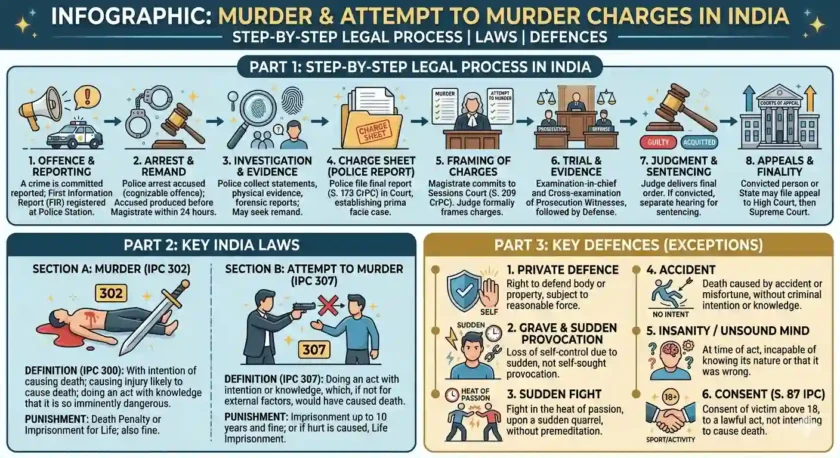
Understanding Murder and Attempt to Murder Under BNS, 2023
Defining Murder and Culpable Homicide Under the Bharatiya Nyaya Sanhita
Murder Under BNS Section 101: Definition and Essential Ingredients
Section 101 of the Bharatiya Nyaya Sanhita, 2023 defines murder replacing the erstwhile IPC Section 300. Consequently, murder occurs when culpable homicide satisfies any of four additional conditions specified under BNS. First, the act is done with intention to cause death of the victim directly. Second, the accused intends to cause bodily injury knowing it will likely cause death. Furthermore, the accused acts with knowledge that the act is imminently dangerous and likely fatal. Fourth, the injury inflicted is sufficient in ordinary course to cause death objectively. The prosecution must prove all essential ingredients—act, intention, knowledge, and causation—beyond reasonable doubt. Additionally, the accused person’s mental state at the moment of the act is critically determinative. Therefore, our criminal defence advocates meticulously analyse facts to challenge every ingredient at trial. Rajendra Criminal Law Firm identifies weaknesses in prosecution evidence before charges are formally framed by courts.
Culpable Homicide Not Amounting to Murder: BNS Section 100
BNS Section 100 defines culpable homicide, which carries significantly lesser punishment than murder. Therefore, distinguishing culpable homicide from murder is a critical defence strategy in every homicide case. Culpable homicide requires causing death with intention to cause death or grievous bodily injury. Furthermore, the accused must know that the act is likely to cause death in the circumstances. The key distinction from murder lies in the degree of intention and knowledge involved. Additionally, BNS Exception clauses—grave and sudden provocation, private defence, sudden fight—reduce murder to culpable homicide. Consequently, our advocates argue applicable exceptions vigorously to obtain lesser charges and reduced sentences. Section 105 BNS prescribes punishment for culpable homicide not amounting to murder up to life imprisonment. Therefore, proper charge framing at the trial stage determines the accused’s entire sentencing trajectory significantly. Early advocacy before charge framing offers the best opportunity to secure culpable homicide classification.
Attempt to Murder Under BNS Section 109: Punishment and Scope
BNS Section 109 governs attempt to murder, replacing the erstwhile IPC Section 307 comprehensively. Therefore, whoever attempts to commit murder and performs an act toward its commission is liable under Section 109. The offence requires proof of intention to commit murder and a direct overt act toward that intention. Furthermore, the accused need not succeed in causing death—attempt alone attracts severe punishment under BNS. Punishment under Section 109 BNS extends to imprisonment up to ten years with fine for ordinary offences. Additionally, if the attempt causes hurt to any person, imprisonment may extend to life imprisonment by the court. Consequently, the severity of attempt to murder charges demands immediate engagement of experienced criminal defence advocates. Our team analyses medical reports, witness statements, and FIR contents to identify defences at the earliest stage. Therefore, Rajendra Criminal Law Firm’s early intervention significantly improves outcomes in attempt to murder matters.
Aggravated Murder: BNS Provisions for Special Categories
BNS, 2023 introduces enhanced provisions for specific aggravated murder categories attracting capital punishment. Therefore, understanding these provisions is essential for accused persons facing charges in special circumstances. Section 103 BNS prescribes death penalty or life imprisonment for murder in ordinary circumstances. Furthermore, Section 103(2) BNS mandates death penalty when murder is committed by a group of five or more persons. This provision specifically targets mob lynching, caste-based, and communal violence resulting in murder. Additionally, murder of a public servant in the execution of duty attracts enhanced penalties under BNS. Section 111 BNS addresses organised crime including murder committed by criminal syndicates and gangs. Consequently, accused persons facing aggravated murder charges require the most experienced criminal defence advocacy available. Our advocates engage forensic experts, challenge identification evidence, and scrutinise mob participation allegations rigorously. Therefore, early and aggressive defence advocacy is indispensable in aggravated BNS murder cases.
Investigation, Arrest and Remand Under BNSS, 2023
FIR Registration and Police Station Procedures Under BNSS
Murder and attempt to murder cases begin with FIR registration at the nearest police station under BNSS. Consequently, understanding FIR procedures under the Bharatiya Nagarik Suraksha Sanhita, 2023 is essential for accused and victims. Section 173 BNSS mandates zero FIR registration at any police station regardless of territorial jurisdiction. Furthermore, the receiving station must transfer the FIR to the jurisdictional station within 15 days. Murder is a cognisable offence—police may arrest without warrant and investigate without Magistrate permission. Additionally, Section 176 BNSS mandates videographic documentation of crime scene inspection in all murder investigations. Forensic teams must reach crime scenes within specific BNSS-prescribed timelines for evidence collection. Consequently, our advocates scrutinise FIR contents, crime scene documentation, and investigation compliance meticulously. Procedural lapses in FIR registration or investigation vitiate evidence and weaken prosecution cases significantly. Therefore, immediate engagement of Rajendra Criminal Law Firm upon FIR registration produces the best defence outcomes.
Arrest Rights and Remand Procedures for Murder Accused Under BNSS
BNSS, 2023 strengthens procedural safeguards protecting arrested persons in murder and attempt to murder cases. Therefore, every accused person must know their arrest rights under BNSS Sections 47–60 immediately upon detention. Section 47 BNSS requires police to inform the arrested person of grounds of arrest clearly. Furthermore, Section 48 BNSS entitles every arrested person to inform a nominated person of their arrest. The accused must be produced before a Magistrate within 24 hours of arrest under Section 58 BNSS. Additionally, remand beyond 15 days requires judicial authorisation by the Magistrate under BNSS provisions. Section 187 BNSS governs police remand—custody for investigation—limited to 15 days maximum per order. Consequently, our advocates appear before Magistrates at remand hearings to challenge unnecessary custody extensions. Bail applications in murder cases are filed before the Sessions Court as murder is a non-bailable offence. Therefore, securing competent representation at every remand hearing protects accused persons’ fundamental rights throughout investigation.
Forensic Investigation and Digital Evidence Standards Under BSA, 2023
The Bharatiya Sakshya Adhiniyam, 2023 modernises evidence standards applicable to murder investigations significantly. Therefore, digital and forensic evidence now plays a decisive role in homicide prosecution and defence. BSA Section 61 recognises electronic records—CCTV footage, call records, GPS location data—as admissible evidence before courts. Furthermore, forensic evidence including DNA reports, ballistic analysis, and post-mortem findings carry substantial weight in murder trials. Section 63 BSA requires certificates authenticating electronic evidence submitted before courts and tribunals. Additionally, our advocates challenge forensic evidence through independent expert witnesses engaging forensic scientists and pathologists. Chain of custody violations in evidence handling create reasonable doubt benefiting the accused significantly. Consequently, BSA-compliant evidence challenges are a cornerstone of Rajendra Criminal Law Firm’s murder defence strategy. Therefore, our forensic evidence review begins immediately upon receiving case briefs from accused persons and families. Rigorous scientific scrutiny of prosecution evidence consistently produces acquittals and reduced sentences at trial.
Courts, Forums and Jurisdiction in Murder Cases Across India
Sessions Court: Primary Trial Court for Murder and Attempt to Murder
Murder and attempt to murder are exclusively triable by the Sessions Court in India under BNSS. Therefore, understanding Sessions Court procedures is fundamental to mounting an effective criminal defence strategy. The BNSS Section 232 commits murder cases from Magistrate courts to Sessions Courts for trial. Furthermore, Sessions Courts have jurisdiction to award death penalty—the maximum punishment under BNS Section 103. The prosecution presents its case through witnesses, forensic experts, and documentary evidence before the Sessions Judge. Additionally, the defence cross-examines prosecution witnesses meticulously to expose inconsistencies and weaknesses. Section 346 BNSS entitles the accused to be represented by an advocate of their choice throughout trial. Consequently, selecting an experienced Sessions Court criminal advocate is the most critical decision an accused makes. Our advocates appear in Sessions Courts across India—Chennai, Mumbai, Delhi, Hyderabad, Kolkata, and Bengaluru. Therefore, Rajendra Criminal Law Firm delivers formidable Sessions Court defence advocacy protecting accused persons comprehensively.
High Courts and Supreme Court: Appeals and Special Leave Petitions
Conviction or acquittal by Sessions Courts may be challenged before High Courts and ultimately the Supreme Court. Therefore, understanding the appellate framework is essential for accused persons and their families after trial conclusions. Section 415 BNSS enables the accused to appeal conviction before the jurisdictional High Court expeditiously. Furthermore, the State may appeal acquittals before the High Court under Section 419 BNSS provisions. High Courts exercise original criminal jurisdiction in certain specified categories of offences under constitutional provisions. Additionally, death penalty confirmation is mandatory before the High Court under Section 392 BNSS before execution. The Supreme Court entertains Special Leave Petitions (SLP) under Article 136 against High Court judgments in murder cases. Consequently, our appellate advocates prepare meticulous SLPs identifying errors of law and fact in lower court judgments. Curative petitions before the Supreme Court offer final recourse for death row convicts under constitutional provisions. Therefore, Rajendra Criminal Law Firm’s appellate team has successfully reversed numerous murder convictions at higher courts.
Legal Defences, Remedies and Support in Murder Cases
Statutory Defences Available to Murder Accused Under BNS
BNS, 2023 preserves critical statutory defences reducing murder charges or resulting in complete acquittal. Consequently, our advocates evaluate every available defence meticulously based on case-specific facts and evidence.
- Right of Private Defence (BNS Sections 34–44): Accused who caused death while protecting themselves or others from imminent harm may claim complete defence.
- Grave and Sudden Provocation (BNS Section 101 Exception 1): Death caused under sudden, grave provocation without premeditation reduces murder to culpable homicide.
- Sudden Fight (BNS Section 101 Exception 4): Death in a sudden quarrel without premeditation and in the heat of passion reduces murder charges significantly.
- Consent (BNS Section 101 Exception 5): Death caused upon the deceased’s own request may reduce criminal liability under specific statutory conditions.
- Unsoundness of Mind (BNS Section 22): Accused incapable of understanding the nature of the act due to mental illness may secure complete acquittal.
- Intoxication (BNS Section 23): Involuntary intoxication negating intention provides defence; voluntary intoxication provides limited protection under BNS.
- Alibi Defence: Proving the accused was elsewhere when murder occurred through witnesses, CCTV, call records, and travel evidence creates reasonable doubt.
- Lack of Intention: Demonstrating the accused lacked the specific intention required under BNS Section 101 results in reduced charges or acquittal.
Bail in Murder Cases: Sessions Court and High Court Applications
Bail in murder cases presents significant legal challenges because murder is a non-bailable, cognisable offence under BNSS. Therefore, accused persons must file bail applications before the Sessions Court under Section 480 BNSS provisions. Sessions Courts consider factors including the nature of accusation, evidence strength, and flight risk possibility. Furthermore, antecedents, criminal history, and community ties heavily influence bail decisions in murder matters. High Courts entertain bail applications under Section 483 BNSS when Sessions Courts reject initial applications. Additionally, the Supreme Court exercises extraordinary bail jurisdiction in cases involving manifest injustice or prolonged incarceration. Medical grounds, age, and gender significantly influence bail decisions in deserving cases before courts. Consequently, our advocates prepare compelling bail applications supported by affidavits, sureties, and documentary evidence. Anticipatory bail under Section 482 BNSS protects persons fearing arrest in false or exaggerated murder cases. Therefore, early filing of anticipatory bail applications is critical before police formally arrest the accused person.
Charge Framing Stage: Opportunity to Reduce Murder to Lesser Offence
The charge framing stage before the Sessions Court is a pivotal opportunity for criminal defence advocates. Therefore, our advocates meticulously argue at the charge framing stage to secure lesser charges against accused persons. Section 230 BNSS governs charge framing—the court must frame charges if it finds prima facie evidence against the accused. Furthermore, our advocates file detailed written arguments demonstrating absence of ingredients for murder under BNS Section 101. Successfully arguing at charge framing reduces murder charges to culpable homicide under Section 100 BNS. Additionally, the Sessions Court may discharge the accused entirely under Section 250 BNSS if evidence is patently insufficient. Discharge from murder charges ends the trial without conviction, restoring the accused’s freedom and reputation. Consequently, the charge framing stage offers the most cost-effective point for intervention in murder proceedings. Our advocates study police chargesheet contents exhaustively, identifying every legal argument supporting discharge or charge reduction. Therefore, Rajendra Criminal Law Firm’s charge framing advocacy consistently produces superior outcomes for accused persons.
Common Legal Issues in Murder and Attempt to Murder Cases
Murder cases involve complex, recurring legal issues requiring specialised criminal defence expertise and experience. Therefore, understanding these issues helps accused persons and families make informed legal decisions promptly.
| Legal Issue | Relevant BNS / BNSS Provision | Forum | Defence Strategy |
|---|---|---|---|
| False implication / Fabricated FIR | BNSS Section 173 | High Court / Sessions Court | Quashing petition; alibi evidence |
| Custodial torture during remand | BNSS Section 48; BNS Section 117 | High Court / NHRC | Habeas corpus; NHRC complaint |
| Unlawful arrest without grounds | BNSS Section 47 | High Court | Habeas corpus writ petition |
| Dying declaration admissibility | BSA Section 26 | Sessions Court | Challenge circumstances of recording |
| Eyewitness identification disputes | BSA Section 12 | Sessions Court | TIP procedure challenges |
| Forensic evidence tampering | BNS Section 238; BSA Section 61 | Sessions Court / CBI | Independent forensic expert testimony |
| Mob lynching / group murder | BNS Section 103(2) | Sessions Court | Individual participation challenge |
| Death penalty challenge | BNS Section 103; BNSS Section 392 | High Court / Supreme Court | Rarest of rare doctrine arguments |
FIR Quashing Before High Court: Protecting the Falsely Accused
High Courts possess inherent jurisdiction under Section 528 BNSS to quash FIRs in appropriate murder cases. Therefore, falsely accused persons may seek FIR quashing before the High Court before trial commences. Quashing is warranted when the FIR discloses no cognisable offence or is manifestly frivolous on its face. Furthermore, courts quash FIRs when they result from personal vendetta, political rivalry, or land dispute motivations. Our advocates file detailed quashing petitions placing entire relevant material before the High Court. Additionally, settlement between parties in private cases may justify quashing FIR before further trial proceedings. However, courts do not quash murder FIRs based on compromise alone—public interest considerations apply strongly. Consequently, establishing false implication through documentary evidence is essential for successful FIR quashing petitions. Our advocates collect contradictory statements, prior dispute records, and alibi evidence supporting quashing applications. Therefore, early High Court intervention in false murder cases prevents prolonged unjust incarceration effectively.
Death Penalty Defence: Rarest of Rare Doctrine and Mitigating Circumstances
The Supreme Court’s “rarest of rare” doctrine severely limits death penalty imposition in murder conviction cases. Therefore, every death penalty case demands meticulous advocacy presenting mitigating circumstances before the Sessions Court and appellate courts. Mitigating factors include young age, mental illness, lack of criminal antecedents, and reformation potential. Furthermore, socioeconomic background, childhood trauma, and provocation contribute to arguments against capital punishment. BNS Section 103 mandates death penalty or life imprisonment—courts must record special reasons for death sentence imposition. Additionally, BNSS Section 392 requires every death sentence to receive mandatory High Court confirmation before execution. The Supreme Court in Bachan Singh v. State of Punjab established the rarest of rare framework governing death penalty decisions. Consequently, our advocates present comprehensive mitigation reports including psychological evaluations, social background studies, and reformation evidence. Therefore, Rajendra Criminal Law Firm’s death penalty defence team combines legal expertise with human rights advocacy for maximum client protection.
Government Departments and Authorities Involved in Murder Cases
Multiple government departments exercise jurisdiction over murder investigations, prosecution, and prisoner welfare. Therefore, understanding these departments helps accused persons and families navigate the criminal justice system effectively.
- State Police (Jurisdictional Police Station): Investigates murder under BNSS; registers FIR, collects evidence, arrests accused, and files chargesheet before court.
- Criminal Investigation Department (CID): State CID investigates complex, high-profile, or politically sensitive murder cases transferred from local police stations.
- Central Bureau of Investigation (CBI): Investigates murder cases involving public servants, interstate networks, or matters transferred by High Courts or Supreme Court.
- Forensic Science Laboratory (FSL): Conducts DNA analysis, ballistics, toxicology, and document examination for evidence used in murder trials.
- National Human Rights Commission (NHRC): Receives complaints about custodial deaths, torture, and human rights violations in murder investigation procedures.
- State Legal Services Authority (SLSA): Provides free legal aid to accused persons who cannot afford private criminal defence representation under BNSS.
- Prison Department: Manages undertrial and convicted prisoners; governs parole, furlough, and remission of sentence for murder convicts.
- Public Prosecutor’s Office: Represents the State in Sessions Court murder trials; the accused must combat the PP’s case through defence advocates.
Types of Legal Support Provided by Rajendra Criminal Law Firm
Rajendra Criminal Law Firm delivers comprehensive criminal defence support across every stage of murder and attempt to murder proceedings. Therefore, clients receive integrated legal services from FIR registration through Supreme Court appeals effectively.
- Emergency Legal Consultation: Immediate 24/7 legal consultation upon arrest or FIR registration in murder and attempt to murder matters.
- Anticipatory Bail Applications: Filing urgent anticipatory bail applications before Sessions Courts and High Courts under BNSS Section 482.
- Regular Bail Applications: Representing accused before Sessions Courts and High Courts for bail in non-bailable murder offences under BNSS.
- FIR Quashing Petitions: Filing Section 528 BNSS petitions before High Courts challenging false and frivolous murder FIRs.
- Sessions Court Trial Defence: Complete trial representation including charge framing arguments, cross-examination, and final arguments before Sessions Courts.
- High Court Appeals: Filing and arguing criminal appeals against Sessions Court murder convictions before jurisdictional High Courts.
- Supreme Court SLP: Preparing and arguing Special Leave Petitions before the Supreme Court against High Court murder judgments.
- Death Penalty Defence: Specialised mitigation advocacy at Sessions Court and appellate stages in capital punishment cases.
- Habeas Corpus Petitions: Filing emergency habeas corpus writs before High Courts for illegally detained murder accused persons.
- NHRC Complaints: Filing National Human Rights Commission complaints for custodial torture and rights violations during murder investigations.
Jurisdiction and Nearby Courts Serving Murder Defence Clients
Rajendra Criminal Law Firm serves murder and attempt to murder accused across multiple jurisdictions throughout India. Therefore, our advocates maintain active presence before all critical criminal courts and forums where clients need representation. Our primary practice covers Sessions Courts in Chennai, Madurai, Coimbatore, Salem, and Tiruchirappalli in Tamil Nadu. Furthermore, we appear before the Madras High Court for bail, appeals, FIR quashing, and habeas corpus matters. Local police stations—including Chennai City Police, CBCID, and Tamil Nadu CID—handle investigations requiring our immediate engagement. Additionally, we represent clients before the Principal Sessions Court Chennai, Fast Track Courts, and Mahila Courts. The NHRC and State Human Rights Commission Tamil Nadu receive our complaints regarding custodial rights violations. Consequently, our pan-India network enables representation before Delhi High Court, Bombay High Court, and the Supreme Court. Therefore, Rajendra Criminal Law Firm provides seamless multi-jurisdictional criminal defence advocacy for every murder case client.
| Forum / Court | Jurisdiction | Key Function in Murder Cases | Relevant BNSS Section |
|---|---|---|---|
| Jurisdictional Magistrate Court | District level | Remand, bail (initial), committal to Sessions | Section 187, 232 |
| Sessions Court | District / City | Trial, charge framing, bail, conviction / acquittal | Sections 230, 250, 346 |
| High Court | State level | Bail, appeals, FIR quashing, death penalty confirmation | Sections 392, 415, 528 |
| Supreme Court of India | National | SLP, curative petition, constitutional challenges | Article 136 Constitution |
| Fast Track Court | District level | Expedited murder trials for specified categories | BNSS Schedule provisions |
| NHRC / SHRC | National / State | Custodial torture, fake encounter, rights violation complaints | Protection of Human Rights Act |
Role of CPC in Civil Remedies Parallel to Murder Criminal Proceedings
The Code of Civil Procedure, 1908 (CPC) provides complementary civil remedies available alongside criminal murder proceedings. Therefore, victims’ families may pursue civil compensation claims simultaneously with criminal prosecution of accused persons. Section 9 CPC confers civil court jurisdiction over compensation suits by murder victims’ dependants against accused persons. Furthermore, the Motor Accidents Claims Tribunal adjudicates compensation in murder-by-vehicle cases under Motor Vehicles Act. CPC Order 39 injunctions may restrain accused persons from alienating assets pending civil compensation decree execution. Additionally, civil courts award compensation for loss of dependency, pain, and suffering caused by murder and homicide. The Fatal Accidents Act, 1855 enables dependants to sue for financial loss resulting from wrongful death caused by others. Consequently, our advocates pursue parallel civil remedies maximising total legal relief available to victims’ families. Therefore, integrated criminal and civil advocacy by Rajendra Criminal Law Firm delivers comprehensive justice for all stakeholders.
Frequently Asked Questions (FAQs)
FAQs on Murder and Attempt to Murder Charges in India
Q1. What is the punishment for murder under the new BNS, 2023?
BNS Section 103 prescribes death penalty or life imprisonment for murder. Group murder by five or more persons mandatorily attracts death penalty or life imprisonment with fine under Section 103(2) BNS.
Q2. What is the punishment for attempt to murder under BNS, 2023?
BNS Section 109 prescribes up to ten years’ imprisonment for attempt to murder. If the attempt causes hurt, the court may award life imprisonment with fine based on injury severity and circumstances.
Q3. Can murder charges be reduced to culpable homicide under BNS?
Yes. BNS Section 101 Exceptions—grave provocation, private defence, sudden fight, and consent—can reduce murder to culpable homicide not amounting to murder, attracting significantly lesser punishment under Section 105 BNS.
Q4. Is bail possible in murder cases under BNSS, 2023?
Murder is non-bailable. Bail applications are filed before the Sessions Court under BNSS Section 480 or High Court under Section 483 based on evidence strength, risk of flight, and other relevant factors.
Q5. What is anticipatory bail and how does it help in murder cases?
Anticipatory bail under BNSS Section 482 protects persons fearing arrest in false murder cases. Courts grant anticipatory bail upon finding that the accusation appears frivolous, malicious, or based on personal vendetta.
Q6. Can a murder FIR be quashed by the High Court under BNSS?
Yes. High Courts quash murder FIRs under Section 528 BNSS when FIRs are false, frivolous, or disclose no cognisable offence. Strong documentary evidence of false implication is essential for successful quashing petitions.
Q7. How is digital evidence used in murder trials under BSA, 2023?
BSA Section 61 admits CCTV footage, call records, GPS data, and WhatsApp messages as evidence. Certificates under BSA Section 63 authenticate electronic evidence, making digital records crucial in murder defence and prosecution.
Q8. What is the “rarest of rare” doctrine in death penalty cases?
The Supreme Court limits death penalty to “rarest of rare” cases where alternative punishment is unquestionably inadequate. Defence advocates present mitigating circumstances to argue that life imprisonment sufficiently serves justice instead.
Q9. Which police station handles murder FIR registration in Tamil Nadu?
Murder FIRs are registered at the jurisdictional police station where the offence occurred. BNSS Section 173 permits zero FIR at any station, transferred to the jurisdictional station within 15 days thereafter.
Q10. Why engage Rajendra Criminal Law Firm for murder defence?
Rajendra Criminal Law Firm provides emergency bail, trial defence, High Court appeals, and Supreme Court SLPs in murder cases. Our BNS, BNSS, and BSA expertise delivers superior outcomes across all criminal courts pan-India.
Read More
- Quashing of FIR in Chennai: A Guide to Section 482 CrPC
- A Guide to Domestic Violence Cases under IPC 498A
- White-Collar Crime in India: Laws, Defences, and Penalties
- Arrears of Maintenance: Execution, Appeal, and Stay Explained
- Enforcement of Maintenance Orders Under BNSS – What Changed From CrPC?
- Ministry of Home Affairs