
Criminal defamation in India is now governed by Section 356 of the Bharatiya Nyaya Sanhita, 2023 (BNS), which replaced Sections 499 and 500 of the Indian Penal Code. In fact, A person who harms another’s reputation through words, signs or visible representations, without a lawful exception, can face simple imprisonment of up to two years, a fine, both, or community service. Because the offence is usually triggered by a private complaint, it is often used as a pressure tactic in business, political, matrimonial and social media disputes.
This guide explains what the law actually requires, how a defamation complaint moves through the court, what defences are available and how an accused person can respond at each stage. It also covers what a genuine complainant must prove and when a settlement is the sensible way out. The aim is to help readers understand their position before a notice arrives, not after a summons is already in hand.
What Is Defamation Under BNS Section 356?
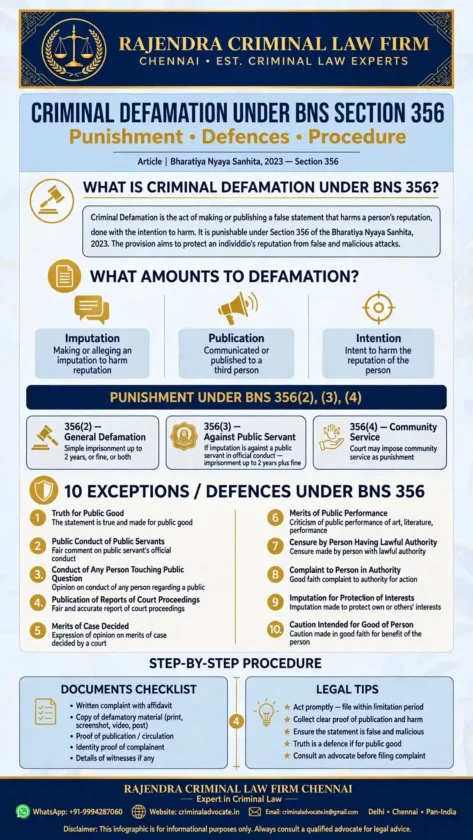
Section 356 BNS defines defamation as making or publishing, by words (spoken or intended to be read), signs or visible representations, an imputation concerning any person, intending to harm or knowing or having reason to believe that it will harm that person’s reputation. The law treats the act as complete when the imputation is communicated to someone other than the person defamed. A private message that only the target reads is not publication, but a group chat, a social media post or a printed notice generally is.
An imputation harms reputation, in the legal sense, when it directly or indirectly lowers the person in the estimation of others, lowers the person’s moral or intellectual character or credit, or causes others to regard the person’s body as being in a loathsome or disgraceful state. A statement made about a deceased person, or about a company, association or group, can also amount to defamation in suitable circumstances.
The Essential Ingredients
| Ingredient | What it means in practice |
|---|---|
| An imputation | A statement of fact or opinion about an identifiable person or entity. |
| Communication to a third person | The statement must be published to at least one person other than the target. |
| Intention or knowledge | The speaker intended harm, or knew or had reason to believe harm would follow. |
| Harm to reputation | Reputation, not mere hurt feelings, must be affected in the eyes of others. |
| No exception applies | Truth for public good, good faith and the other statutory exceptions must not cover the statement. |
Punishment and Nature of the Offence
Under Section 356 BNS, defamation is punishable with simple imprisonment which may extend to two years, or with fine, or with both, or with community service. Moreover, The community service option is new and reflects a policy shift towards less custodial outcomes for minor offences. Printing or engraving defamatory matter, and selling printed matter known to be defamatory, are separately punishable with a similar sentence.
| Feature | Position |
|---|---|
| Maximum jail term | Two years (simple imprisonment) |
| Other penalties | Fine, or community service, or a combination as provided |
| Cognizable or not | Non-cognizable: police cannot register an FIR and arrest without Magistrate’s order |
| Bailable or not | Bailable |
| Triable by | Magistrate |
| Compoundable | Generally yes, by the person defamed, so settlement is possible |
Please confirm the classification against the First Schedule of the BNSS for the exact entry, as schedules can be amended. Because the offence is non-cognizable and bailable, an arrest on a defamation complaint alone is uncommon. The usual risk is a summons, a trial and the cost, time and stress of defending it.
How a Defamation Case Begins
Criminal defamation is normally started by a private complaint to the Magistrate by the person who claims to be aggrieved. The BNSS provision on prosecution for defamation (Section 222, which corresponds to Section 199 of the old CrPC) limits who may complain, and special rules apply when the person defamed is a public servant or holds high office. A police FIR is not the normal route. If someone tells you that the police will register a defamation FIR, ask a lawyer to check whether the facts involve other offences, such as criminal intimidation or online harassment, which carry different rules. See our guide on cyber bullying and online harassment for those situations.
Many complainants first send a legal notice demanding an apology or removal of the content. A notice is not legally mandatory, but it often shows the Magistrate that the dispute was given a chance to settle. An accused person who receives a notice should neither ignore it nor reply emotionally. A calm, factual reply drafted by a lawyer can narrow the issues and sometimes ends the matter.
Step-by-Step: The Court Process
- Complaint filed. The complainant files a written complaint in the court of the competent Magistrate, with copies of the alleged statement, proof of publication and proof of harm.
- Examination of the complainant. The Magistrate records the complainant’s sworn statement and may examine witnesses before deciding whether to issue process.
- Inquiry in some cases. If the accused lives outside the court’s area, the Magistrate must inquire before issuing summons. In fact, This safeguard protects people from being dragged to distant courts.
- Summons. If the Magistrate finds a prima facie case, summons is issued. The accused must appear, furnish a bail bond and receive copies of documents.
- Plea and evidence. The accused is asked whether he pleads guilty. If not, the complainant leads evidence and the defence cross-examines.
- Defence evidence and arguments. The accused may examine the Section 351 BNSS statement and lead evidence to prove truth, good faith or another exception.
- Judgment. The Magistrate acquits, convicts or records a compromise. An appeal lies to the Sessions Court.
Our guide to filing a criminal complaint in Chennai explains the usual paperwork, and the overview of the criminal court process shows how complaint cases differ from police cases.
Defences Available to an Accused Person
The law recognises that open discussion in society, in the press and in courts must be protected. For that reason, Section 356 contains a set of exceptions, which mirror those in the old IPC. A statement does not amount to defamation if it falls within one of them.
- Truth for the public good. A true imputation published for the public good is protected, but truth alone is not enough. The accused must also show public benefit.
- Public conduct of public servants. Honest opinions about how a public servant discharges duties, and about character as far as it appears in that conduct, are protected.
- Conduct touching a public question. Fair comment on the conduct of any person in a matter of public interest is allowed.
- Fair reports of court proceedings. A faithful report of a hearing or its result is protected.
- Opinions on the merits of a decided case. Reasoned comment on a judgment, and on the conduct of parties and witnesses as it appears in the case, is protected.
- Public performances and books. Honest criticism of a work or performance that is placed before the public is permitted.
- Good faith complaints and cautions. A complaint to the proper authority, a warning to protect one’s own or a third person’s interests, and censure by a person with lawful authority are protected if made in good faith.
Good faith means honest care and attention, not carelessness. A person who repeats a rumour without checking it may struggle to claim good faith. A document trail, such as a complaint addressed to the correct authority, strengthens the defence.
Practical Steps If You Receive a Defamation Notice or Summons
- Preserve the evidence. Keep the original post, message, recording or publication, and note the date, time and audience.
- Do not delete in panic. Removing content can be argued as an admission, so take advice before editing or deleting.
- Do not repeat the statement. A fresh publication can create a fresh offence.
- Collect proof of truth and public interest. Documents, official records and witnesses matter more than assertions.
- Check jurisdiction and standing. Is the complainant the person actually defamed? Was the complaint filed in the right court?
- Appear on the summons date. Non-appearance can lead to a warrant, which turns a minor case into a serious one.
- Consider early settlement. An apology, correction or mutual withdrawal is often cheaper than years of trial.
Challenging the Case Early
An accused person is not powerless at the summoning stage. A Magistrate must apply judicial mind before issuing process, and a summoning order that ignores a basic defect can be questioned in revision before the Sessions Court. Where the complaint on its face does not disclose the ingredients, or shows that an exception clearly applies, the High Court may be asked to quash it under the inherent power now found in Section 528 BNSS. The principles are similar to those in our article on quashing proceedings in the High Court. Remember that the High Court uses this power sparingly and will not hold a mini-trial on disputed facts.
The Supreme Court upheld the constitutional validity of criminal defamation in Subramanian Swamy v. Union of India (2016), reasoning that reputation is part of the right to life under Article 21 and that the restriction on speech is reasonable. That decision remains the starting point for courts, even though debate about decriminalising the offence continues.
Defamation, Bail and Settlement
Because the offence is bailable, release on bail is a matter of right once the accused appears and furnishes a bond. Our guide to bail in India explains how bail bonds work, and the explainer on default bail under BNSS Section 187 is useful if related offences are added later. The offence is generally compoundable, so the parties may settle with the court’s recognition. Read our article on whether a compoundable offence can be settled out of court for the process and its limits.
| Option | When it makes sense | Main risk |
|---|---|---|
| Contest the complaint | Clear defence of truth, good faith or public interest | Time and cost of trial |
| Quash in High Court | Complaint fails to disclose offence on its face | Court may decline to interfere on disputed facts |
| Settle and compound | Both sides want closure, apology is acceptable | Terms must be recorded properly to bind the complainant |
| Public clarification | Statement was a genuine mistake | May be used as admission if badly worded |
For Genuine Complainants: What You Must Prove
- The exact words or material that you say caused harm, with proof of publication.
- That the statement refers to you or to an identifiable group of which you are a member.
- That others, not just you, read, heard or saw it.
- That the statement damages reputation, supported by witnesses who understood it that way.
- That no exception applies, which usually means showing that the statement was false or not in good faith.
Weighing the evidence before filing saves time. Moreover, A weak complaint can fail at the summoning stage and, in some situations, expose the complainant to counter-action. Consulting a criminal lawyer early helps both sides assess the strength of the case.
Defamation Online and on Social Media
Firstly, Posts, reels, comments and forwarded messages are all capable of being publication. The same ingredients and exceptions apply, but the evidence is different. Screenshots must be authenticated, and electronic records need a proper certificate under the law of evidence. Repeating or forwarding another person’s defamatory post can create separate exposure, so think before you share. The broader legal landscape for online conduct is covered in our guide to cyber crime laws in India.
Criminal and Civil Defamation Compared
A person whose reputation is harmed can choose between two separate remedies, and sometimes use both. The criminal route aims at punishment, while the civil route aims at compensation and an injunction.
Criminal Route
The complaint is filed before a Magistrate. The standard of proof is beyond reasonable doubt, the accused is entitled to every safeguard of a criminal trial and the possible outcome is a sentence, fine or community service. It is usually cheaper to start but can be slow and may end with no money in the complainant’s hands.
Civil Route
A suit for damages and a permanent injunction is filed in the civil court. The standard is the balance of probabilities, and the court can order the defendant to take down the material and pay compensation. Court fees are payable on the claim amount, so civil defamation suits can be expensive, but the remedy directly addresses the loss. Interim injunctions against publication are granted with care because courts guard free speech and do not stop publication lightly.
Choosing Between Them
The right choice depends on the goal. If the aim is a retraction and removal of content, a civil injunction or a negotiated apology may be faster. If the aim is accountability for a deliberate smear campaign, the criminal route may carry more weight. Whichever route you choose, keep your own conduct clean. Retaliatory posts can create counter-claims and weaken your credibility before the court.
Read More
Key Takeaways
Criminal defamation under BNS Section 356 requires a statement, publication, intent or knowledge of harm and the absence of any statutory exception. The offence is non-cognizable, bailable and generally compoundable, so the realistic risks are summons, trial and reputational stress rather than immediate arrest. Both sides should gather evidence early, avoid fresh publications and consider settlement where an apology can resolve the dispute. If you have received a notice or summons, speak to an advocate before replying and before deleting anything. This article gives general information and is not a substitute for advice on your particular facts.